Battle of the Little Bighorn
The Battle of the Little Bighorn was fought on 25 and 26 June 1876 beside the Little Bighorn River in Montana Territory. Lakota, Northern Cheyenne and Arapaho warriors defending a very large village defeated the 7th United States Cavalry and killed Lieutenant Colonel George Armstrong Custer and every man of the five companies with him. It was the greatest Native American victory of the Plains wars, and it brought an overwhelming military response that ended Lakota independence within a year.
Also known as Little Bighorn, Battle of Little Big Horn, Little Big Horn, Custer's Last Stand, Battle of the Greasy Grass, Greasy Grass, Custer massacre, Custer's last battle, Little Bighorn 1876, 7th Cavalry, They Died with Their Boots On, Little Big Man, Son of the Morning Star
Background
The Fort Laramie Treaty of 1868 set aside the Black Hills as part of a reservation for the Lakota. In 1874 an army expedition led by Lieutenant Colonel George Armstrong Custer reported gold there, and miners poured in. The Lakota refused to sell. The government then ordered all Lakota and Cheyenne bands living in the unceded hunting grounds to come in to the agencies by 31 January 1876. Those who stayed out were handed over to the army, and the Great Sioux War began.
Three columns marched that spring. Brigadier General George Crook was checked at the Rosebud on 17 June and fell back. Brigadier General Alfred H. Terry, coming from the east, joined Colonel John Gibbon on the Yellowstone. On 22 June Terry sent Custer and the 7th Cavalry up Rosebud Creek to find the village and strike it from the south while the rest closed from the north. Custer had about 600 soldiers and several dozen Crow and Arikara scouts. He turned down an offer of extra cavalry and a battery of Gatling guns.
The village on the Little Bighorn, which the Lakota called the Greasy Grass, had grown as people left the agencies for the summer. It held perhaps 6,000 to 8,000 people and 1,500 to 2,000 fighting men, though estimates vary widely. Lakota of several divisions camped there with Northern Cheyenne and a few Arapaho. Sitting Bull was the leading figure. Crazy Horse, Gall, Two Moons and Lame White Man were among the war leaders.
The Battle
Custer's scouts saw signs of the village early on 25 June. Believing his regiment had been seen, he attacked that day without waiting for Terry. About noon he divided his twelve companies. Captain Frederick Benteen took three to scout to the left. Major Marcus Reno took three to cross the river and charge the southern end of the village. Custer kept five, about 210 men, and one company guarded the pack train.
Reno attacked at about three in the afternoon. Warriors came out in growing numbers, and he halted, formed a skirmish line and then fell back into timber by the river. His retreat across the river to the bluffs became a rout, and he lost about 40 men killed. Benteen and the pack train joined him on the hilltop.
Custer had ridden north along the bluffs, probably meaning to strike the village farther down. No man of his five companies survived, so what followed is known from Lakota and Cheyenne accounts and from where the bodies and cartridge cases lay. Warriors crossed the river and pressed his companies from several sides along a ridge. The fight probably lasted about an hour. Custer died with some 40 men on the rise now called Last Stand Hill.
Reno and Benteen held their hilltop under fire through the evening and the next day. On the afternoon of 26 June the village packed up and moved off. Terry and Gibbon arrived on 27 June.
Weapons
Each trooper carried the single-shot Springfield Model 1873 carbine and a Colt Single Action Army revolver. The regiment's sabers had been left behind, so the Model 1860 Light Cavalry Saber played no part. The Gatling gun battery stayed with Terry.
The warriors used bows, lances, knives and clubs, including the Gunstock War Club, and a wide mix of firearms. Archaeological work in the 1980s identified more than forty types of gun from cartridge cases and bullets. They included Henry rifles, the Winchester Model 1866, the Winchester Model 1873, the Sharps Rifle and old muzzle-loaders. The same study suggested that the warriors had perhaps 200 repeaters, an estimate rather than a count. At short range these fired faster than the carbines. Some troopers reported jammed carbines, but the evidence suggests this was not decisive.
Aftermath
The 7th Cavalry lost 268 dead, including scouts and civilians and several men who died of wounds, and about 55 wounded. Lakota and Cheyenne losses are not known. Estimates run from about 30 to more than 100 killed.
The news reached the East during the centennial celebrations of July 1876. Congress enlarged the army, and troops pursued the bands through the winter. Most had surrendered by spring 1877, and that year Congress took the Black Hills. Crazy Horse surrendered in May 1877 and was killed in September. Sitting Bull went to Canada and returned in 1881. An army court of inquiry in 1879 looked into Reno's conduct and did not censure him.
On Screen
They Died with Their Boots On (1941), directed by Raoul Walsh, stars Errol Flynn as Custer. It is largely invention. Custer is shown knowingly sacrificing his regiment, and the troopers fight on open ground with sabers they did not carry. Little Big Man (1970), directed by Arthur Penn from Thomas Berger's novel, sees the battle through a fictional survivor, Jack Crabb, played by Dustin Hoffman. Richard Mulligan's Custer is a vain, raving caricature, and the film is satire, not history. The television miniseries Son of the Morning Star (1991), directed by Mike Robe from Evan S. Connell's book, has Gary Cole as Custer and Rodney A. Grant as Crazy Horse. It follows the record much more closely, showing the divided regiment, Reno's fight in the valley and the Native side of the story. Its account of Custer's last hour is a reconstruction, as any account must be.
Weapons used
-
Springfield Model 1873
Every trooper of the 7th Cavalry carried the single-shot Springfield carbine with 100 rounds. Continued…
-
Colt Single Action Army
The cavalry's sidearm was the .45 Colt revolver, with 24 rounds issued to each man. Continued…
-
Winchester Model 1866For sale
Henry and Winchester Model 1866 repeaters in .44 rimfire were among the most common warrior firearms identified on the field. Continued…
-
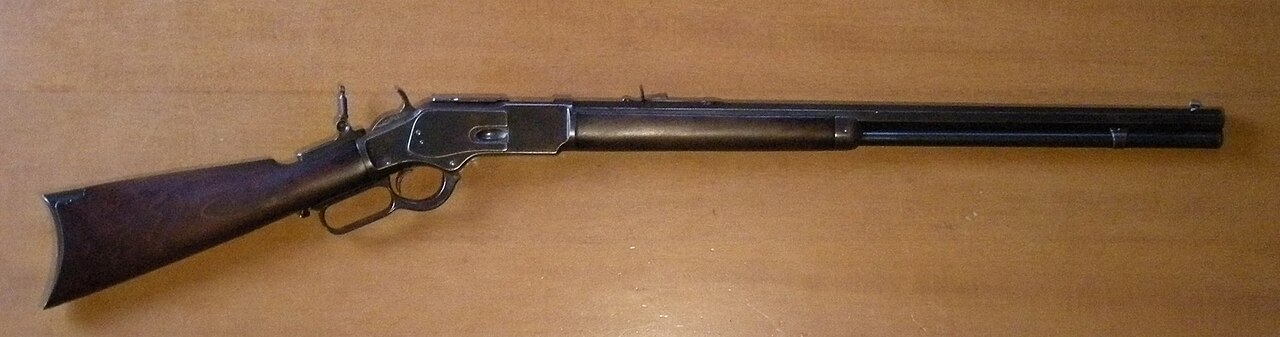
Winchester Model 1873For sale
Some warriors had the newer centerfire Winchester, which added to the rapid fire poured into Custer's companies. Continued…
-
Sharps Rifle
Sharps rifles and carbines were among the many older single-shot arms in Lakota and Cheyenne hands. Continued…
-
Gunstock War Club
Clubs of several kinds, along with bows, lances and knives, finished much of the fighting at close quarters. Continued…
-
Gatling gun
Custer declined a battery of Gatling guns, judging that they would slow his march. Continued…
Sources
Utley, Robert M. Cavalier in Buckskin: George Armstrong Custer and the Western Military Frontier. University of Oklahoma Press, 1988.
Gray, John S. Custer's Last Campaign: Mitch Boyer and the Little Bighorn Reconstructed. University of Nebraska Press, 1991.
Scott, Douglas D., Richard A. Fox Jr., Melissa A. Connor, and Dick Harmon. Archaeological Perspectives on the Battle of the Little Bighorn. University of Oklahoma Press, 1989.
Philbrick, Nathaniel. The Last Stand: Custer, Sitting Bull, and the Battle of the Little Bighorn. Viking, 2010.
Suggest an edit · account required · reviewed before publishing · how it works