Historical Context
Great Sioux War
The war between the United States and the Lakota (Sioux) and their Northern Cheyenne and Arapaho allies for the Black Hills and the hunting grounds of the northern Plains. It began when the army was sent against bands that refused to move to the agencies in 1876, and it included the defeat of Custer's 7th Cavalry at the Little Bighorn. It ended with the surrender of most bands in the spring of 1877.
1876 – 1877
Overview
The Fort Laramie Treaty of 1868 created the Great Sioux Reservation in what is now western South Dakota. It included the Black Hills, and it left the Powder River country to the west as hunting ground closed to settlers. In 1874 an army expedition under Lieutenant Colonel George Armstrong Custer confirmed that there was gold in the Black Hills. Thousands of miners entered the hills in breach of the treaty. In 1875 the United States government tried to buy or lease the land, and the Lakota refused. That December it ordered all bands in the unceded country to report to the agencies by 31 January 1876. Bands led by men such as Sitting Bull and Crazy Horse had no intention of going.
The army moved first in March 1876, when a column attacked a village on the Powder River and was driven off. In the summer three columns under Generals George Crook and Alfred H. Terry and Colonel John Gibbon converged on the hunting grounds. Lakota and Cheyenne warriors fought Crook to a standstill on the Rosebud on 17 June. Eight days later they destroyed Custer and five companies of the 7th Cavalry at the Battle of the Little Bighorn.
The victory could not be repeated. The great village broke up to hunt, and reinforced army columns stayed in the field through autumn and winter. Crook's men destroyed a village at Slim Buttes in September. In November Colonel Ranald S. Mackenzie burned the main Northern Cheyenne village in the Bighorn Mountains, leaving its people without shelter or food in bitter cold. Colonel Nelson A. Miles, based on the Yellowstone, fought Sitting Bull's followers at Cedar Creek in October and Crazy Horse's at Wolf Mountain in January 1877. Hungry and harried, the bands came in to the agencies that spring. Crazy Horse surrendered at Camp Robinson, Nebraska, in May 1877. Sitting Bull led his people into Canada.
Arms of the Great Sioux War
The army's infantry and cavalry carried the single-shot Springfield Model 1873, as a long rifle and as a carbine, and the cavalry also had the Colt Single Action Army revolver. Sabers were usually left in store. The army had a few Gatling gun batteries and light field guns, and Miles used artillery to effect at Wolf Mountain.
The Lakota and Cheyenne fought with bows, lances, knives and clubs such as the Gunstock War Club, and with firearms obtained through trade and capture. These ranged from old muzzle-loaders to the Sharps Rifle and repeaters such as the Winchester Model 1866 and Winchester Model 1873. Ammunition was always scarce, which limited what the warriors could do in a long fight. Their weapons are described more fully under Native American Arms & Weapons.
Why It Mattered
The war ended the independence of the Lakota and Northern Cheyenne. In August 1876 Congress cut off rations to the agency Lakota until they gave up the Black Hills, and an act of February 1877 took the hills and the unceded lands. Crazy Horse was killed at Camp Robinson in September 1877 while being arrested. Sitting Bull returned from Canada and surrendered in 1881. The northern Plains were opened to ranchers, railways and settlers.
The legal dispute lasted longer than the fighting. In 1980 the United States Supreme Court ruled that the Black Hills had been taken without just compensation and upheld an award of more than 100 million dollars. The Lakota have refused the money and still seek the return of the land.
Battles & Operations
Weapons
-
Colt Single Action Army
The Colt Single Action Army of 1873 — the Peacemaker — is the revolver of the American West. Adopted by the U.S. Army in .45 Colt and sold… Continued…
-
Gatling gun
The Gatling gun was the first practical machine gun, a hand-cranked weapon with six to ten barrels rotating around a central shaft, each… Continued…
-
Gunstock War Club
The gunstock war club is a Native American hand weapon made from a flat piece of hardwood shaped like the stock of a musket, often with a… Continued…
-
Sharps Rifle
The Sharps was the finest breech-loading rifle of the American Civil War and the buffalo hunter's gun of the plains that followed.… Continued…
-
Springfield Model 1873
The Springfield Model 1873, known as the Trapdoor Springfield, was the standard rifle and carbine of the United States Army from 1873 until… Continued…
-
Winchester Model 1866
The Winchester Model 1866 — the Yellow Boy, for its gleaming brass receiver — was the first rifle to carry the Winchester name: the Civil… Continued…
-
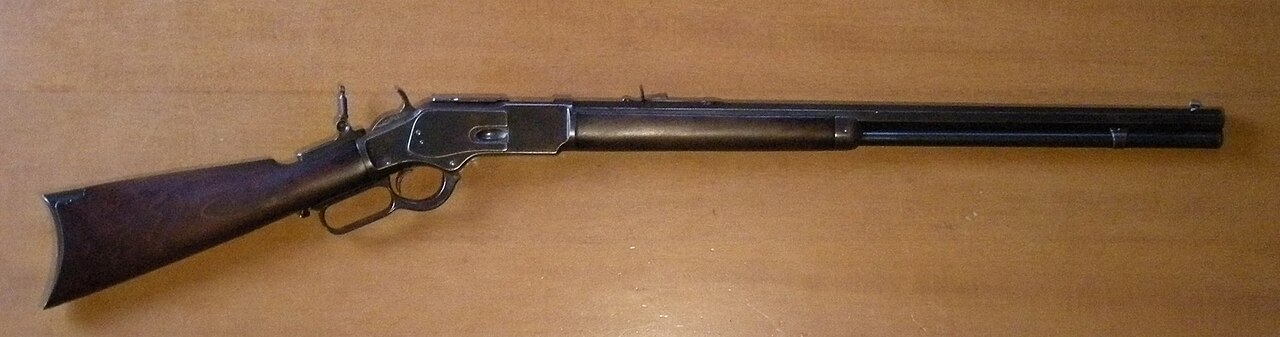
Winchester Model 1873
The Winchester Model 1873 is the archetypal lever-action of the American West: an iron-then-steel-framed repeater feeding centerfire .44-40… Continued…