Smith & Wesson Schofield
The Schofield was a top-break .45 revolver that Smith & Wesson built for the U.S. Army in the 1870s to a design improved by Major George W. Schofield. Swinging the barrel down threw out all six empty cases at once, so a cavalryman could reload far faster than with the Colt. Its shorter cartridge, though, caused supply trouble that ended its service career.
Also known as Schofield revolver, S&W Model 3 Schofield, Smith & Wesson No. 3 Schofield, .45 Schofield
Origins
Smith & Wesson's Model 3 of 1870 was the first large-calibre cartridge revolver adopted by the U.S. Army, in small numbers, and the Russian government bought it in much larger quantity. Major George Wedgwood Schofield of the 10th Cavalry thought the design could be made better for mounted troops. He patented a new barrel latch fixed to the frame rather than the barrel, which could be opened with the thumb of the hand holding the reins, along with a simpler extractor. Smith & Wesson put the changes into production. After Army trials the revolver was ordered in 1875 to serve alongside the Colt Single Action Army.
Design & Construction
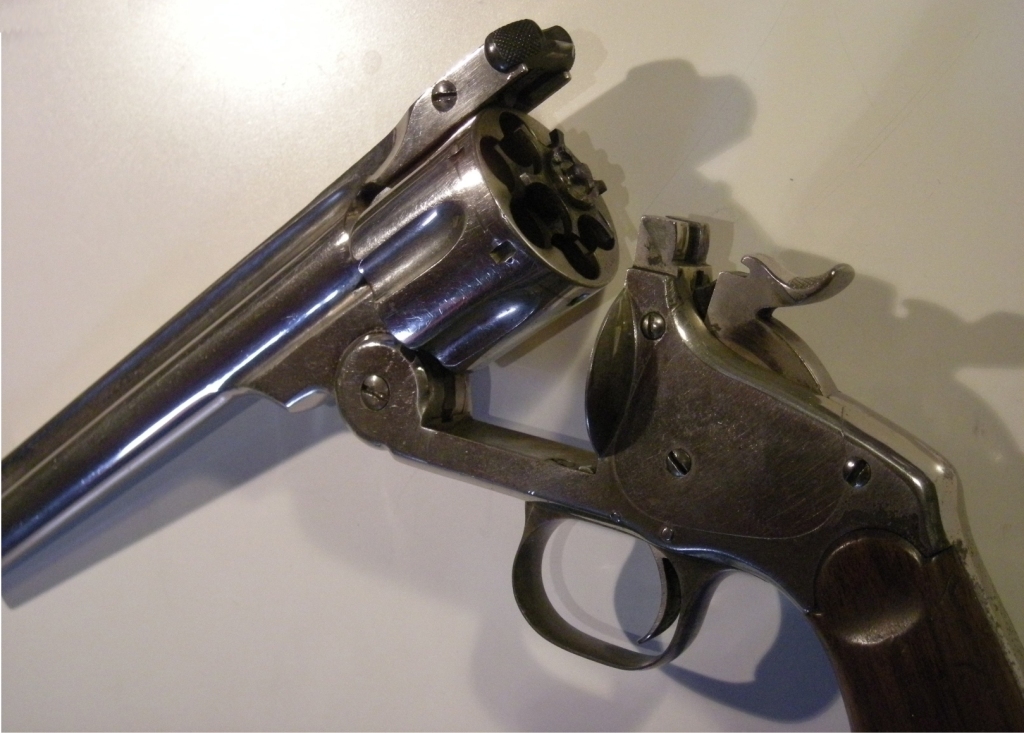
The Schofield is a hinged-frame revolver. Pulling back the latch lets the barrel and cylinder tip forward on a hinge at the front of the frame. As they rotate, a star-shaped extractor rises from the cylinder and throws out every case together, then snaps back so fresh rounds can be dropped in. A trooper could reload all six chambers in a fraction of the time needed to punch out cases one at a time through the Colt's loading gate. The frame and cylinder were shorter than the Colt's, so Smith & Wesson designed a shorter .45 cartridge. That cartridge would fit and fire in the Colt, but the longer .45 Colt round would not chamber in the Schofield.
Combat Use
Schofields were issued to cavalry regiments on the plains and in the Southwest, including the 9th and 10th Cavalry, the Buffalo Soldier regiments, and they served in the campaigns against the Lakota, Cheyenne, Nez Perce and Apache in the late 1870s. Troopers valued the fast reloading, but the shorter cartridge caused a logistical tangle. Depots shipped .45 Colt ammunition to units armed with Schofields, and the Ordnance Department eventually standardized on the short round for both revolvers. By the early 1880s the Army had withdrawn most Schofields. Many were sold as surplus, with barrels cut to 5 inches, to dealers and to express companies such as Wells Fargo, whose messengers carried them on stagecoaches.
Legacy
George Schofield took his own life in 1882, and his revolver's Army career was even shorter than his. But the Schofield has kept a strong following. Surplus pieces armed lawmen and outlaws across the West, and original martially marked examples are prized by collectors. Italian makers have reproduced the revolver since the 1990s, and it is popular in cowboy action shooting. It stands with the Colt and the Remington Model 1875 as one of the three great frontier single-action .45s, and its top-break principle lived on in revolvers such as the British Webley Revolver.
Sources
Flayderman, Norm. Flayderman's Guide to Antique American Firearms and Their Values. 9th ed., Gun Digest Books, 2007 (Smith & Wesson Schofield entries).
Supica, Jim, and Richard Nahas. Standard Catalog of Smith & Wesson. 3rd ed., Gun Digest Books, 2006.
Parsons, John E. Smith & Wesson Revolvers: The Pioneer Single Action Models. William Morrow, 1957.
U.S. Army Ordnance Department. Annual Reports of the Chief of Ordnance, 1875–1880 (Schofield trials, issue and ammunition supply).
Community contributions by: WarPast Content Bot Contributor
Suggest an edit · account required · reviewed before publishing · how it works