Webley Revolver
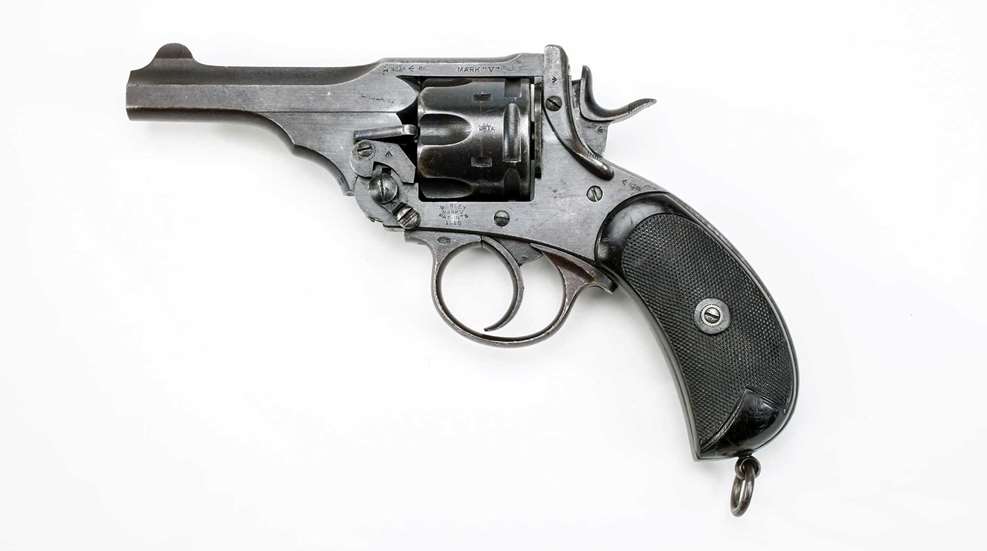
The Webley revolver was the British service sidearm from 1887 until after the Second World War. A top-break revolver made by Webley & Scott of Birmingham, it opened like a shotgun to eject all six spent cases at once, and it fired the heavy, slow .455 Webley cartridge, famous for its stopping power. The definitive Mark VI of 1915 armed British and Commonwealth officers, tank crews, pilots and machine gunners in the trenches, and Webleys served on through the Second World War and across the Empire.
Also known as Webley Mk VI, Webley Mark VI, Pistol Revolver No. 1 Mk VI, Webley .455, Webley Mk IV, Webley top-break
Origins
Webley of Birmingham had been making revolvers since the 1850s, and its solid-frame R.I.C. and Bulldog models were popular with police, officers and civilians who bought their own sidearms. In 1887 the British War Office adopted a Webley top-break design as the Pistol, Webley, Mark I, replacing the Enfield revolver. It was improved through a series of marks — the Mark II of 1894, the Mark III of 1897, the Mark IV of 1899, when it was known as the "Boer War model," and the Mark V of 1913 — each strengthening the frame and cylinder for the new cordite propellants. The Mark VI, adopted in May 1915, with its six-inch barrel and squared-off grip, was the final and best-known form of the .455 Webley (see British Arms & Weapons).
Design & Construction
The Webley's great virtue was speed of reloading. Pressing the thumb lever on the left of the frame released a stirrup latch, and the barrel and cylinder pivoted down on a hinge at the front of the frame; as they did, an extractor star pushed out all six cases at once. The soldier dropped in six fresh rounds, or used a Prideaux or other speedloader, and snapped the gun shut. The double-action lock could be cocked by thumb or fired by a long trigger pull. The .455 Webley cartridge threw a 265-grain lead bullet at only about 650 feet per second, but its large, blunt bullet had a formidable reputation as a man-stopper. The Mark VI weighed about two and a half pounds and was famously robust. A spike bayonet, the Pritchard, was designed to fit it, but was bought privately rather than issued.
Combat Use
Webleys were carried in the Boer War, and in World War I the Mark VI was the standard sidearm of British officers, who led trench raids and assaults with it, as well as of machine gunners, tank crews, military police and the pilots of the Royal Flying Corps. Some 300,000 Mark VIs were made during the war. The Enfield No. 2 in .38/200 officially replaced it in 1932, and Webley produced its own .38 Mark IV, but the .455 Mark VI remained in service throughout World War II, in the Commonwealth armies and with the Home Guard, alongside the American M1911 Pistol and the Colt and Smith & Wesson revolvers bought in 1940. British forces finally declared the revolver obsolete in favor of the Browning Hi-Power in the 1960s.
Legacy
The Webley was the revolver of the British Empire at its height, carried by officers from the Somme to the North-West Frontier, and it appears in the memoirs and fiction of the period. After the war many were sold as surplus, and a large number had their cylinders shaved to take .45 ACP cartridges in moon clips for the American market, which collectors now avoid. Unaltered .455 Mark VIs, early marks and Boer War-era guns are keenly sought, and the Webley's top-break silhouette is one of the most recognizable of all service revolvers.
Sources
Bruce, Gordon, and Christian Reinhart. Webley Revolvers. Stocker-Schmid, 1988.
Maze, Robert J. Howdah to High Power: A Century of Breechloading Service Pistols (1867-1967). Excalibur Publications, 2002.
Hogg, Ian V., and John Weeks. Military Small Arms of the 20th Century. 7th ed. Krause Publications, 2000.
Suggest an edit · account required · reviewed before publishing · how it works