Historical Context
Boer Wars
Two wars between Britain and the Boer republics of the Transvaal and the Orange Free State. The first (1880-1881) ended with the British defeat at Majuba Hill; the second (1899-1902) was the largest war of the Victorian age, fought with the Mauser, the Lee-Metford and Lee-Enfield, quick-firing artillery and the Maxim, and it taught the British Army the lessons of smokeless powder and the magazine rifle.
1880 – 1881 and 1899 – 1902
Overview
The Boers were the descendants of Dutch, German and French Huguenot settlers at the Cape of Good Hope. After Britain took the Cape for good in 1806, thousands of them trekked inland in the 1830s to get away from British rule, and by the 1850s they had founded two republics beyond the Orange and Vaal rivers: the Orange Free State and the South African Republic, better known as the Transvaal. Britain annexed the bankrupt Transvaal in 1877. In December 1880 the Boers rose, and in a war of less than three months their mounted riflemen beat every British force sent against them, at Bronkhorstspruit, Laing's Nek, the Ingogo and finally at the Battle of Majuba Hill on 27 February 1881, where the British commander, Major-General Sir George Colley, was killed. Britain restored the Transvaal's self-government under a vague British suzerainty.
Gold was found on the Witwatersrand in 1886, and the Transvaal became the richest state in Africa, flooded with foreign miners, the Uitlanders, whom President Paul Kruger refused to enfranchise. The Jameson Raid of 1895-96, a failed attempt by Cecil Rhodes's men to overthrow his government, convinced Kruger that another war was coming, and he spent the gold on Mauser rifles and modern artillery. When Britain massed troops on the frontiers in 1899, the two republics declared war on 11 October and struck first, besieging Ladysmith, Kimberley and Mafeking (see the Siege of Mafeking). In "Black Week," 10-15 December 1899, three British columns were beaten in turn at Stormberg, the Battle of Magersfontein and the Battle of Colenso, and in January 1900 Sir Redvers Buller's attempt to relieve Ladysmith failed again at the Battle of Spion Kop.
Lord Roberts took over with Lord Kitchener as his chief of staff and a quarter of a million men. He relieved Kimberley, trapped and captured General Piet Cronjé's army at the Battle of Paardeberg on 27 February 1900, and took Bloemfontein in March, Johannesburg in May and Pretoria on 5 June. The Boer governments did not surrender. For two more years commandos under Christiaan de Wet, Koos de la Rey, Louis Botha and Jan Smuts fought a guerrilla war across the veld, and Kitchener answered with lines of blockhouses and barbed wire, mounted drives, the burning of farms and the concentration camps in which some 26,000 Boer women and children and at least 20,000 black Africans died of disease. The Treaty of Vereeniging on 31 May 1902 made the republics British colonies; in 1910 they joined the Cape and Natal in the Union of South Africa. Britain had sent about 450,000 troops and lost some 22,000 dead, two thirds of them to disease.
Arms of the Boers
The Boer commando was a militia of citizens who turned out with their own horses and rifles and elected their own officers. In 1881 they fought with the Westley Richards falling-block and the British Martini-Henry Rifle, and their marksmanship, learned hunting game, was already the decisive weapon. Before the second war the republics bought about 37,000 of the Mauser Model 1895, a charger-loading 7 mm bolt-action rifle firing smokeless powder, from Ludwig Loewe and DWM in Germany, and from them the British learned the word "Mauser" as a byword for invisible, long-range fire. The Transvaal's Staatsartillerie, the republics' only regular soldiers, served Krupp and Creusot 75 mm quick-firers, four Creusot 155 mm Long Tom siege guns, Maxims and the 37 mm QF 1-pounder Pom-Pom, all of them outranging the British field guns at the start of the war. Captured British rifles, including the Lee-Enfield Rifle, re-armed the commandos as the Mauser ammunition ran out.
Arms of the British
The British infantry of 1881 carried the Martini-Henry, a single-shot black-powder rifle whose smoke gave away every firing line. By 1899 it had the Lee-Metford Rifle and the Lee-Enfield in .303, ten-round magazine rifles firing cordite, though until the Boers taught them otherwise British soldiers were trained to fire by volley at the word of command. Field batteries had the Ordnance BL 15-pounder, a sound gun with no recoil system and only shrapnel shell; the Royal Navy landed 4.7-inch and 12-pounder guns on improvised carriages to answer the Long Toms. Infantry and cavalry both had the Maxim Gun, officers carried the Webley Revolver, and private purchases such as the Mauser C96 were common on both sides. Khaki replaced red, the cavalry gave up the lance and sword for the rifle, and the mounted infantry raised from Britain, Canada, Australia and New Zealand became the army's answer to the commando.
Why It Mattered
The Boer Wars were Britain's first wars against an enemy armed with the same modern weapons as itself, and they exposed the British Army as badly trained for them. The lessons of Magersfontein and Colenso, that smokeless magazine rifles made the frontal attack in close order suicidal, that entrenched riflemen could hold ground against ten times their number, and that artillery needed range, recoil systems and high-explosive shell, drove the reforms of the next decade: the Short Magazine Lee-Enfield, the "mad minute" of rapid aimed fire, the 18-pounder gun, and the professional Expeditionary Force of 1914. The blockhouse and the concentration camp, and the guerrilla war that provoked them, foreshadowed the colonial and counter-insurgency wars of the twentieth century. In South Africa the wars shaped the Afrikaner nationalism of the following century and left the country's black majority, who had fought and suffered on both sides, with no share in the peace.
Battles & Operations
-
Battle of Majuba Hill (27 February 1881)
The Battle of Majuba Hill was fought on 27 February 1881 on the Natal-Transvaal border, the last action of the First Boer War.… Continued…
-
Battle of Colenso (15 December 1899)
The Battle of Colenso was fought on 15 December 1899 on the Tugela River in Natal, the third British defeat of Black Week. General Sir… Continued…
-
Battle of Magersfontein (11 December 1899)
The Battle of Magersfontein was fought on 11 December 1899 south of Kimberley, the second British defeat of Black Week. Lord Methuen's… Continued…
-
Siege of Mafeking (13 October 1899 – 17 May 1900)
The Siege of Mafeking lasted 217 days, from 13 October 1899 to 17 May 1900, the longest siege of the Second Boer War. Colonel Robert… Continued…
-
Battle of Paardeberg (18 – 27 February 1900)
The Battle of Paardeberg was fought on the Modder River in the Orange Free State from 18 to 27 February 1900, Britain's first great victory… Continued…
-
Battle of Spion Kop (23 – 24 January 1900)
The Battle of Spion Kop was fought on 23-24 January 1900 on the Tugela Heights in Natal, during Buller's second attempt to relieve… Continued…
Weapons
-
Creusot 155 mm Long Tom
The Long Tom was the British name for the four 155 mm Creusot siege guns that the Transvaal bought from France in 1897 for the forts around… Continued…
-
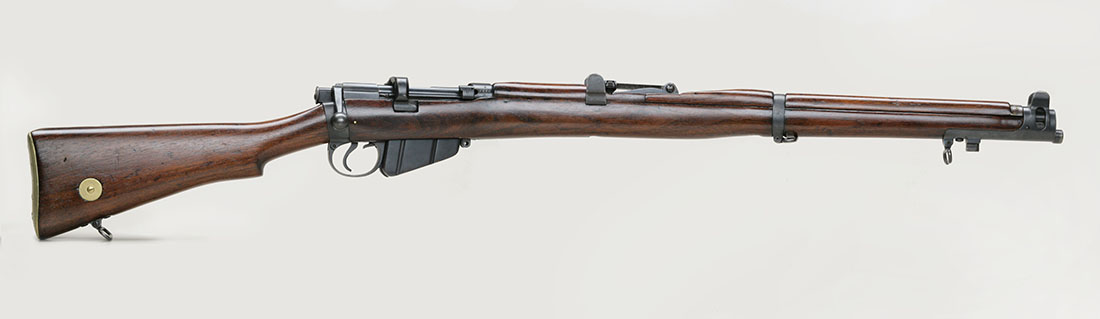
Lee-Enfield Rifle
The Lee-Enfield was the British Empire's rifle for over half a century: a bolt-action .303 whose rear-locking action and ten-round magazine… Continued…
-
Lee-Metford Rifle
The Lee-Metford was the British Army's first magazine rifle and the parent of the Lee-Enfield. Adopted in 1888, it joined James Paris Lee's… Continued…
-
Martini-Henry Rifle
The Martini-Henry was Britain's first purpose-built breechloading service rifle: a falling-block single-shot in .577/450, dropping its… Continued…
-
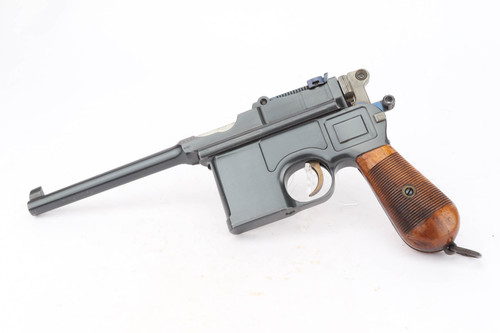
Mauser C96
The Mauser C96 is a German semi-automatic pistol that entered service in 1896, designed by the Feederle brothers at Mauser's Oberndorf… Continued…
-
Mauser Model 1895
The Mauser Model 1895 was the rifle of the Boer commandos in the Second Boer War. A German-made 7 mm bolt-action with a five-round magazine… Continued…
-
Maxim Gun
The Maxim gun was the first true machine gun: a weapon that used the energy of each shot to load and fire the next, and would keep firing… Continued…
-
Ordnance BL 15-pounder
The BL 15-pounder was the field gun of the Royal Field Artillery in the Second Boer War. A 3-inch breech-loader firing a fourteen-pound… Continued…
-
QF 1-pounder Pom-Pom
The pom-pom was a Maxim machine gun enlarged to fire a one-pound 37 mm explosive shell, the first automatic cannon to see war. Named by… Continued…
-
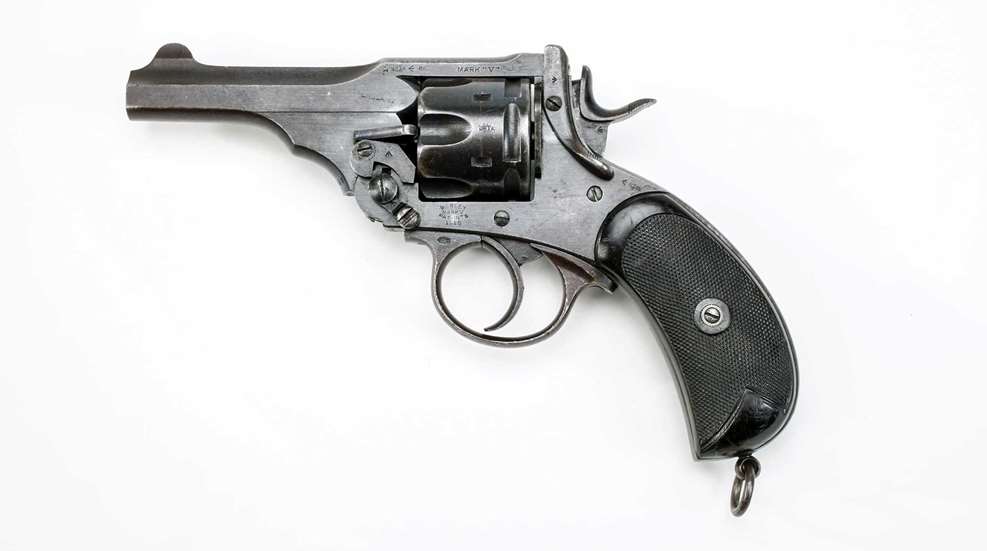
Webley Revolver
The Webley revolver was the British service sidearm from 1887 until after the Second World War. A top-break revolver made by Webley & Scott… Continued…