Mauser C96
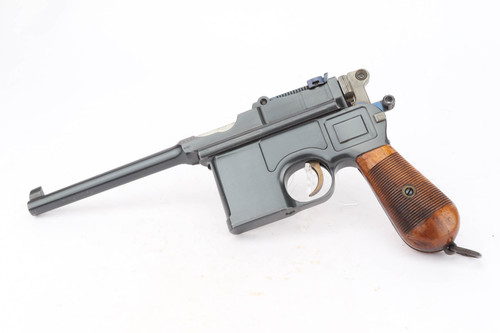
The Mauser C96 is a German semi-automatic pistol that entered service in 1896, designed by the Feederle brothers at Mauser's Oberndorf works. Its round grip earned it the nickname 'Broomhandle'. It loads from a stripper clip into a fixed ten-round magazine ahead of the trigger and takes a hollow wooden holster-stock that turns it into a light carbine. Over a million were made, and it served for half a century with armies and officers from the Boer War to Winston Churchill at Omdurman, Germany's 'Red 9' of 1916, and China's warlord and revolutionary armies.
Also known as Broomhandle, C96, Mauser C96, Model 1896, Red 9, M1916, Bolo Mauser, M712 Schnellfeuer, box cannon
Origins
Originally manufactured by Mauser in Germany, the C96 entered service in 1896. The design came from the three Feederle brothers, who worked in Paul Mauser's experimental shop at Oberndorf; Mauser patented it in 1895 and put it on sale the following year as the Construktion 96. It was one of the first successful semi-automatic pistols, arriving before the Luger and a generation before the M1911 Pistol, and it fired a powerful new bottlenecked cartridge, the 7.63x25mm Mauser, which was the fastest handgun round in the world until the 1930s. The German army did not adopt it at first, but it sold widely on the commercial market to officers and adventurers across the world.
Design & Construction
The C96 is a short-recoil, locked-breech pistol: barrel and bolt recoil together a short distance before a pivoting locking block drops and releases the bolt. Remarkably, the whole mechanism is held together without a single pin or screw except the one holding the grips — the parts interlock and slide into the frame. Its distinctive grip earned it the nickname "Broomhandle". The magazine is a fixed box in front of the trigger guard, loaded from the top with ten rounds on a stripper clip, which gives the pistol its forward-heavy shape. A hollow wooden holster doubles as a shoulder stock, and the tangent rear sight is optimistically graduated to 1,000 meters. Variants included the short-barreled "Bolo" model of the 1920s, the Chinese-market 9mm Mauser Export, and the M712 Schnellfeuer of 1932, a select-fire machine pistol with a detachable magazine.
Combat Use
Winston Churchill carried a C96 in the cavalry charge at Omdurman in 1898, and both sides used it in the Boer Wars. In the World War I the German army, short of Luger pistols, bought about 150,000 chambered for the 9mm Parabellum cartridge; these were marked with a large red "9" carved into the grips, and they are known as "Red 9"s. The Bolsheviks and the Red Army's commissars favored the pistol in the Russian Civil War. Its longest service was in China, where an international arms embargo from 1919 barred imports of military rifles but not pistols, making the stocked C96 the next best thing, and Chinese arsenals built copies by the hundreds of thousands. Called the "box cannon," it armed warlord, Nationalist and Communist troops through the World War II and into the Korean War.
Legacy
Mauser built about a million C96 pistols before production ended in 1937, and Spanish and Chinese makers added many more. It was the first pistol to prove that a semi-automatic handgun could be a practical military weapon, and its silhouette is one of the most recognizable of any firearm. Its fame in popular culture runs from Churchill's memoirs to Han Solo's blaster in Star Wars, which was built on a C96. Original examples with stocks, "Red 9"s and Chinese-marked pistols are all prized by collectors.
Sources
Belford, James N., and Jack Dunlap. The Mauser Self-Loading Pistol. Borden, 1969.
Erickson, Wayne R., and Charles E. Pate. The Broomhandle Pistol, 1896-1936. Erickson-Pate, 1985.
Breathed, John W., and Joseph J. Schroeder. System Mauser: A Pictorial History of the Model 1896 Self-Loading Pistol. Handgun Press, 1967.
Suggest an edit · account required · reviewed before publishing · how it works