Siege of Mafeking
The Siege of Mafeking lasted 217 days, from 13 October 1899 to 17 May 1900, the longest siege of the Second Boer War. Colonel Robert Baden-Powell held the small railway town on the western border of the Transvaal with about 2,000 irregulars, townsmen and Barolong against a Boer force that began at 6,000 and a 155 mm Long Tom, by bluff, improvised guns and ceaseless activity. A Boer assault on 12 May 1900 was defeated, and the relief five days later set off celebrations in London so wild they added a word, 'mafficking,' to the language.
Also known as Mafeking, Mafikeng, Mahikeng, Beleg van Mafeking, Siege of Mafikeng, Mafeking 1899-1900, Relief of Mafeking, Baden-Powell at Mafeking, Mafficking, Mafeking cadets, 217-day siege, Eloff's attack, Protectorate Regiment, Barolong Mafeking, Mafeking siege money
Background
Mafeking was a town of about 1,500 whites and, in the adjoining Stadt, some 5,000 to 7,000 Barolong and other Africans, on the railway from the Cape to Rhodesia just inside the Bechuanaland border, eight miles from the Transvaal. It had been the base of the Jameson Raid and had little military value, but in the summer of 1899 Colonel Robert Baden-Powell was sent to raise two regiments of irregulars on the frontier to draw Boer strength away from Natal and the Cape, and he made the town his base and fortified it. His garrison was the Protectorate Regiment of about 500 men, raised locally, a few hundred British South Africa Police, Cape Police and volunteers, a Town Guard of townsmen, and the armed Barolong who defended the Stadt; perhaps 2,000 men in all, with seven Maxims and a handful of old guns. On 13 October 1899, two days after the war began, General Piet Cronjé arrived with about 6,000 Boers and summoned the town to surrender.
The Siege
Baden-Powell's method was activity and bluff. He strung a perimeter of forts, trenches and dummy defenses six miles round the town, laid fake minefields with ceremony where Boer scouts could see, had his men step over imaginary barbed wire until the Boers believed in it, and sent out raids by night that cost him men but persuaded Cronjé the garrison was far stronger than it was. A Boer attack on 31 October was beaten off, and in November Cronjé took most of his force south to the Modder and Magersfontein, leaving General J. P. Snyman with about 2,000 men to keep the town under siege. A Creusot 155 mm Long Tom, brought by rail from Pretoria, shelled the town from the middle of October; a lookout rang a bell when its smoke was seen, and the inhabitants had enough warning to reach their shelters. Sunday was by agreement a day of truce, kept with cricket matches, concerts and a siege newspaper. Food was rationed and then ran short; the Africans in the Stadt were rationed harder than the whites, and many died of hunger, a fact the garrison's legend long left out. The garrison's armorers built a howitzer, the "Wolf," from a steam pipe, and brought an old muzzle-loading gun, "Lord Nelson," into service. Boys of the Cadet Corps carried messages and later the siege's own stamps.
On 12 May 1900, with relief known to be near, Field-Cornet Sarel Eloff, President Kruger's grandson, led about 240 Boers through the Barolong Stadt in the dark, set fire to its huts as a signal, and seized the British South Africa Police fort and the headquarters telephone, from which he rang Baden-Powell to boast of it. Snyman did not support him. The Barolong and the garrison closed in behind, cut his party into three, and by evening Eloff and about a hundred of his men had surrendered. Five days later, on 17 May, a flying column of about 2,000 men under Colonel Bryan Mahon, which had ridden north from Kimberley, joined Colonel Herbert Plumer's Rhodesian force from the north and fought its way into the town. The siege had lasted 217 days. Garrison losses, white and black, were a few hundred killed, wounded and missing, apart from those who died of disease and hunger.
Weapons
The defense depended on a few machine guns and many old rifles. Baden-Powell's seven Maxim Guns, moved from fort to fort on carts, could be concentrated wherever the Boers threatened, and the Boers, with only a couple of thousand men to cover a six-mile perimeter, never again risked a general assault after October. The Protectorate Regiment and the police had the Lee-Metford Rifle and its carbine; the Town Guard and the Barolong had largely the Martini-Henry Rifle and older Sniders, and some Barolong had no firearms at all until captured Boer rifles came in. The Boers had the Mauser Model 1895, a QF 1-pounder Pom-Pom, Krupp guns and the Creusot 155 mm Long Tom, which fired some 1,500 shells into the town for little result. The garrison's improvised artillery and its home-made ammunition, cast from the town's lead and brass, were as much for morale as for effect.
Aftermath
Mafeking made Baden-Powell the most famous soldier in the Empire. The news of the relief reached London on the night of 18 May 1900 and set off celebrations so wild that "to maffick" entered the dictionary; the town's long resistance, reported in the siege's newspapers and by the correspondents trapped in it, had become a symbol of British pluck during the gloom of Black Week. The Boys' cadet corps of the siege was one of the seeds of the Boy Scout movement, which Baden-Powell founded in 1908. Later historians, reading Sol Plaatje's diary and the garrison's own records, have restored the part the Barolong played and the hunger they suffered, and have questioned how much of Baden-Powell's legend the siege deserved. The town is now Mahikeng, the capital of South Africa's North West Province.
Weapons used
-
Lee-Metford Rifle
The Protectorate Regiment and the British South Africa Police held the perimeter with Lee-Metford rifles and carbines. Continued…
-
Martini-Henry Rifle
The Town Guard and the Barolong defenders of the Stadt were armed largely with old Martini-Henrys and Sniders. Continued…
-
Maxim Gun
Baden-Powell's seven Maxims, moved from post to post, were the garrison's main firepower; the Boers had their own. Continued…
-
Creusot 155 mm Long Tom
A Boer Long Tom shelled the town from October, its 94-pound shells announced by a lookout's bell so the inhabitants could take cover. Continued…
-
QF 1-pounder Pom-Pom
The Boer besiegers' pom-pom fired into the town through the siege. Continued…
-
Mauser Model 1895
Snyman's commandos, and Eloff's storming party of 12 May, were armed with the Mauser. Continued…
-
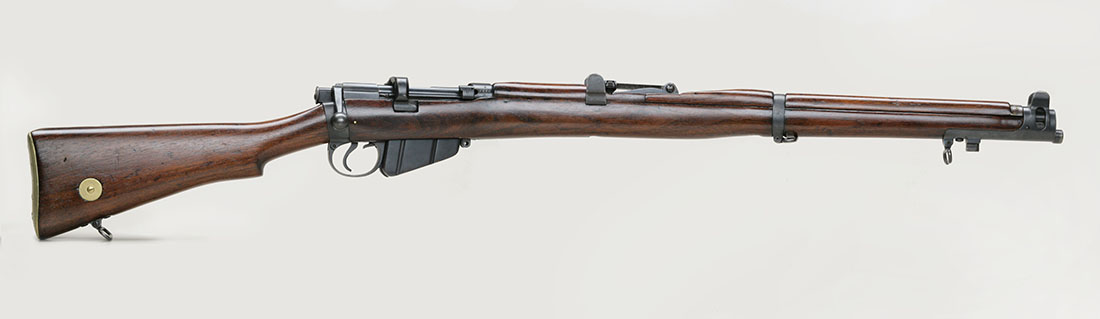
Lee-Enfield Rifle
Mahon's and Plumer's relief columns, which entered the town on 17 May 1900, carried the Lee-Enfield. Continued…
Sources
Pakenham, Thomas. The Boer War. Weidenfeld & Nicolson, 1979.
Jeal, Tim. Baden-Powell. Hutchinson, 1989.
Plaatje, Sol T. The Boer War Diary of Sol T. Plaatje: An African at Mafeking. Edited by John L. Comaroff. Macmillan, 1973.
Gardner, Brian. Mafeking: A Victorian Legend. Cassell, 1966.
Suggest an edit · account required · reviewed before publishing · how it works