Battle of Paardeberg
The Battle of Paardeberg was fought on the Modder River in the Orange Free State from 18 to 27 February 1900, Britain's first great victory of the Second Boer War. Lord Roberts's march round the Boer flank to relieve Kimberley cut off General Piet Cronjé's army of 4,000 men, which dug in along the river bank with its wagons. Kitchener's frontal attacks on 18 February, 'Bloody Sunday,' cost 1,270 men, but a week of bombardment and trench-digging, with the Royal Canadian Regiment in the last advance, forced Cronjé to surrender on 27 February, the anniversary of Majuba.
Also known as Paardeberg, Paardeberg Drift, Slag van Paardeberg, Perdeberg, Paardeberg 1900, Cronjé's surrender, Bloody Sunday 18 February 1900, Majuba Day 1900, Battle of Paardeberg Drift, Royal Canadian Regiment Paardeberg, Wolwekraal, Kitchener's attack, Roberts's first victory, Canada's first battle
Background
Field Marshal Lord Roberts arrived in South Africa in January 1900 with Lord Kitchener as his chief of staff and a plan to stop attacking the Boers where they were strongest. While Methuen held Cronjé's attention at Magersfontein, Roberts gathered about 35,000 men and 100 guns on the Modder and in mid-February swung them east and north round the Boer left, across the open veld, toward Kimberley and Bloemfontein. John French's cavalry division rode through the Boer screen and relieved Kimberley on 15 February. Cronjé, outflanked and with his supply line cut, left Magersfontein the same night and set off east along the Modder toward Bloemfontein with his whole force, about 5,000 men, and a train of several hundred ox wagons carrying their families and belongings. The wagons slowed him to a crawl. On 17 February French's exhausted cavalry, riding south from Kimberley, got ahead of him at Paardeberg Drift and held him on the river until Roberts's infantry came up.
The Battle
Cronjé formed his laager in the bed of the Modder, which ran through the plain in a deep trench of its own with steep banks, and his burghers dug in along the banks for a mile or so on either side. Roberts was ill, and on Sunday 18 February Kitchener took charge and ordered a frontal assault from both sides of the river by the three divisions on hand, about 15,000 men, without waiting for the artillery to do its work. The attacks went in piecemeal across a flat plain swept by Mauser fire from the river bank. The Royal Canadian Regiment, in its first battle, went forward with the Cornwalls and lost heavily; the Highland Brigade, which had been at Magersfontein, was pinned again; a mounted infantry force under Hannay charged the laager on Kitchener's direct order and its commander was killed. By nightfall the British had lost about 1,270 men, 320 of them killed, the heaviest British loss of any single day of the war, and the laager was untouched. Christiaan de Wet, arriving from the south with a few hundred men, seized a kopje on the British flank and held it for two days, offering Cronjé a way out, but Cronjé would not leave his wounded and his wagons.
Roberts resumed command the next day and chose siege over assault. More than 90 guns, with howitzers and naval 4.7-inch guns, shelled the laager day after day, setting the wagons on fire, killing the oxen and horses, and filling the river with their carcasses; the British infantry dug saps toward the Boer trenches each night. Cronjé refused terms on 19 February and refused to let his men break out. Before dawn on 27 February the Royal Canadian Regiment, with the Gordon Highlanders in support, advanced to within sixty yards of the eastern end of the Boer trenches and dug in under fire. Half the Canadians withdrew in the confusion, but two companies held on, and at daylight the Boers opposite them raised white flags. Cronjé surrendered that morning with about 4,000 men, the largest capitulation of the war, on the nineteenth anniversary of the Battle of Majuba Hill.
Weapons
Paardeberg showed both faces of the war. On 18 February the entrenched Mauser Model 1895 broke every attack across open ground, as it had at Magersfontein and Colenso; the British and Canadian Lee-Enfield Rifle and Lee-Metford Rifle could reply only at a bank with no visible enemy. Over the following week the balance turned. Massed artillery, Ordnance BL 15-pounder field guns, 5-inch howitzers whose lyddite shells could reach into the river bed, and the naval guns, did what no infantry attack could, and the spade and the sap brought the British rifles close enough to make the trenches untenable. The Boer guns in the laager, Krupps and a QF 1-pounder Pom-Pom, were silenced one by one. The Maxim Gun covered the British advances. It was the first battle of the war in which the British used their superiority in artillery and numbers with patience rather than in a rush.
Aftermath
Cronjé's surrender broke the Boer front in the west. Roberts marched on to take Bloemfontein on 13 March 1900, and the news of Paardeberg, coming with the relief of Ladysmith the next day, ended the gloom of Black Week in Britain. The 4,000 prisoners were shipped to St Helena. For Canada the battle was its first as a nation in arms overseas, and Paardeberg Day was kept by the Canadian army for years. The Boer republics did not give up; De Wet, who had tried to save Cronjé, turned to the guerrilla war that lasted two more years, and the defeat convinced the Boer leaders never again to tie their commandos to wagons and fixed positions.
Weapons used
-
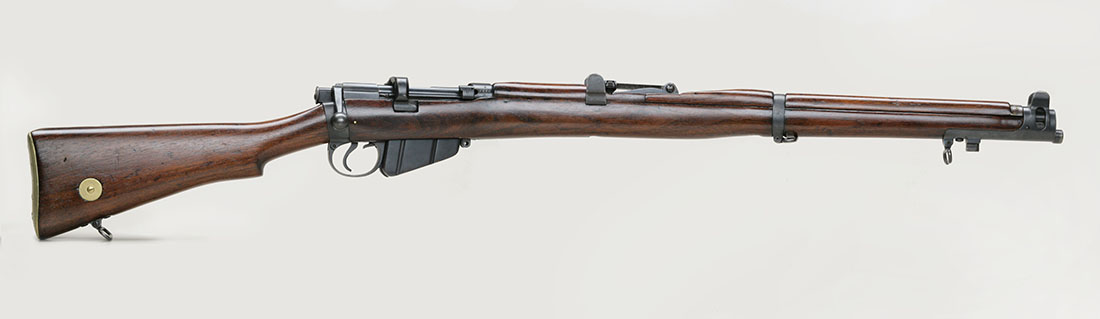
Lee-Enfield Rifle
The British and Canadian infantry that attacked the laager on 18 February and dug toward it over the following week carried the Lee-Enfield. Continued…
-
Lee-Metford Rifle
Many of Roberts's battalions still had the Lee-Metford; the Royal Canadian Regiment carried it at Paardeberg. Continued…
-
Mauser Model 1895
Cronjé's 4,000 burghers in the river bank trenches broke every frontal attack with Mauser fire before the guns wore them down. Continued…
-
Ordnance BL 15-pounder
Roberts brought up over 90 guns, 15-pounders among them, and shelled the laager for nine days. Continued…
-
QF 1-pounder Pom-Pom
The Boers had pom-poms in the laager, and De Wet used his to cover the relief attempt from the south. Continued…
-
Maxim Gun
British Maxims supported the infantry, and the Boer guns in the laager were silenced one by one by the bombardment. Continued…
-
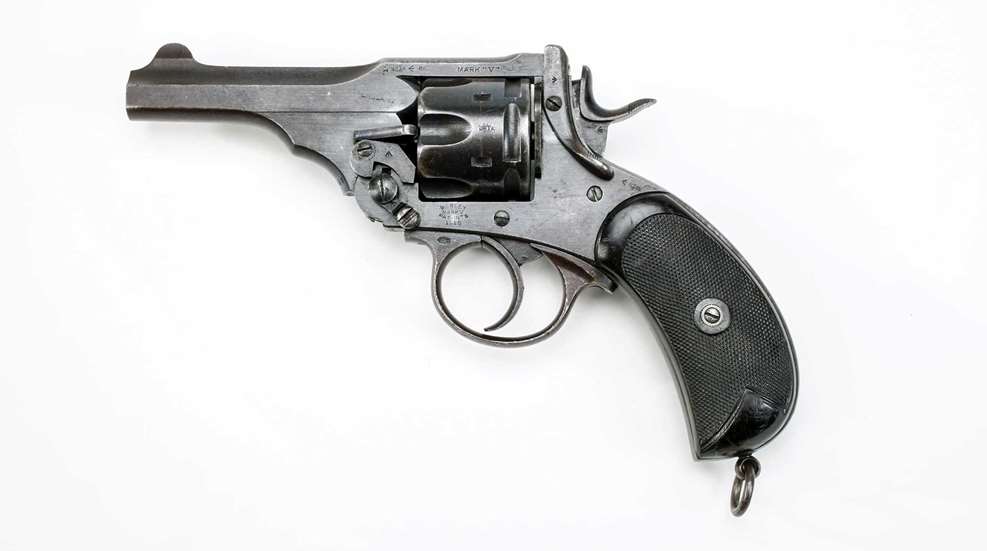
Webley Revolver
Carried by the British officers at the head of the attacks of Bloody Sunday. Continued…
Sources
Pakenham, Thomas. The Boer War. Weidenfeld & Nicolson, 1979.
Nasson, Bill. The War for South Africa: The Anglo-Boer War, 1899-1902. Tafelberg, 2010.
Miller, Carman. Painting the Map Red: Canada and the South African War, 1899-1902. McGill-Queen's University Press, 1993.
Amery, L. S., ed. The Times History of the War in South Africa, 1899-1902. Vol. 3. Sampson Low, Marston, 1905.
Suggest an edit · account required · reviewed before publishing · how it works