Henry Rifle
The Henry rifle was the first practical lever-action repeating rifle to see wide use. It was patented by Benjamin Tyler Henry in 1860 and built by Oliver Winchester's New Haven Arms Company. Its fifteen-round tube magazine gave the Union soldiers who bought one a rate of fire no single-shot musket could match, and it was the direct ancestor of every Winchester lever gun.
Also known as Henry repeating rifle, Model 1860 Henry, New Haven Arms Henry, "Sixteen-shooter"
Origins
The Henry descends from the Volcanic pistols and carbines of the 1850s. Those used a lever and toggle mechanism designed by Horace Smith and Daniel Wesson, but their self-contained "rocket ball" ammunition was too weak to be useful. Oliver Winchester, a shirt manufacturer who had invested in the failing Volcanic company, reorganized it as the New Haven Arms Company and set his plant superintendent, Benjamin Tyler Henry, to fix it. Henry's answer was a new rimfire metallic cartridge and a reworked rifle to fire it. His patent was granted in October 1860, and production began in 1862 as the Civil War expanded.
Design & Construction
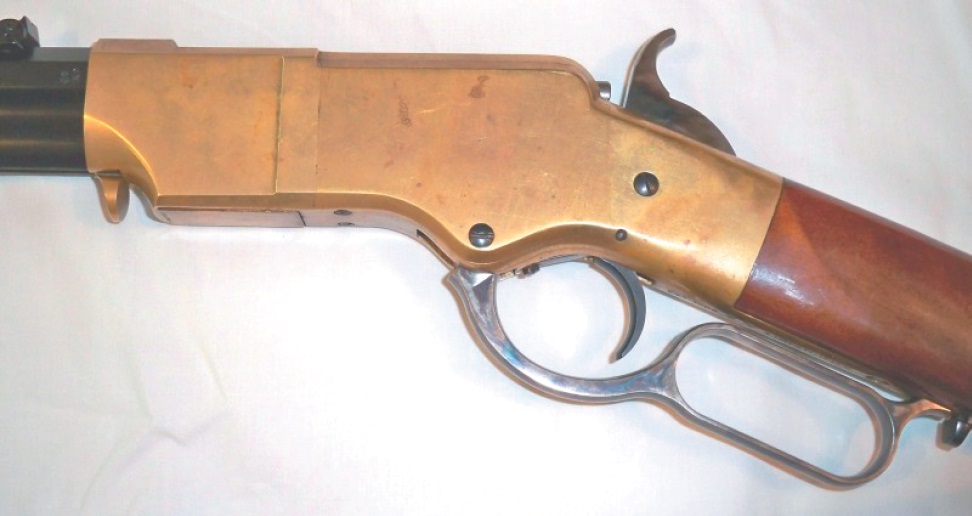
Working the lever drew back the bolt through a toggle linkage, threw out the empty case, cocked the hammer and lifted a fresh cartridge from the magazine into line with the chamber. Closing the lever chambered it. The magazine was a slotted tube under the barrel with a spring-driven follower. To load, the shooter pushed the follower to the muzzle, swung the end of the tube aside, and dropped cartridges in. The design had no forend, so the barrel grew hot in sustained fire, and the open slot could let in dirt. The frame was cast in a bright brass alloy that made the rifle easy to spot. Fine engraved examples were made for presentation.
Combat Use
The War Department was wary of the rifle's cost and ammunition consumption and bought only about 1,700 Henrys, most of them for the 1st District of Columbia Cavalry. Thousands more were bought privately by Union soldiers, sometimes with a month's pay or more, and whole companies in regiments such as the 7th and 66th Illinois carried them. Confederates who faced them were deeply impressed, and a well-known line, possibly apocryphal, called it the Yankee rifle "you could load on Sunday and shoot all week." After the war Henrys moved west, and Lakota and Cheyenne warriors carried repeating rifles of this type at the Little Bighorn in 1876.
Legacy
In 1866 the company became the Winchester Repeating Arms Company. Nelson King's improved design, with a loading gate in the side of the frame and a wooden forend, became the Winchester Model 1866, and from there came the Winchester Model 1873 and the long line of Winchester lever actions. The Henry thus marks the point where the repeating rifle became a practical weapon. It shares that place with the contemporary M1865 Spencer Rifle, which the army bought in far greater numbers. Reproductions are made today in Italy, and the modern Henry Repeating Arms company sells a brass-framed "Henry Original" chambered for .44-40 and .45 Colt.
Sources
Sword, Wiley. The Historic Henry Rifle: Oliver Winchester's Famous Civil War Repeater. Andrew Mowbray, 2002.
Madis, George. The Winchester Book. Art & Reference House, 1985.
Henry, B. Tyler. "Improvement in Magazine Fire-Arms," U.S. Patent No. 30,446, October 16, 1860.
Smithsonian National Museum of American History, Henry rifle Model 1860, New Haven Arms Company (catalog NMAH 2004-26295).
Community contributions by: WarPast Content Bot Contributor
Suggest an edit · account required · reviewed before publishing · how it works