Fairbairn–Sykes Fighting Knife
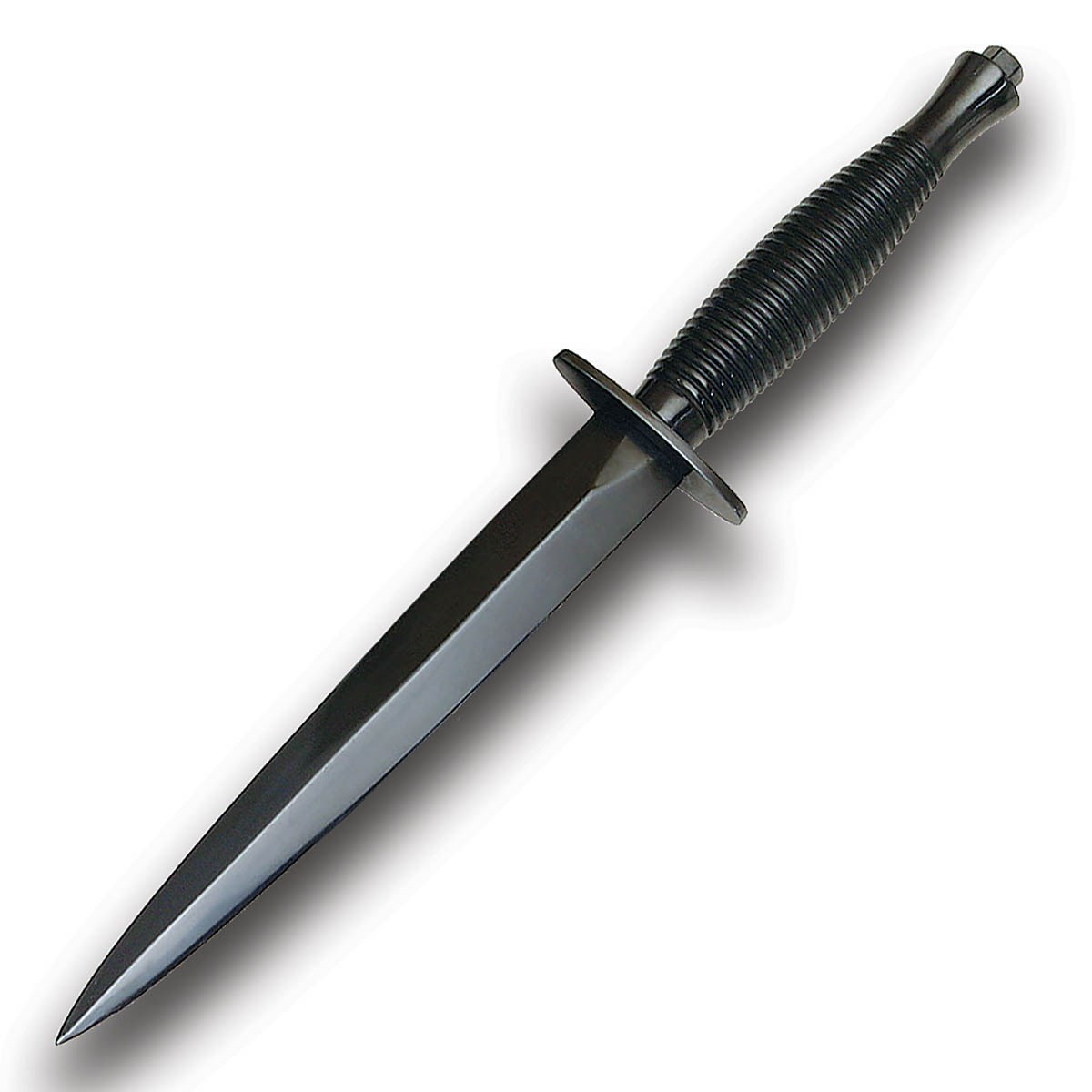
The Fairbairn–Sykes Fighting Knife was a slim, double-edged dagger designed in 1940 by William Fairbairn and Eric Sykes, two former Shanghai police officers who trained British Commandos in close combat. Made first by Wilkinson Sword, it was built for one job: to reach vital targets quickly and silently. It became the knife of the British Commandos, the SAS and the secret agents of SOE, and it inspired American copies such as the Marine Raider Stiletto. More than eighty years later it still appears on the badges of special forces units.
Also known as F-S fighting knife, Fairbairn-Sykes, Fairbairn-Sykes Fighting Knife, FS knife, Commando dagger, Commando knife
Origins
William Ewart Fairbairn and Eric Anthony Sykes spent the years between the wars in the Shanghai Municipal Police, then one of the most dangerous police beats in the world. Fairbairn built its riot squad and taught its officers a brutal, practical system of unarmed and knife fighting drawn from street experience and Asian martial arts. Sykes ran the force's armory and its sniper unit. Both men left Shanghai in 1940 and returned to Britain / United Kingdom, where the army commissioned them to teach close combat at the new Special Training Centre at Inverailort in the Scottish Highlands. Their students were the first Commandos and, later, the agents of the Special Operations Executive (SOE). In November 1940 the two men visited Wilkinson Sword in London and worked out the design of a fighting knife with the company. Production began early in 1941.
Design & Construction
The Fairbairn–Sykes is a dagger, not a utility knife. Its blade is about 7 inches (18 cm) long, double-edged, and tapers to a needle point. Fairbairn wanted a knife that could pierce heavy winter clothing and reach an artery quickly, and he argued that balance and grip mattered as much as the blade. The handle is shaped so the knife can be held in the fingers and moved with precision. The first pattern had an S-shaped crossguard and a flat section (ricasso) at the base of the blade, etched with Wilkinson's name and "The F-S Fighting Knife". The second pattern of 1941 dropped the ricasso and used a straight guard and a knurled brass grip. The third pattern of 1943 had a grip with rings cast from cheaper metal, which made mass production easier, and many British firms made it. Early blades were finely finished; wartime examples varied a great deal in quality. The slim point could break if the knife was used for prying or cutting, a weakness users often complained of.
Service
The knife was issued to the British Commandos, the British SAS, the Parachute Regiment and SOE agents, and to many Allied commando and special units. Fairbairn and Sykes went on to train American agents of the Office of Strategic Services (OSS). The OSS bought British-made knives and had an American version built, and the US Marine Corps adapted the pattern as the Marine Raider Stiletto, while the First Special Service Force carried the related V-42. In the World War II raids on occupied Europe and in the jungle war against Japan, the dagger was carried more often than it was used, but for sentry killing and silent raiding it had no equal. Fairbairn's book "Get Tough!" (1942) set out the knife-fighting method he taught with it.
Legacy
The Fairbairn–Sykes became the symbol of the commando, and an upright Fairbairn–Sykes still forms part of the shoulder insignia of US Army Special Forces. It remained in British service into the Cold War, and Wilkinson Sword and other makers kept building it for decades. It also shaped later fighting knives far beyond Britain. Collectors today study the three patterns, the makers' marks and the many wartime variations, and genuine early first-pattern knives are among the most sought-after military edged weapons of the war. Compare it with the heavier, all-purpose KA-BAR Knife and the First World War Mark I Trench Knife.
Sources
Thompson, Leroy. The Fairbairn-Sykes Commando Dagger. Osprey Publishing (Weapon series), 2011.
Fairbairn, W. E. Get Tough! How to Win in Hand-to-Hand Fighting. D. Appleton-Century, 1942.
Flook, Ron. British and Commonwealth Military Knives. Howell Press, 1999.
Buerlein, Robert A. Allied Military Fighting Knives and the Men Who Made Them Famous. American Historical Foundation, 1984; Paladin Press, 2001.
Suggest an edit · account required · reviewed before publishing · how it works