KA-BAR Knife
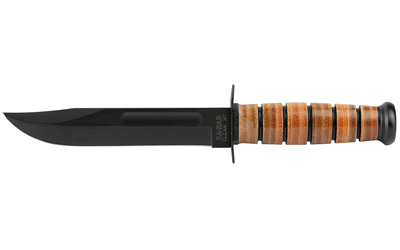
The KA-BAR is the fighting and utility knife of the United States Marine Corps: a seven-inch clip-point blade of carbon steel with a blood groove, a stacked-leather handle and a steel pommel, adopted in November 1942 as the USMC 1219C2 and the Navy Mark 2. Made by Union Cutlery under its KA-BAR trademark and by Camillus, PAL and Robeson, well over a million were issued in the Second World War, and Marines have carried it in every conflict since. It is the most recognizable American military knife ever made.
Also known as Ka-Bar, USMC Fighting/Utility Knife, USN Mark 2, 1219C2, Mark 2 combat knife
Origins
When the Marines went to war in 1942 they had no standard fighting knife. The Mark I Trench Knife of 1918 was obsolete, the Marine Raider Stiletto was a specialist's weapon that broke too easily, and the Corps needed a blade that could fight in a foxhole and then open a ration can. Colonel John M. Davis and Major Howard E. America of the Marine Corps Quartermaster's Department worked with Union Cutlery of Olean, New York, to adapt a commercial hunting knife, and on 23 November 1942 the result was approved as the USMC Fighting/Utility Knife, drawing number 1219C2. The Navy adopted the same knife as the Mark 2 for its Seabees and sailors. Union Cutlery stamped its blades with the KA-BAR trademark it had used since 1923 — the story, told by the company, is of a fur trapper's letter reporting he had "k a bar" (killed a bear) with one of its knives — and the name attached itself to the whole type.
Design & Construction
The blade is seven inches of 1095 carbon steel, clip-pointed with a false edge along the clip and a fuller on each side to lighten it; the overall length is just under twelve inches. The handle is a stack of compressed leather washers, grooved for grip and sealed, held between a steel cross guard and a steel pommel that was pinned, not threaded, so it could be used as a hammer. The scabbard was leather, later fiberglass. The design is deliberately unrefined: the steel takes a keen edge and sharpens easily in the field, the leather handle stays warm and grippy when wet, and every part could be produced in enormous quantity. Union Cutlery, Camillus Cutlery, PAL Blade and Robeson (ShurEdge) all made it under contract during the war, with makers' marks the chief way collectors tell them apart.
Combat Use
From Guadalcanal to Okinawa the KA-BAR was on every Marine's belt, and it earned its reputation less in the hand-to-hand fights of legend than in the ten thousand daily uses of an infantryman's blade: digging, prying, cutting vines and wire, opening crates and cans, and, when it came to it, killing. It went to Korean War and Vietnam War unchanged, was commercially revived by KA-BAR in the 1970s, and is still purchased by Marines today, including a version issued to the US Navy SEALs. In 1997 the reconstituted KA-BAR company began a run of "Fighting/Utility" knives marked for the Marine Corps, Army, Navy and Air Force.
Legacy
The KA-BAR is to American military knives what the M1911 Pistol is to American sidearms: the design everything else is measured against. Its profile is instantly known, its pattern has been copied by makers around the world, and original wartime examples with clear maker's marks are prized by collectors, with Robeson and PAL marks scarcer than the KA-BAR and Camillus knives that were made in the greatest numbers.
Sources
Cole, M.H. U.S. Military Knives, Bayonets and Machetes, Book IV. 1990.
Silvey, Michael W. Knives of the United States Military: World War II. 1999.
KA-BAR Knives, Inc. corporate history (kabar.com).
National Museum of the Marine Corps, Triangle, Virginia — edged weapons collection.
Suggest an edit · account required · reviewed before publishing · how it works