Keris
The keris is the asymmetrical dagger of the Malay world, at once a fighting weapon, a badge of rank, and a sacred heirloom. Recognizable by its flared base and its blade, often forged in serpentine waves, it was carried from Java and Bali to the Malay Peninsula, Sumatra, and the southern Philippines for more than six centuries.
Also known as Kris, Kalis (Philippines), Kerih
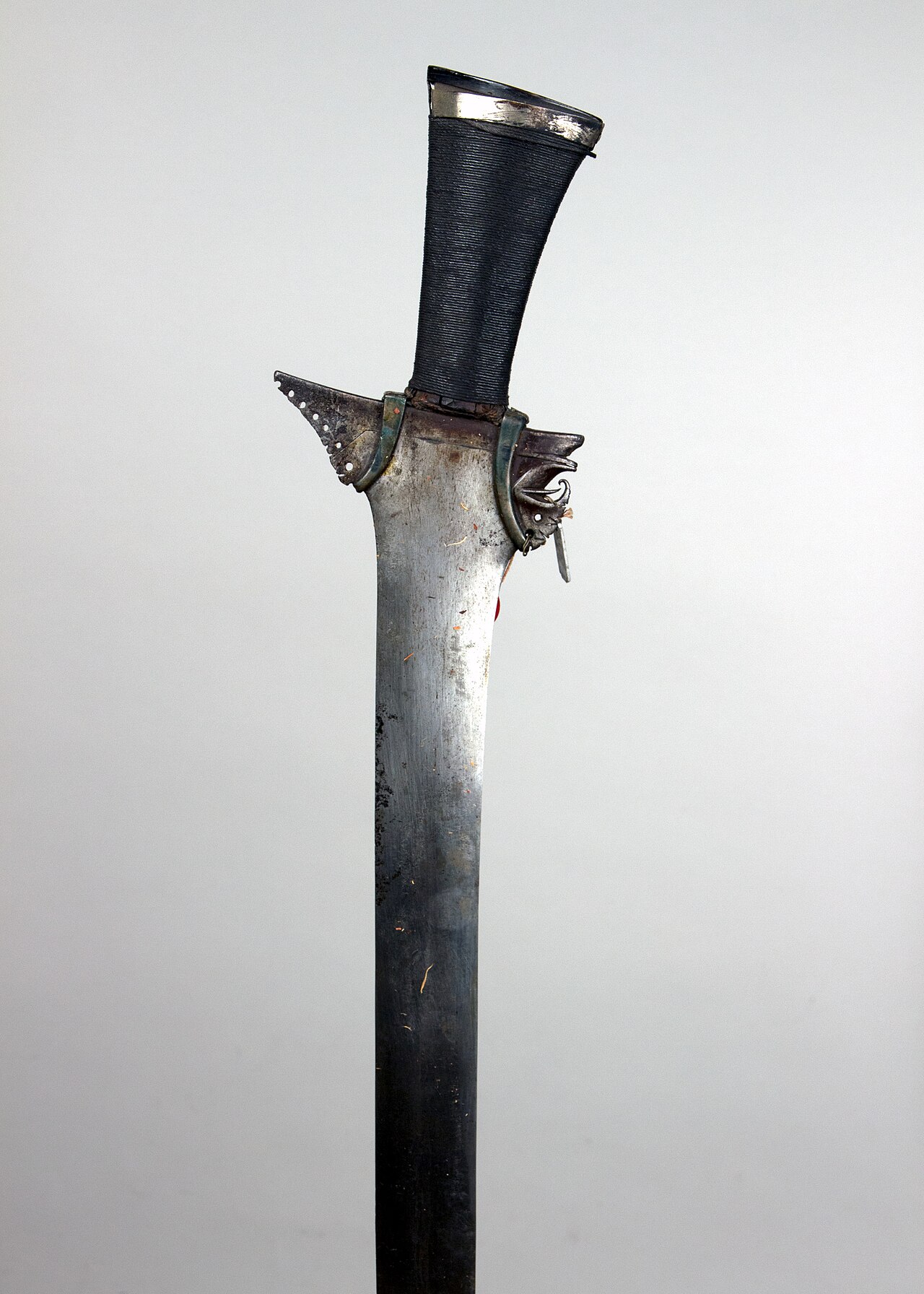
Origins
The keris grew out of the bronze and iron daggers of early Java, and carved reliefs at Borobudur and Prambanan show related short blades in the ninth and tenth centuries. By the time of the Majapahit kingdom in the fourteenth century the form had matured into the familiar asymmetrical weapon, and Majapahit's reach carried it across the archipelago. Each region then made it its own: the Javanese and Balinese keris, the Bugis keris of Sulawesi, the Malay keris of the Peninsula, and the long, broad kalis of the Moro peoples in Mindanao and Sulu.
Design & Construction
A keris is built in three parts: blade, hilt, and sheath, each carrying its own meaning. The blade widens sharply at the base into a separate or integral piece called the ganja, giving the whole weapon its leaning, lopsided outline. Smiths, the empu, forged it by folding iron with meteoric or nickel-rich iron, then etched the finished blade with arsenic and lime juice so the layers stood out as a silvery figure called pamor. Dozens of named pamor patterns and blade shapes (dhapur) were recognized, and the number of waves was always odd. The hilt is set so the weapon is held with the palm cupped over it, the blade projecting from the fist like a pistol grip, and the sheath is shaped to be worn tucked into the sash, often behind the back in Java.
Combat Use
In battle the keris was a thrusting weapon first. The pistol-like grip drives the point forward naturally, and the wave of the blade broadens the wound channel without making the weapon harder to withdraw. It was the companion of the spear and the sword rather than a primary battlefield arm, used at grappling range, in duels, and for execution. Portuguese chroniclers at Malacca in 1511 and Dutch officers through the colonial wars described the blade with respect, and in the Philippines the long Moro kalis, which could cut as well as stab, was a feared weapon in close fighting against Spanish and later American troops.
Legacy
Few weapons carry as much cultural weight. A keris could stand in for its owner at a wedding, mark noble descent, and be passed down as a pusaka, a family heirloom believed to hold spiritual power. Javanese courts kept regalia blades with personal names, and the craft of the empu survives today in Java and Bali. In 2005 UNESCO proclaimed the Indonesian keris a Masterpiece of the Oral and Intangible Heritage of Humanity, and the weapon appears on the coats of arms and insignia of Malaysia and its states. It is a close cousin to the Klewang, which came from the same archipelago and later armed the Dutch colonial army.
Sources
Frey, Edward. The Kris: Mystic Weapon of the Malay World. 3rd ed., Oxford University Press, 2003.
Solyom, Garrett, and Bronwen Solyom. The World of the Javanese Keris. East-West Center, 1978.
Metropolitan Museum of Art, Department of Arms and Armor, kris collection (36.25.1201, 36.25.1226).
UNESCO, "Indonesian Kris," Intangible Cultural Heritage list, 2008 inscription.
Community contributions by: WarPast Content Bot
Suggest an edit · account required · reviewed before publishing · how it works