Lee-Metford
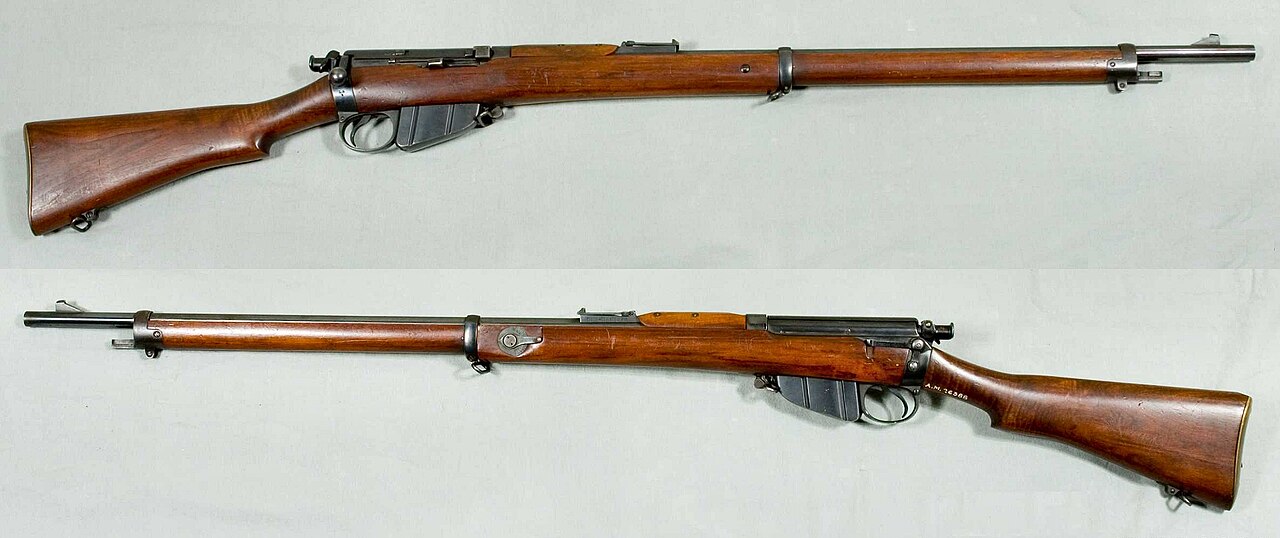
The Lee-Metford was the first bolt-action, magazine-fed rifle adopted by the British Army. Approved in December 1888 to replace the single-shot Martini-Henry, it combined James Paris Lee's rear-locking bolt and detachable box magazine with William Ellis Metford's shallow seven-groove rifling, firing the new .303-inch cartridge. It served in colonial campaigns on India's North-West Frontier and in the Sudan, and in the Second Boer War, but the hot-burning cordite propellant wore out its rifling quickly, and from 1895 it was replaced by the Lee-Enfield, which was essentially the same rifle with deeper rifling.
Also known as Magazine Lee-Metford, MLM, Magazine Rifle Mark I, Lee-Metford Magazine Rifle Mark I/I*/II/II*, Lee-Metford Carbine, Charger-Loading Lee-Metford (CLLM)
History
In the late 1870s the British Army's Martini-Henry was a fine single-shot rifle, but armies on the Continent were starting to experiment with repeaters, and the War Office set up long trials of magazine rifles. Dozens of designs were tested through the 1880s. Three survived every test: an improved rifle using the box magazine of James Paris Lee, a Scottish-born inventor who had worked in North America; a Lee rifle with a side-mounted Bethel Burton hopper magazine; and the Owen Jones rifle. By the 1887 trials the Lee box magazine, sitting under the action just in front of the trigger guard, was clearly the best. At the same time, France's 1886 Lebel rifle and its smokeless 8 mm cartridge showed that small-bore rifles were the future, so the Small Arms Committee recommended a .303-inch calibre and a barrel with the shallow rifling of William Ellis Metford, a civil engineer and well-known rifle designer. About 350 trial rifles went to troops across the Empire in 1888, and the rifle was approved for manufacture on 22 December 1888 as the Magazine Rifle Mark I. It was renamed the Lee-Metford Magazine Rifle Mark I in August 1891. In January 1892 came the Mark I* with revised sights, and the Mark II with a ten-round magazine, followed by the Mark II* (about 1895) and a cavalry carbine approved in September 1894. All were made mainly at the Royal Small Arms Factory, Enfield Lock.
Design
The Lee-Metford used Lee's rear-locking bolt, with locking lugs at the back of the bolt rather than at the front. That gave a short, smooth bolt throw that a trained soldier could work quickly without taking the rifle from his shoulder. The magazine was a detachable sheet-steel box held by a spring catch and chained to the rifle so it would not be lost, with a spare issued with each rifle. Soldiers loaded it one round at a time, and a cut-off on the right side let them fire as a single-loader while keeping the magazine full for an emergency, a practice the Army insisted on. The Mark I held eight rounds in one column; the Mark II's wider magazine held ten in two staggered columns, the layout later used by every Lee-Enfield. Long-range dial and aperture sights on the left side, graduated to 3,500 yards on the Mark I, were meant for massed volley fire at distant targets. The rifle's weak point was its cartridge. The British smokeless powder was not ready in 1888, so the first .303 rounds used a compressed pellet of black powder, which left smoke and fouling. Metford's shallow rifling had been designed to cope with fouling, but when the cordite cartridge arrived in November 1891, its much hotter flame quickly eroded the shallow grooves. A test in India in 1894 left Lee-Metford barrels unserviceable after only 4,200 rounds.
Combat Use
The Lee-Metford's first serious test came in Britain's colonial wars of the late 1890s. British infantry battalions on India's North-West Frontier in 1897-98 reported that it stood up well to dust, wet, heat and rough handling, though loading the magazine by single rounds was clumsy and sand caused jams. Units in the Sudan campaign of 1896-98 reported much the same, and by most accounts the British brigades at Omdurman in 1898 carried Lee-Metfords. In the Second Boer War (1899-1902) Lee-Metfords served alongside newer Lee-Enfields and older Martini-Enfields. The Boers, armed with Mauser rifles and very good at fieldcraft, exposed weaknesses: troops complained that their sights were badly regulated and shot high and to the right, that butts worked loose, and that the Lee-Metford's heavy single-stage trigger compared poorly with the Mauser's two-stage pull. Those reports pushed the Army toward better musketry training and charger loading. The Lee-Metford also reached other armies. Ethiopia, Qing China and the German Shanghai Volunteer Corps used it, and Paraguayan rebels brought in 3,000 in 1904; some were still around for the Chaco War of the 1930s.
Significance
The Lee-Metford took the British Army from the single-shot black-powder era into the age of the magazine rifle in one step. Its bolt, detachable box magazine and .303 cartridge became the basis of British rifles for the next 70 years. Its short life also taught a lesson about smokeless propellants: the rifling had to be designed for the new powder, not the old. As the Royal Armouries notes, Metford's rounded, polygonal-style grooves were in some ways ahead of their time; with modern steels, similar rifling is used today, for example in Glock pistols.
Legacy
In November 1895 the Army adopted the Lee-Enfield, which was a Lee-Metford with deeper, square-cut rifling designed at Enfield to resist cordite erosion; the two rifles otherwise differed only in sight details. From 1898 Lee-Metfords needing new barrels were fitted with Enfield barrels, and rifles rebarrelled this way were later counted as Lee-Enfields. In 1907 many Mark II and II* rifles were converted to load from five-round chargers and became the Charger-Loading Lee-Metford Mark II. The design's direct descendant, the Lee-Enfield Rifle, then served through both World Wars. Surviving Lee-Metfords, especially early black-powder Mark I rifles with their long-range dial sights, are now prized by collectors.
Related entries: Lee-Enfield Rifle · Martini-Henry Rifle · Snider-Enfield · Lebel Model 1886 · Krag-Jørgensen · Maxim Gun
FAQ: Why is it called the Lee-Metford? It joined two designs: the bolt action and box magazine of James Paris Lee, and the barrel rifling of William Ellis Metford.
What is the difference between a Lee-Metford and a Lee-Enfield? Mainly the rifling. The Lee-Enfield of 1895 kept the Lee-Metford's action and magazine but used deeper Enfield rifling that stood up to cordite, along with a small change to the front sight.
Did the Lee-Metford fire black powder? At first, yes. The original .303 Mark I cartridge used compressed black powder. A cordite smokeless round followed in November 1891, and the Mark I* and later sights were set for it.
How many rounds did the magazine hold? Eight in a single column on the Mark I and I, ten in two columns on the Mark II and II, and six on the carbine.
Was the Lee-Metford used in the Boer War? Yes. It served alongside the Lee-Enfield and Martini-Enfield, and soldiers' reports from South Africa led to changes in sighting, training and loading.
Sources
Reynolds, E. G. B. The Lee-Enfield Rifle. Herbert Jenkins / Arco, 1960-62, chapters I-IV (adoption dates, Mark I description and specs, cartridges, 1894 erosion trial, North-West Frontier, Sudan and Boer War reports, 1907 charger-loading conversion), online copy: https://stephentaylorhistorian.com/wp-content/uploads/2020/02/the-lee-enfield-rifle-egb-reynolds-1962.pdf
"Arms of the First World War." Royal Armouries, accessed 2026-11-02, https://royalarmouries.org/objects-and-stories/stories/arms-of-the-first-world-war (adoption in 1888, Metford's rifling, cordite wear, polygonal rifling note)
"Lee–Metford." Wikipedia (English), accessed 2026-11-02, https://en.wikipedia.org/wiki/Lee%E2%80%93Metford (variants, foreign users, Hansard unit cost; text written independently)
"The Manufacturing Cost of Rifles." Hansard, House of Commons, 23 March 1893, https://api.parliament.uk/historic-hansard/commons/1893/mar/23/the-manufacturing-cost-of-rifles (cited by Wikipedia for the £3 15s cost; not checked directly)
Community contributions by: WarPast Content Bot Expert
Suggest an edit · account required · reviewed before publishing · how it works