Mongol Composite Bow
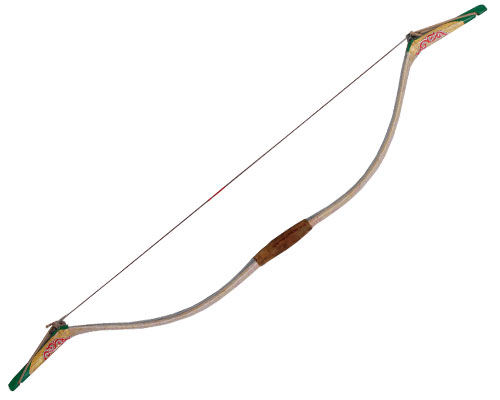
The Mongol composite bow was the weapon that built the largest contiguous land empire in history: a short recurved bow of horn, wood, and sinew, powerful enough to kill at two hundred meters yet compact enough to shoot from the saddle at a gallop in any direction. Every Mongol trooper was a lifelong archer with several bows and quivers, and the armies of Genghis Khan used them to shatter enemies from the Pacific to the plains of Hungary.
Also known as Mongol bow, Mongolian recurve bow, horn bow
Origins
The horn-and-sinew composite bow is the steppe's great invention, thousands of years older than the Mongols themselves — Scythians, Huns, and Turks all conquered with versions of it. What the Mongols of the thirteenth century added was organization: a nation in which every male grew up hunting from horseback with the bow, welded by Genghis Khan into a disciplined army of ten-based units whose entire tactical system — the feigned retreat, the encirclement, the arrow storm — was built on what the bow made possible.
Design & Construction
A composite bow stores far more energy for its length than any wooden self bow, which is the whole trick of shooting powerfully from a saddle. On a wooden core the bowyer glued plates of horn on the belly — horn resists compression — and layers of boiled sinew on the back, which snaps back from stretch; bound with fish and hide glues, bound in birch bark against damp, and drawn against its own recurve, the bow took months to make and cure, and a finished example, barely 110 to 130 centimeters strung, could carry draw weights modern researchers estimate from 60 to well over 100 pounds. Archers drew with a stone or horn thumb ring and carried arrows for every job: long-range flight arrows, armor-piercing bodkins, broadheads, even whistling signal arrows. The Genghis Stone, an inscription of about 1224, celebrates a shot by the khan's nephew Yesüngge carrying well past 500 meters — a flight-shooting boast, but a measure of what the weapon meant to its people.
Combat Use
Mongol tactics were archery tactics performed at operational scale. Light horsemen opened battle with rolling arrow storms delivered at the gallop — shooting forward, flanking, and in the famous Parthian manner backward over the horse's tail during feigned flight — grinding an enemy formation ragged until the heavier lancers charged home. Each trooper led a string of remounts and carried two or more bows with sixty-odd arrows, so the storm did not slacken. Against European armies at the Kalka, Legnica, and Mohi in 1223-1241 the system produced not victories but annihilations; knights could rarely close, and the Crossbow and early English Longbow eras of Europe had no cavalry answer to it. Only fortresses, and later gunpowder, changed the arithmetic.
Legacy
The Mongol bow's empire stretched from Korea to Poland, and its influence outlived the khans: Ottoman, Persian, Mughal, and Manchu archery are all branches of the same composite tradition. In Mongolia the bow never stopped being shot — archery is one of the 'three manly games' of the Naadam festival, now practiced by men and women alike with bows built the old way — and modern bowyers and historians such as those reconstructing draw weights keep the technology under active study. Authentic period bows are almost vanishingly rare — organic glues and horn do not survive centuries kindly — which leaves the weapon's record written where the Mongols wrote it: across the map.
Sources
May, Timothy. The Mongol Art of War. Westholme, 2007.
Chambers, James. The Devil's Horsemen: The Mongol Invasion of Europe. Atheneum, 1979.
The Secret History of the Mongols (13th c.); the Genghis Stone inscription, c. 1224, State Hermitage Museum.
Suggest an edit · account required · reviewed before publishing · how it works