Historical Context
Mongol Invasions
The conquests of Genghis Khan and his successors across Asia and into Europe in the thirteenth century, creating the largest contiguous land empire in history. Mounted archers with composite bows won in the field, and captured Chinese and Persian engineers took the cities.
1206 – c. 1300
Overview
In 1206 the Mongol tribes proclaimed Temüjin their ruler as Genghis Khan. Within twenty years his armies had invaded northern China, destroyed the Khwarazmian empire of Central Asia and Iran, and raided into Russia. His successors went further: the Jin dynasty of northern China fell in 1234, Russian principalities were conquered from 1237, and in 1241 Mongol armies defeated the Poles and Germans at Legnica and the Hungarians at Mohi. In 1258 they sacked Baghdad and ended the Abbasid caliphate. The advance into the Middle East was stopped at the Battle of Ain Jalut in 1260 by the Mamluks of Egypt, but in China the conquest of the Song dynasty was completed in 1279. Invasions of Japan in 1274 and 1281 failed, and so did campaigns into Southeast Asia.
Weapons and Tactics
The Mongol army was a force of mounted archers. Every man rode with several horses and carried the powerful Mongol Composite Bow, with different arrows for range and for armor, and heavier troops also had lances, maces and armor of leather or iron lamellae. Organized in units of ten, a hundred, a thousand and ten thousand, they could maneuver across great distances, feign retreat to draw enemies out of formation, and shoot down those who followed. Against cities they used engineers recruited from the peoples they had conquered: Chinese crews working catapults and gunpowder weapons, and Muslim engineers who built counterweight trebuchets for the siege of Xiangyang in 1273.
Gunpowder and the Spread of Technology
The Mongols met gunpowder weapons in their wars against the Jin and the Song — bombs, rockets and the Fire Lance — and used them in turn. Their empire, stretching from Korea to Hungary, carried people, trade and technology along the Silk Roads, and historians have long argued that it helped gunpowder reach the Islamic world and Europe.
Legacy
The Mongol conquests killed millions and destroyed cities from Central Asia to Iraq, but they also created, for a time, one political order across most of Eurasia. Their successor states ruled China, Iran, Central Asia and Russia for generations, and the image of the Mongol horse archer remains one of the most powerful in military history.
Battles & Operations
-
Battle of Legnica (9 April 1241)
The Battle of Legnica was fought on 9 April 1241 near Legnica in Silesia, in what is now south-western Poland. A Mongol force, the northern… Continued…
-
Battle of Ain Jalut (3 September 1260)
The Battle of Ain Jalut, fought on 3 September 1260 in the Jezreel Valley of Galilee, was the first time a Mongol army was decisively… Continued…
Weapons
-
Arming Sword
The arming sword was the one-handed, double-edged sword of the medieval knight, carried from the eleventh to the fifteenth century with a… Continued…
-
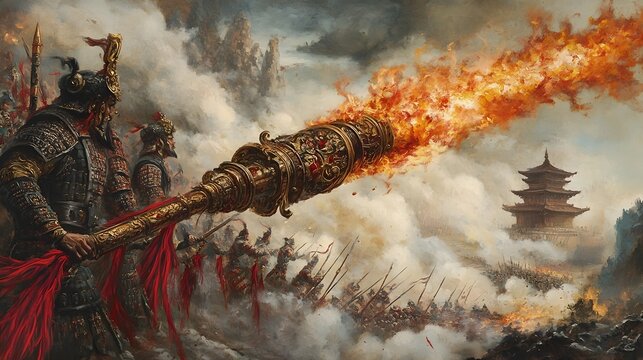
Fire Lance
The fire lance was the first gunpowder weapon to be held in the hand: a tube of bamboo or paper, packed with gunpowder and tied to a spear… Continued…
-
Great Helm
The great helm was the fully enclosed, flat-topped or sugarloaf helmet of the high medieval knight, worn from around 1220 until the mid… Continued…
-
Knight's Lance
The knight's lance was the defining weapon of medieval European heavy cavalry: a long wooden shaft with an iron head, held tight under the… Continued…
-
Mail Hauberk
The mail hauberk was the principal body armor of European warriors for most of the Middle Ages: a long shirt of thousands of interlinked… Continued…
-
Medieval Mace
The mace is concentrated impact: a weighted head of iron or bronze on a stout haft, built to transmit force THROUGH armor rather than cut… Continued…
-
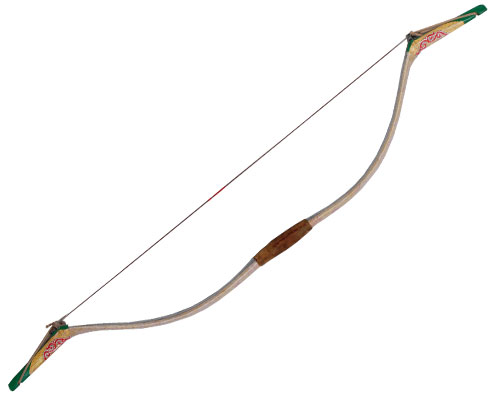
Mongol Composite Bow
The Mongol composite bow was the weapon that built the largest contiguous land empire in history: a short recurved bow of horn, wood, and… Continued…
-
Mongol Lamellar Armor
Mongol lamellar armor was the body armor of the heavier Mongol cavalry in the thirteenth and fourteenth centuries. It was built from… Continued…