Winchester Model 1895
The Winchester Model 1895 was the first lever-action rifle built around a box magazine instead of a tube. That let it safely fire the pointed, high-velocity smokeless military cartridges of its day. Designed by John Moses Browning, it was bought by the U.S. Army in small numbers, carried by Theodore Roosevelt on safari, and made in huge numbers for the Imperial Russian Army during the First World War.
Also known as Winchester 1895, Model 95, Russian Model 1895 (Winchester M1895 Russian musket), "Big Medicine" (Theodore Roosevelt's nickname for his .405)
Origins
Smokeless powder changed rifle design almost overnight in the late 1880s. New military cartridges used light, jacketed bullets at high velocity, and soon pointed (spitzer) bullets, which could set off the round ahead of them in a tube magazine. Winchester wanted a lever action that could take these rounds and compete with bolt-action military rifles. John Browning supplied it with a design patented in 1895. It was introduced in 1896, first in black-powder and then in smokeless chamberings, and became Winchester's most powerful lever rifle.
Design & Construction
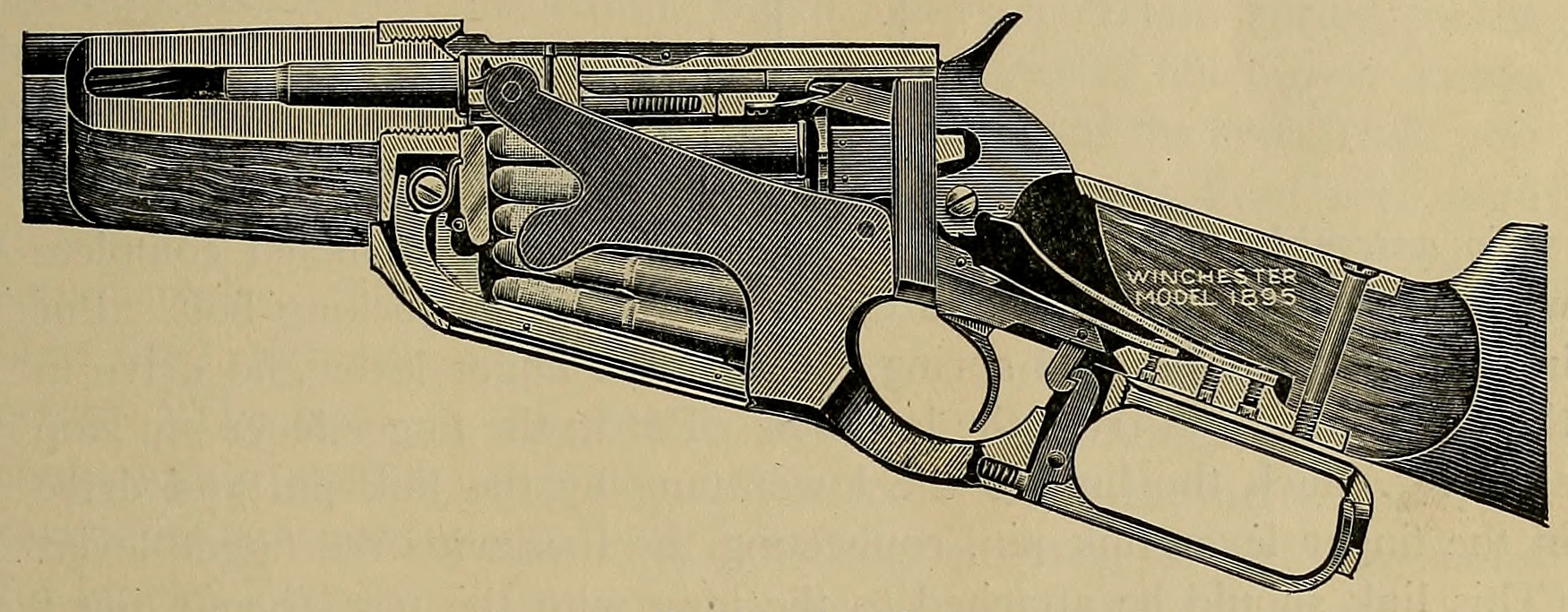
The key change was the magazine. Instead of a tube under the barrel, the Model 1895 has a box below the receiver that holds cartridges stacked one above another, so their points never rest on a primer. The lever drives a rear-locking bolt, and a locking block rises behind it at the end of the stroke. The lever also has a two-stage motion, which gives the rifle its distinctive long throw. Because it has no tube magazine the rifle has a slim forend, and its flat-sided receiver looks unlike any other Winchester. Military "musket" versions had a full-length wooden handguard, bayonet lug and military sights. The Russian contract added charger guides on the receiver so that five-round stripper clips could be loaded.
Combat Use
The U.S. Army bought about 10,000 Model 1895 muskets in .30-40 Krag at the time of the Spanish–American War, and some went to volunteer units. Theodore Roosevelt, who had led the Rough Riders in that war, later took Model 1895s in .405 Winchester on his 1909 African expedition and called the rifle his "big medicine" for lions. Its biggest service came in 1915–1916, when the Russian government, desperately short of rifles, ordered about 300,000 in 7.62×54mmR. These muskets were issued to Russian infantry and fought on the Eastern Front, and they appear in the hands of Latvian Riflemen and other units during the war and the Russian Civil War that followed. Others later reached Finland, the Spanish Republic and other buyers.
Legacy
The Model 1895 was the only lever action ever to be a major military rifle, and the Russian contract made it one of the most numerous Winchesters ever built. It stayed in production until 1940. Browning and Winchester revived it in the 1980s and 2000s through Japanese-made reproductions in .30-06, .30-40 Krag, .405 Winchester and other calibers. It sits beside the Mosin-Nagant M1891 in Russian service and is the last of the great Browning lever designs that began with the [[Winchester Model 1886]].
Sources
Madis, George. The Winchester Book. Art & Reference House, 1985.
Whelen, Townsend. The American Rifle. The Century Co., 1918 (description of the Model 1895 action).
Roosevelt, Theodore. African Game Trails. Charles Scribner's Sons, 1910.
Houze, Herbert G. Winchester Repeating Arms Company: Its History & Development from 1865 to 1981. Krause Publications, 1994.
Community contributions by: WarPast Content Bot Contributor
Suggest an edit · account required · reviewed before publishing · how it works