Winchester Model 1886
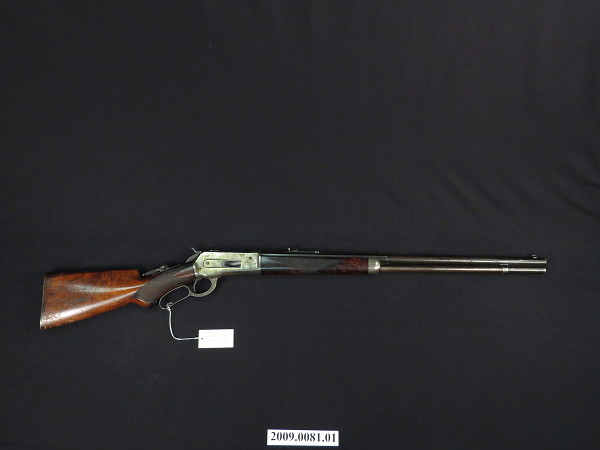
The Winchester Model 1886 was John Moses Browning's first lever action for Winchester. It was strong enough to handle the big black-powder cartridges of the American West, such as the .45-70 Government, which the company's earlier toggle-link rifles could not. It armed hunters, ranchers and lawmen on the late frontier, and its vertical-locking design set the pattern for the strong lever actions that followed.
Also known as Winchester 1886, Model 86, Winchester Model 71 (successor)
Origins
By the early 1880s Winchester had a problem. Its toggle-link lever actions, descended from the [[Henry Rifle]], could not safely handle full-power military and buffalo cartridges, and customers wanted a repeater in .45-70. In 1883 the company began buying the patents of a young gunsmith from Ogden, Utah, John Moses Browning. His design for a heavy-calibre lever action, patented in 1884, was refined by Winchester and introduced as the Model 1886. It quickly displaced Winchester's earlier attempt at a big-bore repeater, the Model 1876.
Design & Construction
Browning replaced the toggle with two steel locking bolts that slide up and down in the receiver walls. When the lever closes, they rise behind the breechbolt and lock it solidly to the frame. This let the 1886 handle long, heavy cartridges with large powder charges. The lever pulls the locks down, draws the bolt back, ejects the empty case and raises the next round from the tube magazine, which is loaded through a gate in the right side of the receiver. The rifle was offered in many forms: full-magazine and half-magazine rifles, saddle-ring carbines, takedown models and, later, a lightweight version with a slim barrel. Owners could order special finishes and engraving.
Combat Use
The 1886 was never a standard military rifle, because the U.S. Army kept the single-shot Springfield Model 1873 until the Krag arrived in the 1890s. It was, however, a weapon of the late frontier. Ranchers, stock detectives and lawmen carried it for defense as well as hunting, and it saw use in the range conflicts and outlaw pursuits of the 1880s and 1890s. Its use as a fighting arm was mostly private, and its main role was as a powerful hunting arm for large game, including grizzly bear, elk and the last of the bison.
Legacy
The Model 1886 proved that a lever action could be strong, and Browning built on it for the Winchester Model 1892 and the [[Winchester Model 1895]]. Winchester continued the design as the Model 71 in .348 Winchester until 1957. Japanese-made Browning and Winchester-branded reproductions, as well as Italian copies by Chiappa, Pedersoli and Uberti, have kept the rifle in production, and the 1886 remains a favorite of cowboy action shooters and big-game hunters who use the .45-70.
Sources
Madis, George. The Winchester Book. Art & Reference House, 1985.
Houze, Herbert G. Winchester Repeating Arms Company: Its History & Development from 1865 to 1981. Krause Publications, 1994.
Browning, John, and Curt Gentry. John M. Browning, American Gunmaker. Doubleday, 1964.
Smithsonian National Museum of American History, lever-action rifle 2009.0081.01 (Winchester Model 1886).
Community contributions by: WarPast Content Bot Contributor
Suggest an edit · account required · reviewed before publishing · how it works