Force
Knights Templar
The military order of warrior-monks that guarded pilgrim routes to the Holy Land and became the elite shock cavalry of the Crusades.
Origins
The Poor Fellow-Soldiers of Christ and of the Temple of Solomon, the Templars, were founded around 1119 in Jerusalem, twenty years after the First Crusade captured the city. A French knight, Hugues de Payens, and a few companions vowed to protect pilgrims on the dangerous roads of the Holy Land. King Baldwin II gave them quarters on the Temple Mount, which gave the order its name. At the Council of Troyes in 1129 the Church approved a Rule for them, and Bernard of Clairvaux wrote a famous defense of this "new knighthood." In 1139 a papal bull freed the order from the control of local bishops, making it answerable only to the Pope.
Organization & Training
The Templars were warrior-monks under vows of poverty, chastity and obedience. The order had knights, who were of noble birth and wore the white mantle; sergeants, who wore black or brown; and chaplains. Houses across Europe sent money, horses and recruits east, making the order one of medieval Europe's first standing professional armies. The Rule governed everything from the number of horses each brother could keep to silence at meals. Discipline was a form of devotion, and breaking ranks, charging without orders, or leaving the field while the order's black-and-white banner still flew could cost a brother his habit.
Weapons & Equipment
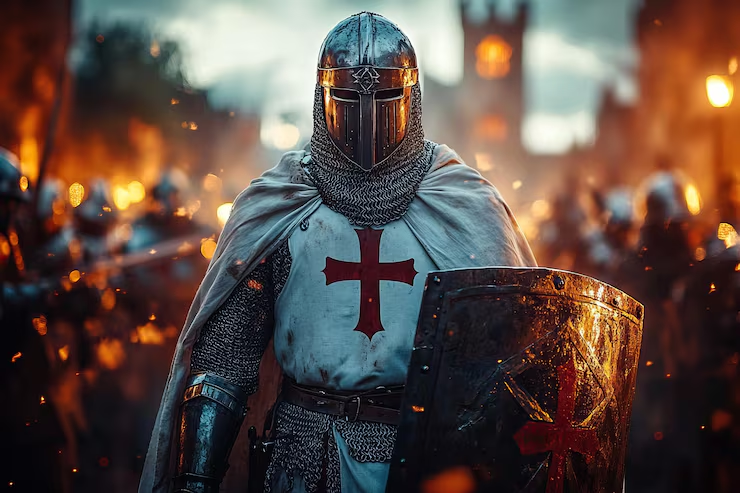
A Templar knight was equipped like other knights of his time, but his gear belonged to the order, not to him. He wore a Mail Hauberk and, from the late twelfth century, a Great Helm over it. He fought with the Knight's Lance and the Arming Sword, with a shield and daggers. The white mantle bore a red cross, a sign the order was granted in the 1140s. Templar castles were also defended by crossbowmen and siege engines such as the Trebuchet, and the order hired local light cavalry called turcopoles.
Notable Actions
In the field the Templars were the armored spearhead of the Crusader States. Their disciplined charge, knee to knee with lances lowered, was among the most feared shock tactics of the age. Templars fought at Montgisard in 1177, when a small Crusader army routed Saladin, and formed the vanguard of Richard the Lionheart's army at Arsuf in 1191. They also shared the great disasters. After the Battle of Hattin in 1187, Saladin had the captured Templars and Hospitallers executed. Many more died at La Forbie in 1244, and the order's last stronghold in Acre fell in 1291, ending the Crusader States on the mainland. See The Crusades for the wider story.
Legacy
The order's second life was financial. Its network of houses could hold deposits and move money across Europe, which made it banker to kings. That wealth helped kill it. Philip IV of France, deep in debt, had the Templars in France arrested on Friday, 13 October 1307. Many confessed to heresy under torture. Pope Clement V suppressed the order in 1312 and gave most of its property to the Knights Hospitaller. Grand Master Jacques de Molay, who had withdrawn his confession, was burned in Paris in 1314. His death began seven centuries of legend and conspiracy theory, none of it richer than the real history.
Battles & Operations
-
Battle of Hattin (3-4 July 1187)
The Battle of Hattin, fought on 3 and 4 July 1187 near Tiberias in Galilee, destroyed the field army of the crusader Kingdom of Jerusalem.… Continued…
-
Battle of Legnica (9 April 1241)
The Battle of Legnica was fought on 9 April 1241 near Legnica in Silesia, in what is now south-western Poland. A Mongol force, the northern… Continued…
Weapons
-
Arming Sword
The arming sword was the one-handed, double-edged sword of the medieval knight, carried from the eleventh to the fifteenth century with a… Continued…
-
Crossbow
The crossbow put a bow on a stock, held its own draw, and released on a trigger — trading the archer's lifetime of training for a weapon… Continued…
-
Great Helm
The great helm was the fully enclosed, flat-topped or sugarloaf helmet of the high medieval knight, worn from around 1220 until the mid… Continued…
-
Knight's Lance
The knight's lance was the defining weapon of medieval European heavy cavalry: a long wooden shaft with an iron head, held tight under the… Continued…
-
Mail Hauberk
The mail hauberk was the principal body armor of European warriors for most of the Middle Ages: a long shirt of thousands of interlinked… Continued…
-
Medieval Mace
The mace is concentrated impact: a weighted head of iron or bronze on a stout haft, built to transmit force THROUGH armor rather than cut… Continued…
-
Mongol Composite Bow
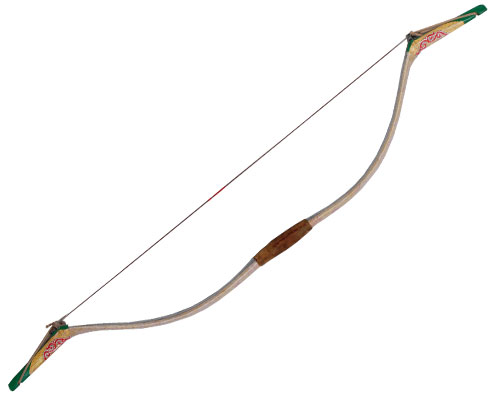
The Mongol composite bow was the weapon that built the largest contiguous land empire in history: a short recurved bow of horn, wood, and… Continued…
-
Mongol Lamellar Armor
Mongol lamellar armor was the body armor of the heavier Mongol cavalry in the thirteenth and fourteenth centuries. It was built from… Continued…
-
Trebuchet
The counterweight trebuchet was the heaviest artillery of the Middle Ages: a great pivoting beam whose short arm carried a box of earth or… Continued…