Battle of Cowpens
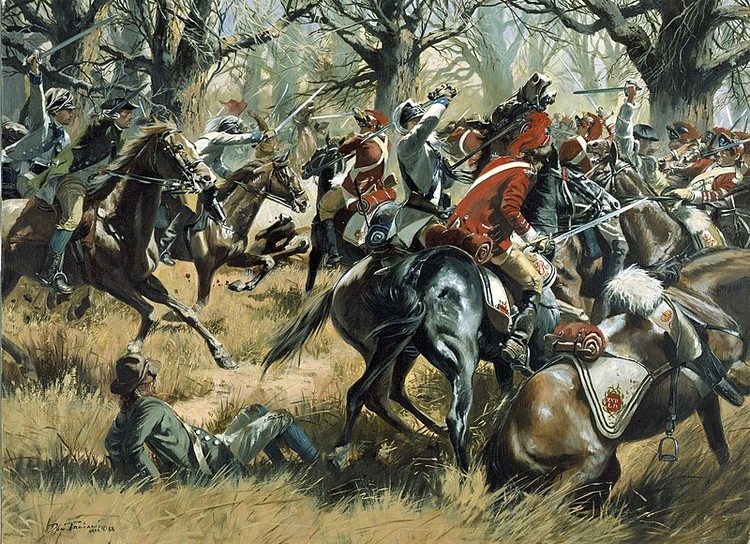
The Battle of Cowpens, fought on 17 January 1781 at a frontier pasture near the North Carolina border of South Carolina, was one of the most complete American victories of the Revolutionary War. Brigadier General Daniel Morgan placed militia riflemen, militia musketmen and Continental regulars in three lines to receive a dawn attack by Lieutenant Colonel Banastre Tarleton's British Legion and regulars. Tarleton's force was drawn forward, outflanked on both sides and destroyed in under an hour, with more than 800 British killed, wounded or captured, a blow that led on to Guilford Courthouse and Yorktown.
Also known as Cowpens, Battle of the Cowpens, Hannah's Cowpens
Background
The Battle of Cowpens was a military engagement of the American Revolution fought near Cowpens, South Carolina. After taking Charleston in May 1780 and destroying an American army at Camden in August, the British under Lord Cornwallis seemed to be in control of the southern colonies. Then a Loyalist force was wiped out at Kings Mountain in October, and General Nathanael Greene, the new American commander in the South, took the unusual risk of dividing his small army. He sent Brigadier General Daniel Morgan, the former commander of the riflemen at Saratoga, west into the South Carolina backcountry with about 600 men to raise the militia and threaten the British outposts; by January militia had brought his force to about 1,000. Cornwallis sent his most aggressive officer, Lieutenant Colonel Banastre Tarleton, after him with about 1,100 men: the British Legion's cavalry and infantry, the 7th Regiment of Foot (Royal Fusiliers), the 1st Battalion of the 71st Highlanders, light infantry, a detachment of the 17th Light Dragoons, and two light guns. On 16 January Morgan stopped at a well-known cattle pasture, the Cowpens, with the Broad River a few miles behind him, and decided to fight.
The Battle
Morgan's plan was built around what his militia could and could not do. In front he put a skirmish line of riflemen from Georgia and the Carolinas. About 150 yards behind them came a line of militia under Andrew Pickens, whom Morgan asked for only two volleys "at killing distance" before they fell back. On the rise behind them stood the main line of Maryland and Delaware Continentals and veteran Virginia militia under Lieutenant Colonel John Eager Howard. Lieutenant Colonel William Washington's Continental dragoons and mounted militia waited out of sight behind the hill. Tarleton's men had marched through the night, and he attacked at dawn on 17 January without resting them. The riflemen shot down officers and fell back, and the militia fired their volleys and retired around the American left. Tarleton's dragoons rode after them and were driven off by Washington's cavalry. The British infantry then pushed up against Howard's line, and Tarleton sent the 71st to overlap its right. Howard ordered his flank company to turn and face them, but it misunderstood and began to withdraw, and the whole Continental line fell back in good order. Thinking the Americans were beaten, the British rushed forward in disorder. At Morgan's order the Continentals halted and turned, fired a volley at about thirty yards and charged with the bayonet. At the same time Washington's cavalry hit the British right and rear, and Pickens' re-formed militia came round to strike the 71st on the left. The British line collapsed. Tarleton's Legion cavalry refused his order to charge, and he escaped with a few dozen men after crossing swords with Washington himself.
Weapons
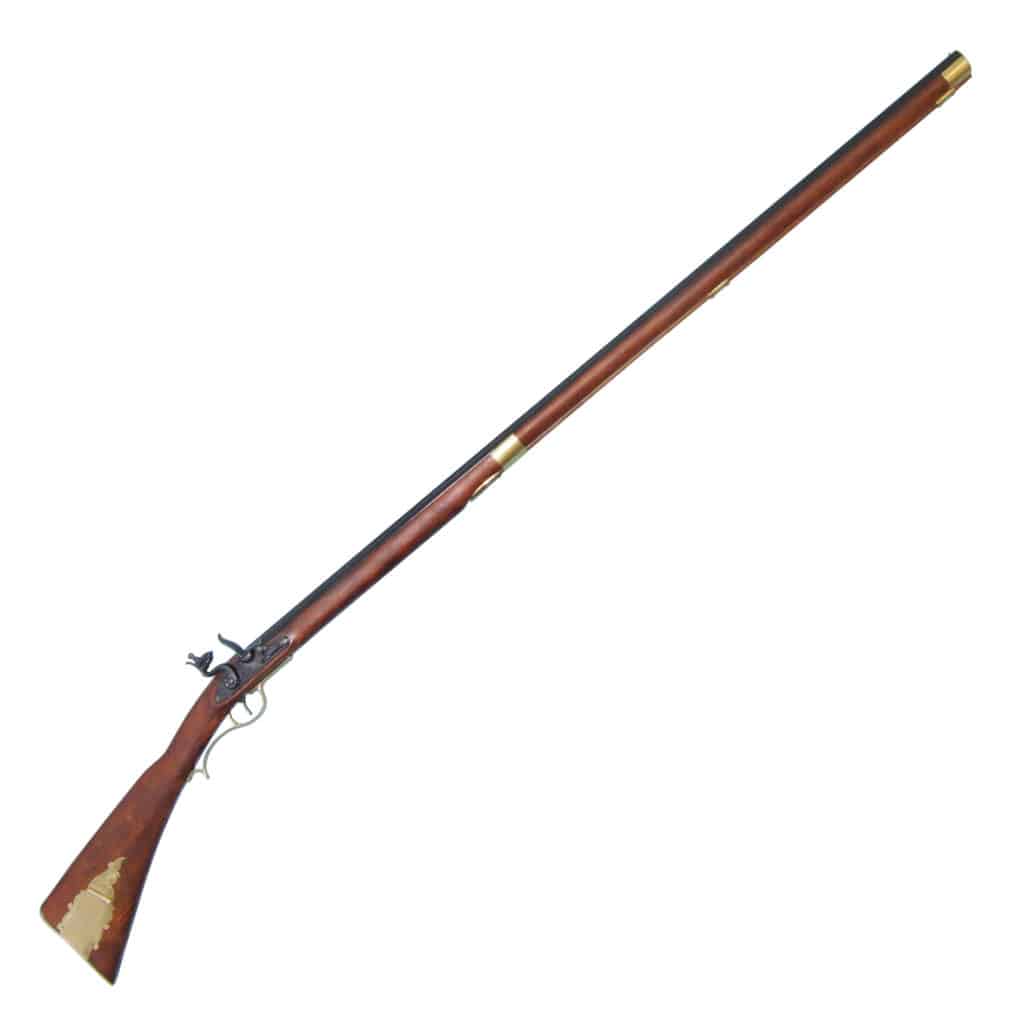
The British regulars carried the Brown Bess Musket and relied on the bayonet charge, which had broken American troops again and again since the Battle of Long Island. Morgan's skirmishers carried the Kentucky Long Rifle, accurate at longer range but slow to load and unable to take a bayonet, and many of the Continentals were armed with the French Charleville Musket. The battle was decided at close range with the Socket Bayonet and by the sabers of Washington's dragoons. Tarleton's artillery was a pair of light 3-pounders of the type known as the Grasshopper Cannon, both captured.
Aftermath
In less than an hour Tarleton lost about 110 killed and 200 wounded, with some 600 more taken prisoner, as well as both guns, the colors of the 7th Regiment, horses and wagons. That was nearly a quarter of Cornwallis's army. Morgan lost about 25 killed and 124 wounded. Morgan marched north at once with his prisoners, and Cornwallis burned his own baggage to chase him and Greene across North Carolina in the "Race to the Dan". The pursuit exhausted the British army, which won a costly victory at Guilford Courthouse in March and then marched into Virginia, where it surrendered at Yorktown in October 1781. Cowpens is often called the American Cannae, the one real double envelopment of the war, and it is now preserved as Cowpens National Battlefield.
Weapons used
-
Brown Bess Musket
The musket of Tarleton's regulars: the 7th Fusiliers, the 71st Highlanders and the British Legion infantry. Continued…
-
Kentucky Long RifleFor sale
Carried by the militia riflemen of Morgan's skirmish line, who aimed at British officers and sergeants before falling back. Continued…
-
Charleville Musket
By 1781 French-supplied muskets armed many of the Maryland and Delaware Continentals in Howard's main line. Continued…
-
Socket Bayonet
The Continentals' bayonet charge at thirty yards broke the British infantry line and turned the battle. Continued…
-
Grasshopper Cannon
Tarleton's two light 3-pounders fired on the American line and were both captured when the British broke. Continued…
Sources
Babits, Lawrence E. A Devil of a Whipping: The Battle of Cowpens. University of North Carolina Press, 1998.
Buchanan, John. The Road to Guilford Courthouse: The American Revolution in the Carolinas. John Wiley & Sons, 1997.
Higginbotham, Don. Daniel Morgan: Revolutionary Rifleman. University of North Carolina Press, 1961.
Tarleton, Banastre. A History of the Campaigns of 1780 and 1781 in the Southern Provinces of North America. London, 1787.
Suggest an edit · account required · reviewed before publishing · how it works