Kentucky Long Rifle
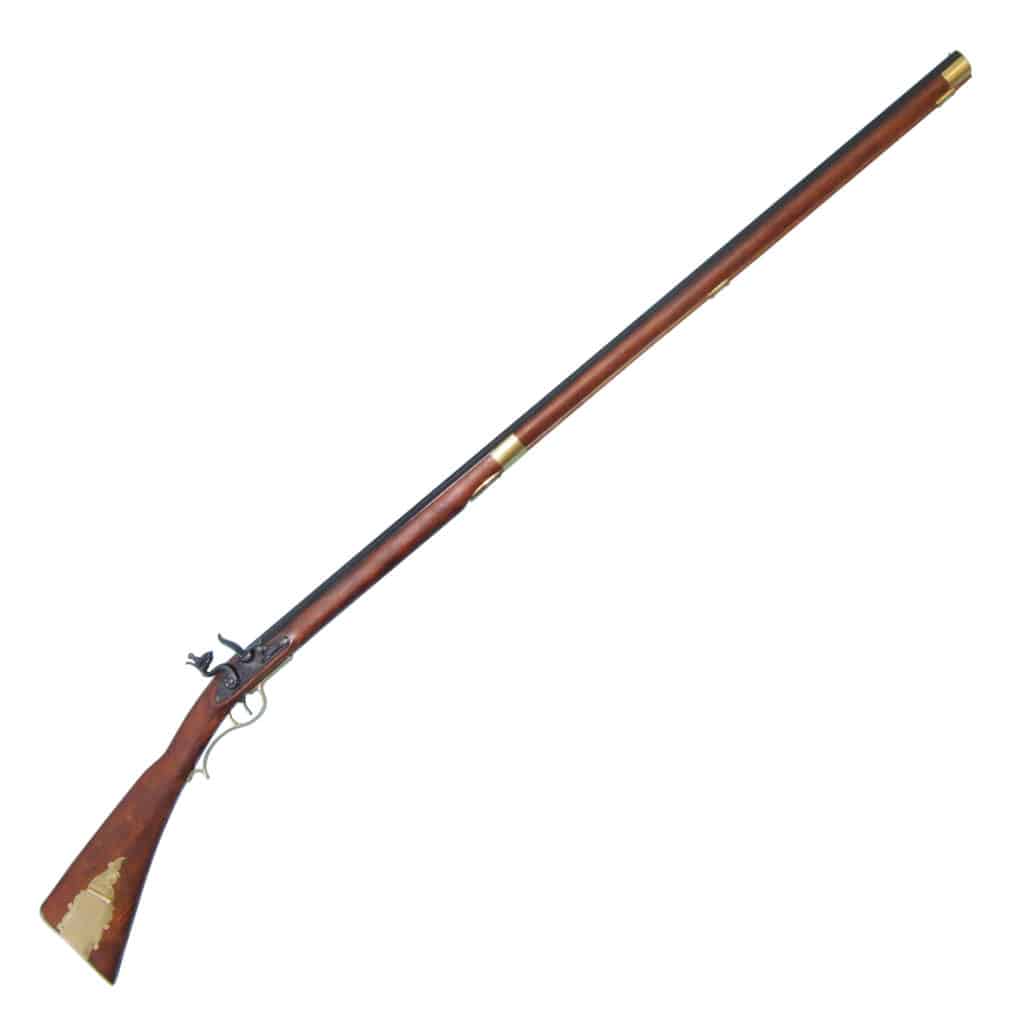
The Kentucky long rifle was the long-barreled, small-caliber flintlock rifle developed by German gunsmiths in Pennsylvania in the eighteenth century. Accurate to 200 yards and more with a patched round ball, it was the rifle of frontier hunters and of the American riflemen of the Revolution, whose marksmanship at Saratoga and Kings Mountain became legend. Slow to load and without a bayonet, it could not replace the musket, but it became a symbol of American independence and of the gunsmith's art.
Also known as Kentucky rifle, Pennsylvania rifle, Pennsylvania-Kentucky rifle, American long rifle, long rifle
Origins
German and Swiss immigrants who settled in southeastern Pennsylvania in the early eighteenth century brought with them the Jäger rifle, a short, heavy, large-caliber rifle used for hunting in the forests of central Europe. On the American frontier, where hunters traveled far and had to carry their powder and lead with them, gunsmiths in Lancaster County and elsewhere adapted it. They lengthened the barrel, reduced the caliber, and made the rifle lighter and more graceful. By the 1740s and 1750s a distinctly American rifle had emerged. It spread down the Great Wagon Road into Virginia and the Carolinas, and it became known as the Pennsylvania rifle. The name "Kentucky rifle" came later, from a popular song of 1822, "The Hunters of Kentucky," about the Battle of New Orleans.
Design & Construction
The long rifle's barrel was between about 42 and 46 inches long, octagonal, and cut with spiral grooves that spun the ball. Calibers were small, usually .40 to .50, which saved powder and lead. The key to its accuracy was the patched ball: a round lead ball slightly smaller than the bore was wrapped in a greased patch of linen or leather, which gripped the rifling and cleaned the barrel as it was rammed down. The stock was usually curly maple, running the full length of the barrel, and many rifles had a brass patchbox in the butt to hold the patches, as well as brass and silver inlays and carving. The finest rifles of the "golden age," from about 1775 to 1825, are masterpieces of American folk art. A good rifle could hit a man-sized target at 200 yards or more, far beyond the range of a musket.
Combat Use
When the Revolution began, Congress raised companies of riflemen from Pennsylvania, Maryland and Virginia, and they marched to the siege of Boston in 1775. Their accuracy impressed both sides. Daniel Morgan's riflemen fought at Quebec and at Saratoga in 1777, where tradition says that one of them, Timothy Murphy, shot the British general Simon Fraser. At Kings Mountain in 1780 frontier riflemen destroyed a Loyalist force led by Patrick Ferguson, inventor of the Ferguson Rifle. But the long rifle took much longer to load than a musket and could not take a bayonet, and riflemen caught in the open by British infantry, as at the Battle of Long Island, were easily overrun. Most American soldiers, including the Minutemen of Massachusetts, carried smoothbore muskets such as the Brown Bess Musket and French Charleville Musket; the rifle was a specialist's weapon.
Legacy
After the Revolution the long rifle went west with settlers and hunters, and it fought again in the War of 1812. In the nineteenth century it was converted to percussion ignition and replaced by the heavier plains rifle. But the Kentucky rifle became one of the great symbols of the American Revolution and of the American frontier, and the idea of the American rifleman as a marksman goes back to it. Signed rifles by known makers are among the most valuable of American antique firearms.
Sources
Kindig, Joe, Jr. Thoughts on the Kentucky Rifle in Its Golden Age. Trimmer Printing, 1960.
Dillin, John G. W. The Kentucky Rifle. National Rifle Association, 1924.
Shumway, George. Rifles of Colonial America. 2 vols. George Shumway, 1980.
Suggest an edit · account required · reviewed before publishing · how it works