Battle of Guilford Court House
The Battle of Guilford Court House was fought on 15 March 1781 in what is now Greensboro, North Carolina. About 1,900 British and German troops under Lord Cornwallis attacked some 4,400 Americans under Nathanael Greene, who had drawn them up in three lines. Cornwallis drove Greene from the field and took his guns, but lost more than a quarter of his army in doing so. Too weak to hold the Carolinas, he marched to Virginia, and seven months later he surrendered at Yorktown.
Also known as Battle of Guilford Courthouse, Guilford Courthouse, Guilford Court House 1781, Battle of Guilford, Guilford Courthouse National Military Park, The Patriot, The Patriot final battle, Patriot movie battle
Background
Nathanael Greene took command of the American southern army in December 1780, after the disaster at the Battle of Camden. He divided his small force, and on 17 January 1781 the detachment under Daniel Morgan destroyed Banastre Tarleton's command at the Battle of Cowpens. Lord Cornwallis set out to catch Morgan and Greene before they could reunite. He burned most of his army's baggage to move faster and chased them across North Carolina in winter weather. Greene won the race, crossing the Dan River into Virginia in mid-February.
Cornwallis had outrun his supplies and gained nothing. Greene, reinforced by Virginia and North Carolina militia and new Continental recruits, recrossed the Dan and after several weeks of maneuver offered battle at Guilford Court House, a small county seat on the main road. He had about 4,400 men, though most were militia. Cornwallis had about 1,900, nearly all of them veterans. On 15 March the British marched some twelve miles, most of them without breakfast, and attacked early in the afternoon.
The Battle
Greene copied the plan Morgan had used at Cowpens, on a larger scale and over more wooded ground. His first line, about 1,000 North Carolina militia, stood behind a rail fence facing open fields. On its flanks were riflemen, Continental light infantry and the cavalry of William Washington and Henry Lee. Several hundred yards back, in thick woods, was a second line of Virginia militia. The third line, on rising ground near the courthouse, held about 1,400 Continentals from Virginia and Maryland. Greene asked the North Carolinians to fire two volleys before they retired.
After a short exchange of cannon fire the British advanced across the fields, with the 71st Highlanders and the Hessian Regiment von Bose on the right and the 23rd and 33rd Regiments on the left, supported by the Guards. The militia's fire at close range did real damage, and then most of the first line ran. The Virginians in the woods fought longer and broke up the British formation into separate groups. On the southern flank, Lee's Legion and a body of riflemen drew the Hessians and a Guards battalion into a separate fight well away from the main action.
The British units that reached the third line arrived piecemeal. The first attack, by the 33rd under James Webster, was thrown back. The 2nd Battalion of Guards then broke the newly raised 2nd Maryland Regiment and took two guns, but was struck in turn by the veteran 1st Maryland and by Washington's cavalry. A savage hand-to-hand fight followed. A long-repeated account, which comes from Henry Lee's memoirs, says that Cornwallis ordered his artillery to fire grapeshot into the struggling mass and hit his own Guards. Some recent historians doubt that it happened in that way. Greene, unwilling to risk the only regular army in the South, ordered a retreat. He left his four 6-pounders behind and withdrew in good order.
Weapons
The British infantry carried the Brown Bess Musket and relied, as usual, on the Socket Bayonet. The Continentals were armed largely with French muskets such as the Charleville Musket, and their officers were under orders to carry the Spontoon. Riflemen from the Virginia backcountry on both American flanks used the Kentucky Long Rifle. Opposite them on the British left was a company of Hessian Jäger with the Jäger Rifle, the German weapon from which the American rifle had developed. The cavalry on both sides fought mainly with the saber and carried pistols such as the Light Dragoon Pistol. Cornwallis's artillery included light 3-pounders of the kind described under Grasshopper Cannon.
Aftermath
Cornwallis reported 93 killed, 413 wounded and 26 missing, more than a quarter of his force. Webster was among the mortally wounded. The Americans lost about 79 killed and 185 wounded, and several hundred militia were listed as missing, most of whom had simply gone home. In Parliament, Charles James Fox said that another such victory would ruin the British army.
Cornwallis could not stay where he was. He retreated to Wilmington on the coast and in late April marched north into Virginia. Greene turned back into South Carolina and over the following months recovered most of the interior. Cornwallis's road ended at the Siege of Yorktown.
On Screen
The final battle of The Patriot (2000), directed by Roland Emmerich, is not named in the film and blends Cowpens with Guilford Court House. The militia who are asked to fire two shots and then fall back, drawing the British onto Continentals waiting behind a rise, come from Morgan's plan at Cowpens, and Greene asked the same of his first line at Guilford. The presence of Cornwallis, played by Tom Wilkinson, belongs to Guilford, since Tarleton commanded alone at Cowpens. The film ends in a clear American victory like Cowpens, whereas Cornwallis held the field at Guilford. Benjamin Martin, played by Mel Gibson, and the Continental officer Harry Burwell, played by Chris Cooper, are fictional. Colonel Tavington, played by Jason Isaacs, is killed in the battle. Banastre Tarleton, on whom he is loosely based, survived the war and died in England in 1833.
Weapons used
-
Brown Bess Musket
The musket of the Guards, the 23rd, 33rd and 71st Regiments, who fought their way through three American lines. Continued…
-
Charleville Musket
French muskets of this type armed many of the Maryland and Virginia Continentals in Greene's third line. Continued…
-
Socket Bayonet
Bayonet charges carried the first line and decided the hand-to-hand fight between the Guards and the 1st Maryland. Continued…
-
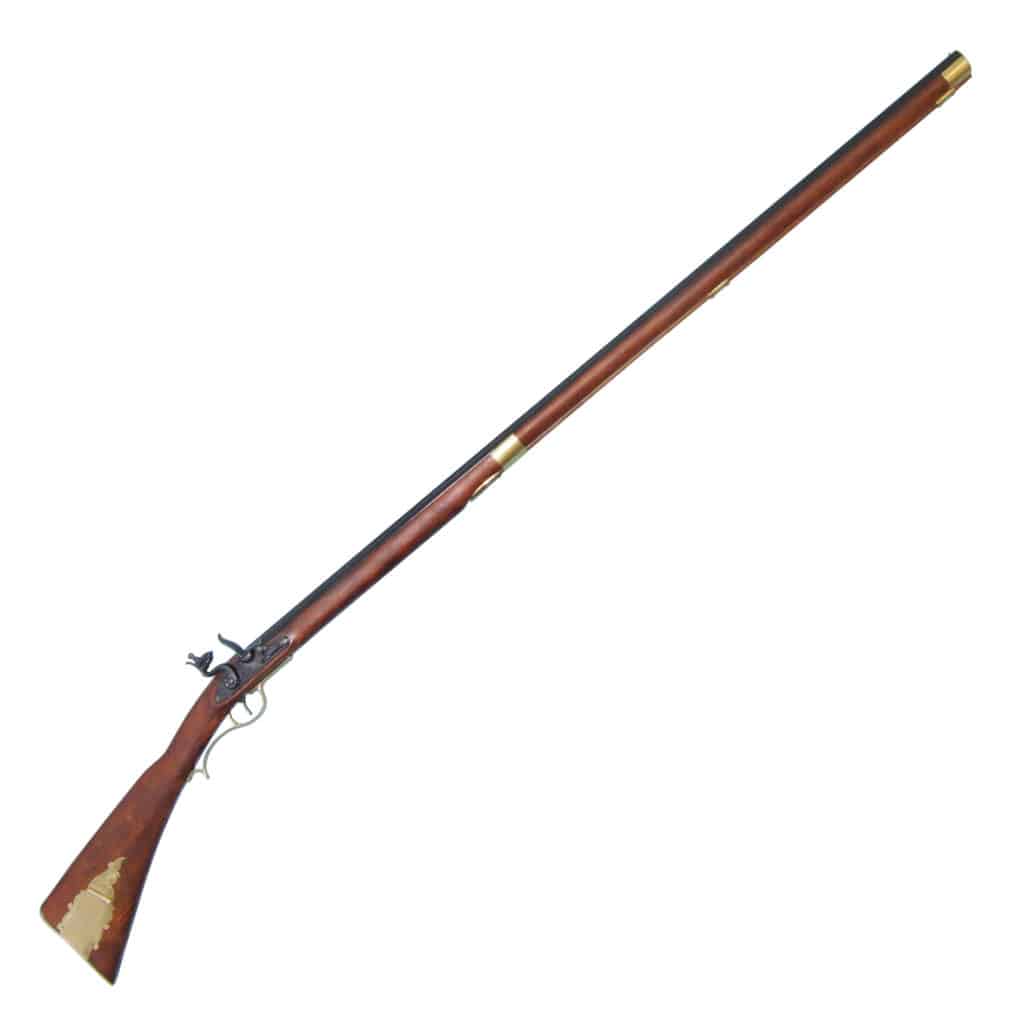
Kentucky Long RifleFor sale
Virginia and North Carolina riflemen on both flanks of the first line picked off British officers and men as they advanced. Continued…
-
Jäger Rifle
A company of Hessian Jäger fought on the British left with the light infantry of the Guards. Continued…
-
Light Dragoon Pistol
Sabers and horse pistols armed the cavalry of William Washington, Henry Lee and Banastre Tarleton. Continued…
-
Spontoon
The half-pike that Continental infantry officers were ordered to carry. Continued…
-
Grasshopper Cannon
Cornwallis's Royal Artillery detachment brought light 3-pounders of this kind into the fight at the third line. Continued…
Sources
Babits, Lawrence E., and Joshua B. Howard. Long, Obstinate, and Bloody: The Battle of Guilford Courthouse. University of North Carolina Press, 2009.
Buchanan, John. The Road to Guilford Courthouse: The American Revolution in the Carolinas. John Wiley & Sons, 1997.
Pancake, John S. This Destructive War: The British Campaign in the Carolinas, 1780-1782. University of Alabama Press, 1985.
Wickwire, Franklin, and Mary Wickwire. Cornwallis: The American Adventure. Houghton Mifflin, 1970.
Suggest an edit · account required · reviewed before publishing · how it works