M3 Grease Gun
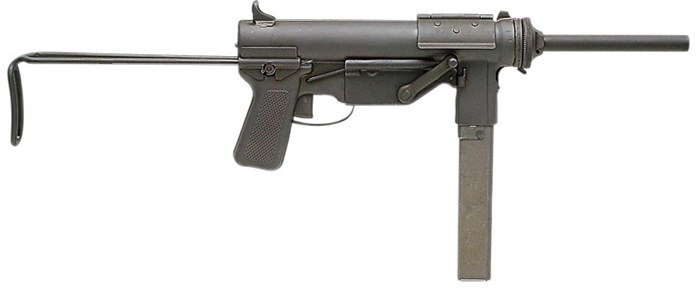
The M3 'Grease Gun' was America's Sten: a .45 caliber submachine gun of stamped steel and welded seams, designed in 1942 to replace the superb but slow-and-costly Thompson with something a car plant could stamp out by the hundred thousand. Ugly, slow-firing, and utterly practical, it armed tankers and GIs from Normandy to Korea and Vietnam — and stayed in U.S. armored vehicles until the 1990s, outliving the Thompson it replaced by half a century.
Also known as M3, M3A1, United States Submachine Gun Cal. .45 M3
Origins
The Thompson Submachine Gun cost the government dearly in machine-hours and dollars, and by 1942 Ordnance wanted what Britain's Sten had proved possible: a submachine gun designed for the stamping press. George Hyde's design, engineered for production by GM's Inland Division and built by its Guide Lamp headlight plant, was standardized as the M3 in December 1942. Soldiers took one look at the tubular receiver and sliding wire stock and named it after the mechanic's grease gun it resembled; the name never left.
Design & Construction
The M3 is blowback simplicity in stamped halves welded together: full-automatic only, firing .45 ACP from an open bolt at a deliberate 400-450 rounds per minute — slow enough to squeeze single shots, controllable enough for its short range mission. The 30-round double-column single-feed magazine was its Sten-inherited weak point; the wire stock doubled as cleaning rod and magazine loader. The 1944 M3A1 fixed the gun's one mechanical grief — the fragile crank-handle cocking mechanism — by deleting it entirely: the shooter cocked the A1 with a finger in a slot in the bolt. Cost told the story: a Thompson ran the government over $40; an M3 under $20 and falling.
Combat Use
The Grease Gun went to the troops the Thompson fit worst: tank and vehicle crews who needed something short beside the hatch, drivers, paratroopers, and headquarters men. It fought through Northwest Europe and the Pacific, then Korea, then in the hands of ARVN and American advisors in Vietnam; a suppressed version served the OSS. Complaints were constant — it looked like plumbing and felt like it — and loyalty grew anyway, because the M3 fed, fired, and survived neglect. Armored crews kept M3A1s in their vehicles through Desert Storm in 1991, a fifty-year service life no other American SMG approached.
Legacy
The M3 closed the American submachine gun story: after it, the assault rifle absorbed the role. As history it is the American entry in the wartime stamped-steel class beside the Sten Gun and MP40 — proof the arsenal of democracy could do cheap-and-adequate as well as anyone. Transferable M3/M3A1s are blue-chip items in the automatic-weapons collecting field, and the name 'Grease Gun' remains the affectionate standard for the whole idea of the honest, homely weapon that simply works — a title it earned across five decades, three wars, and every complaint its own users ever filed about it.
Sources
Iannamico, Frank. The U.S. M3-M3A1 Submachine Gun. Moose Lake Publishing, 1999.
Hyde, George — Ordnance Department design records, 1942.
Dunlap, Roy. Ordnance Went Up Front. Samworth, 1948.
Suggest an edit · account required · reviewed before publishing · how it works