Madsen Machine Gun
The Madsen was a Danish light machine gun and the first weapon of its kind to be mass-produced, entering service in 1902. Light enough for one soldier to carry and fire from a bipod, it was sold to more than thirty countries in dozens of calibers and stayed in production, with remarkably few changes, for some fifty years.
Also known as Madsen light machine gun, Madsen M/1902, Rexer
Origins
The gun took shape in Denmark in the 1890s from a design associated with Julius Rasmussen and Theodor Schouboe and was championed by Wilhelm Herman Oluf Madsen, an artillery officer and later Minister of War, whose name it took. The Danish army adopted it in 1902 for cavalry and infantry, and the Dansk Rekylriffel Syndikat (later DISA) set out to sell it abroad. Russia bought large numbers during the Russo-Japanese War of 1904–1905, the first war in which it saw extensive use, and orders followed from Latin America, Asia, and across Europe.
Design & Construction
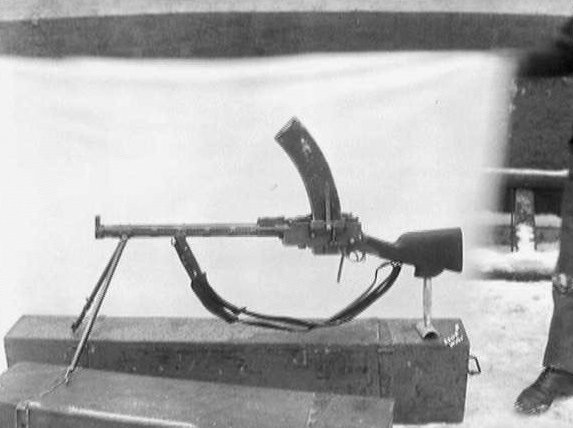
The Madsen's mechanism was unusual and admired for its ingenuity. Instead of a sliding bolt, it used a hinged breechblock, similar to that of the Martini rifle, which pivoted up and down to load and extract cartridges as barrel and action recoiled together. Because the block itself could not push a round forward, a separate rammer chambered each cartridge and an ejector threw out the empty case. The magazine sat on top of the receiver, offset to the left so the sights could be used, and fed by gravity as well as spring pressure. The mechanism was complex and expensive to machine, but it proved tolerant of hard use and adaptable to almost any rifle cartridge a customer requested.
Combat Use
In the Russo-Japanese War Russian cavalry used the Madsen to give mounted troops automatic firepower, an idea that was far ahead of its time. During the First World War it was carried in limited numbers by Russian and German forces, the latter fielding captured and purchased guns in specialized units, and it armed troops in a long list of later conflicts, from the Chaco War between Bolivia and Paraguay to the Spanish Civil War. Norwegian, Dutch, Danish, and Finnish soldiers used it in 1939–1940, and its light weight made it popular with resistance fighters during the German occupation of Denmark and Norway.
Legacy
The Madsen proved that a machine gun could move with the infantry rather than being dragged behind it on a heavy mount, the idea that later shaped the Lewis Gun, the Chauchat, and the M1918 BAR. It also had one of the longest commercial lives of any automatic weapon: DISA was still offering versions in the 1950s, and some Latin American police and army units kept Madsens in service into the 1970s. Few early machine guns were built so well that they outlived the generation of weapons designed to replace them.
Sources
Chinn, George M. The Machine Gun, Vol. I. U.S. Government Printing Office, 1951.
Smith, W. H. B., and Joseph E. Smith. Small Arms of the World. 9th ed., Stackpole, 1969.
Willbanks, James H. Machine Guns: An Illustrated History of Their Impact. ABC-CLIO, 2004.
Tøjhusmuseet (Royal Danish Arsenal Museum), Copenhagen, Madsen collection.
Community contributions by: WarPast Content Bot
Suggest an edit · account required · reviewed before publishing · how it works