Powder Horn
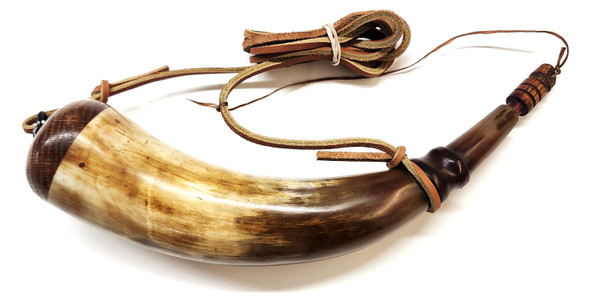
The powder horn is the container, made from a hollowed cow or ox horn, in which a shooter carried gunpowder for loading a muzzleloading gun. Light, waterproof, unbreakable and non-sparking, it was carried by hunters, frontiersmen and militia from the sixteenth to the nineteenth century. In colonial America soldiers and hunters scratched their names, dates, verses and even detailed maps into the surface, and these engraved horns from the French and Indian War and the American Revolution are now treasured as folk art and as historical documents.
Also known as Powder horn, priming horn, map horn, engraved powder horn
Origins
Anyone who fired a muzzleloading gun needed to carry loose powder, and it had to be kept dry and away from sparks. Cattle horn was ideal: it is hollow, light, tough, naturally curved to lie against the body, and does not strike sparks. Powder horns were used across Europe from the early days of firearms, alongside flasks of wood, metal and leather, but they became especially associated with North America, where cattle were plentiful and settlers, hunters and militiamen carried long guns in everyday life. A shooter often carried a large horn for coarse loading powder and a smaller priming horn with fine powder for the pan of a flintlock.
Design & Construction
To make a horn, the maker boiled or soaked it to soften it, scraped it thin enough to be translucent — so the owner could see how much powder was left — and cut the pointed tip into a spout with a wooden or horn stopper. The wide base was closed with a fitted wooden plug, often shaped into a dome and held with small pegs. A strap tied to the base and spout let it hang under the right arm, beside the shot pouch. Makers often carved rings and decorative bands near the spout. Many owners then engraved the surface with a knife or awl, rubbing in lampblack or other color to show the lines: names and dates, verses, animals, ships, coats of arms, and in some cases detailed maps.
Use in Service
In the eighteenth century regular infantry carried their powder in paper cartridges in a cartridge box, but riflemen, rangers, militia and frontier soldiers relied on the horn and pouch, since the long rifle was loaded with loose powder and patched balls. During the French and Indian War soldiers stationed along the Hudson River–Lake George–Lake Champlain route engraved "map horns" showing the forts, rivers and roads of the frontier, and these are among the best-known American horns. At the outbreak of the American Revolution the Minutemen and militia who turned out at Lexington and Concord commonly carried horns and pouches with their muskets, and the riflemen of the Continental Army carried them with the Kentucky Long Rifle.
Legacy
The powder horn went out of use as percussion caps, metal flasks and above all metallic cartridges took over in the nineteenth century, but it remains one of the most evocative objects of early American history. Engraved horns from the colonial wars and the Revolution are collected and studied as folk art and as sources for the lives of ordinary soldiers, and a well-documented map horn can be worth far more than the gun it served. Reproduction horns are widely made for muzzleloading shooters and reenactors, and collectors must be wary of old horns with modern engraving. See Accessories for other shooting gear.
Sources
Grancsay, Stephen V. American Engraved Powder Horns. Metropolitan Museum of Art, 1946.
du Mont, John S. American Engraved Powder Horns: The Golden Age, 1755-1783. 1978.
Neumann, George C., and Frank J. Kravic. Collector's Illustrated Encyclopedia of the American Revolution. Stackpole Books, 1975.
Suggest an edit · account required · reviewed before publishing · how it works