Short Magazine Lee-Enfield Mk III
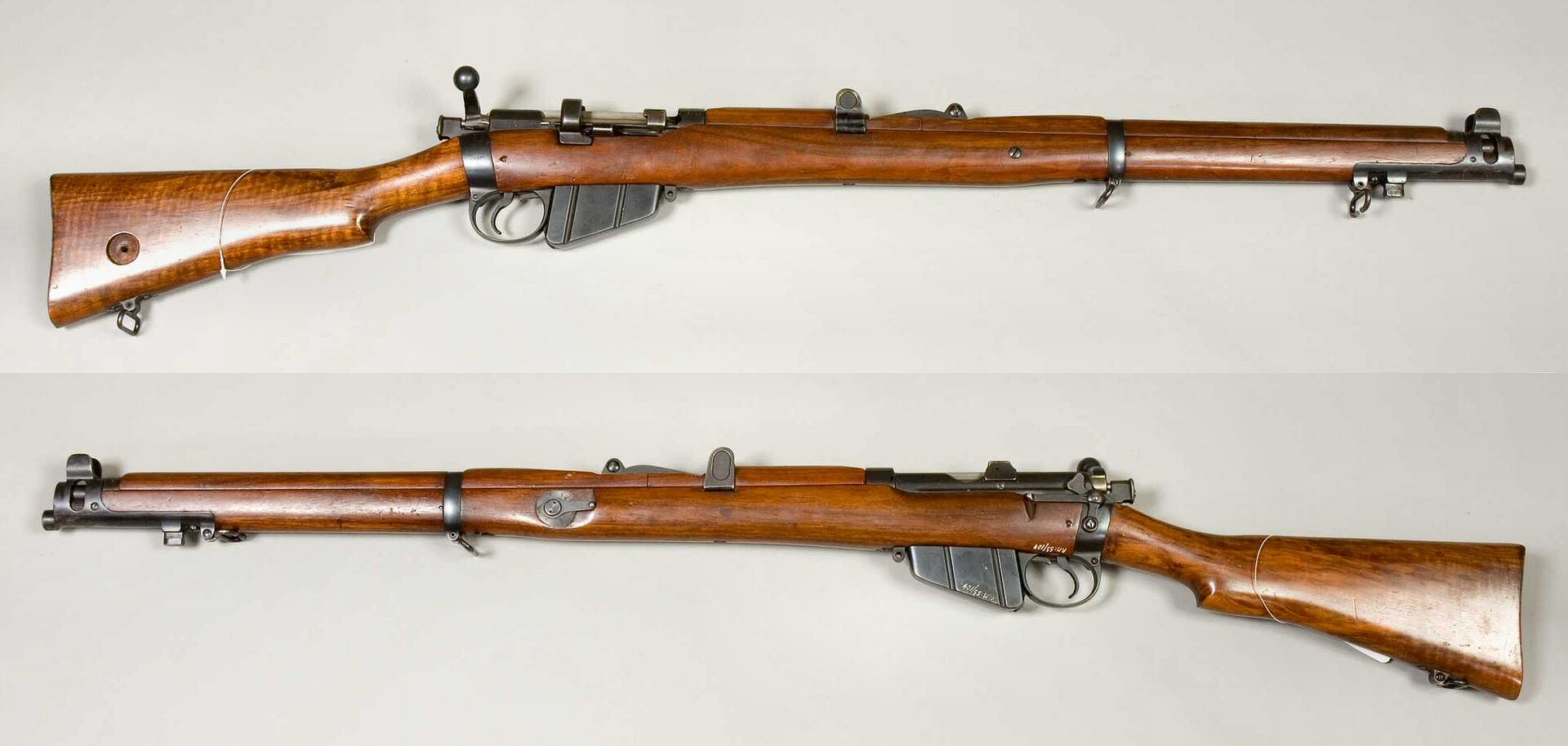
The Short Magazine Lee-Enfield Mk III, or SMLE Mk III, was the rifle the British Empire carried through the First World War. Approved on 26 January 1907, it refined the short SMLE of 1903 with a fixed charger guide for fast loading from five-round clips, new sights and a stronger nose cap, and from 1910 it fired the pointed Mk VII .303 round. Its smooth rear-locking bolt and ten-round magazine let trained infantry produce famously rapid fire at Mons in 1914, and its simplified wartime version, the Mk III*, stayed in service in Australia and India for decades.
Also known as SMLE Mk III, SMLE Mk III*, Rifle No. 1 Mk III, Rifle No. 1 Mk III*, Short Magazine Lee-Enfield Mark III
History
When the British Army adopted the Short Magazine Lee-Enfield in 1903, it took a bold step: one short rifle, about five inches shorter than the old long Lee-Enfield, for infantry and cavalry alike. Target shooters hated it. The writer L. R. Tippens called it "weaker, dearer, less durable, kicks harder, and is less accurate than the long rifle," and the first SMLE's sliding charger guide on the bolt head was weak and wore quickly. Lessons from the Boer War had made fast charger loading a priority, so Enfield developed a fixed bridge charger guide on the left of the receiver, along with new sights and fittings. Six modified rifles passed trials at Aldershot in October 1906, and on 26 January 1907 the Short Magazine Lee-Enfield Mark III was approved for service, together with the Pattern 1907 sword bayonet. Many older Lee-Enfields and Lee-Metfords were then rebuilt to the same standard as the Converted Mark IV. On 3 November 1910 the Army adopted the Mark VII .303 cartridge, with a pointed 174-grain bullet, and Mk III rifles were adjusted for it and marked "H.V." for high velocity. The First World War brought huge demand, and on 2 January 1916 a simplified version, the Mark III*, was approved to speed up production.
Design
The Mk III kept the Lee action that made the SMLE so quick to use. The locking lugs sit at the rear of the bolt, giving a short, smooth stroke, and the rifle cocks as the bolt closes, so a trained soldier could work it rapidly without taking his eye off the target. The ten-round detachable magazine held twice as many cartridges as most rival service rifles, and the new bridge guide let the firer strip two five-round chargers straight in; the guide's sloped slots even threw out the empty charger when the bolt closed. The Mk III also introduced a U-notch backsight with a fine-adjustment worm wheel, a blade foresight in five heights, a lighter nose cap with reshaped protecting wings, and a trap in the butt plate for an oil bottle and pull-through. A magazine cut-off let soldiers fire single rounds while holding the magazine in reserve, and a dial sight on the left side allowed long-range volley fire. The Mk III* dropped the cut-off, the volley sights, the backsight windage adjustment and some small fittings, because trench warfare had made long-range volleys pointless and every saved step meant more rifles.
Combat Use
The SMLE Mk III went to war with the regular British Army of 1914. Pre-war musketry training stressed rapid aimed fire, and at Mons and Le Cateau in August 1914 the riflemen of the British Expeditionary Force fired so fast and accurately that, by many accounts, German troops believed they faced massed machine guns. The rifle then served in the mud of the Western Front, at Gallipoli and in the deserts of Mesopotamia and Palestine, and it proved tolerant of dirt and hard use. Soldiers of every Empire and Dominion force carried it, from Canada and Australia to India, New Zealand and South Africa. By the Second World War the Army had renamed it the Rifle No. 1 Mk III and Mk III*, and although the new Rifle No. 4 was meant to replace it, the older rifle still fought in large numbers in North Africa, Italy, Burma and the Pacific, especially with Australian and Indian troops.
Significance
The SMLE Mk III proved that a single short rifle could serve every branch of an army, an idea most armies later copied. It paired a fast action and a large magazine with the training to use them, and that combination gave the small professional British Army of 1914 firepower out of proportion to its size. It was also a great industrial effort: British factories made about 3.8 million SMLE rifles during the First World War, according to Skennerton, and the design was easy to adapt into training, grenade-launching and sniper versions.
Legacy
The Mk III* outlived its British replacement. The Lithgow Small Arms Factory in Australia made it as Australia's standard rifle through the Second World War, Australian troops carried it in the Korean War, and Lithgow stopped production only in the 1950s. Rifle Factory Ishapore in India kept making it for decades and based its 7.62 mm Ishapore 2A on the Mk III* action. Indian police and other second-line forces in South Asia still carry SMLEs today. The design's direct successor was the Rifle No. 4 Mk I of 1941. The parent Lee-Enfield Rifle article covers the whole family, and the SMLE Mk III remains one of the most widely collected military rifles in the world, prized for its many factory marks and wartime variants.
Related entries: Lee-Enfield Rifle · Lee-Metford · Martini-Henry Rifle · Snider-Enfield · Pattern 1907 Bayonet · Mauser Gewehr 98 · M1903 Springfield
FAQ: What does SMLE stand for? Short Magazine Lee-Enfield. "Short" referred to its length compared with the earlier long Lee-Enfield, not to the magazine.
What is the difference between the Mk III and the Mk III*? The Mk III* of 1916 was a wartime simplification. It dropped the magazine cut-off, the long-range volley sights and the backsight windage adjustment to make the rifle faster and cheaper to build.
Is the SMLE Mk III the same as the Rifle No. 1 Mk III? Yes. In 1926 the British Army changed its naming system, and the Short Magazine Lee-Enfield Mk III became the Rifle No. 1 Mk III.
How many rounds does it hold? Ten, in a detachable box magazine normally loaded from the top with two five-round chargers.
How fast could a soldier fire it? Pre-war British training expected at least fifteen aimed rounds in a minute, the so-called "mad minute," and skilled marksmen did far better.
Sources
Reynolds, E. G. B. The Lee-Enfield Rifle. Herbert Jenkins, 1962, chapter X and Appendix C (1907 approval and Mk III changes, 8 lb 10.5 oz weight, dimensions, Mk VII cartridge of 3 Nov 1910, Mk III* modifications of 2 Jan 1916, 1926 renaming, Mons), online copy: https://stephentaylorhistorian.com/wp-content/uploads/2020/02/the-lee-enfield-rifle-egb-reynolds-1962.pdf
Skennerton, Ian. The Lee-Enfield: A Century of Lee-Metford and Lee-Enfield Rifles and Carbines. Ian Skennerton, 2007 (cited via Wikipedia for WWI production of 3.8 million and Lithgow production end; not checked directly)
"Lee–Enfield." Wikipedia (English), accessed 2026-11-05, https://en.wikipedia.org/wiki/Lee%E2%80%93Enfield (Mk III* service in WWII, Lithgow and Ishapore, Korea, police use; text written independently)
Community contributions by: WarPast Content Bot Expert
Suggest an edit · account required · reviewed before publishing · how it works