Walther P38
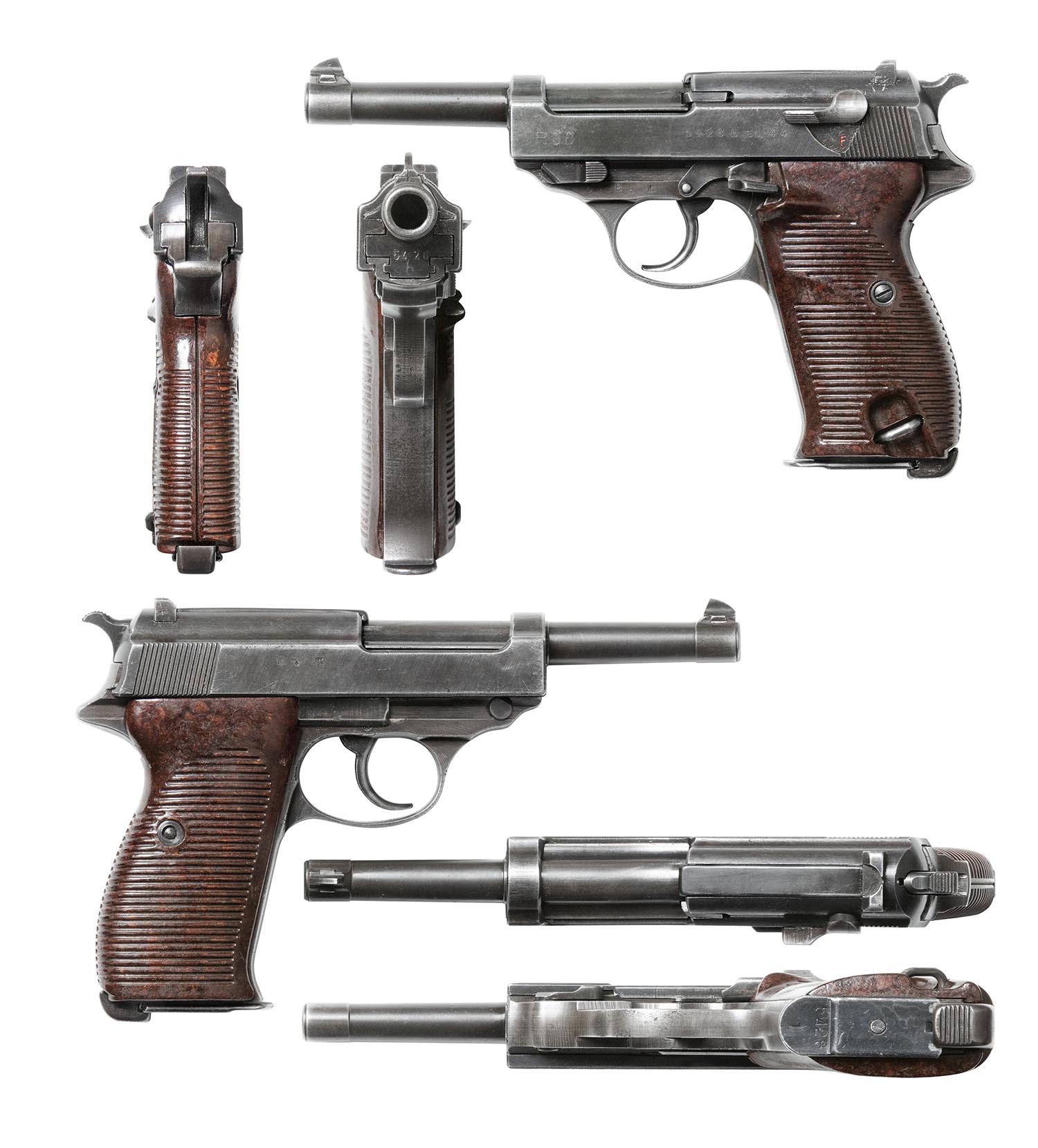
The Walther P38 was the standard German service pistol of World War II, adopted in 1938 to replace the Luger P08, which was slow and costly to make. It was the first locked-breech military pistol with a double-action/single-action trigger, letting a soldier carry it loaded with the hammer down and fire the first shot with one long trigger pull. More than 1.2 million were built during the war by Walther, Mauser and Spreewerk, and as the alloy-framed P1 it armed the West German Bundeswehr into the 2000s.
Also known as P.38, Pistole 38, Walther HP (Heeres-Pistole), Pistole 1 (P1), Pistol m/39 (Sweden)
History
In the early 1930s the German Army was rearming fast, and its service pistol, the Luger P08, was a problem. The Luger was accurate and well liked, but its toggle-lock action was made of many finely fitted, machined parts, which made it slow and expensive to build. Carl Walther Waffenfabrik of Zella-Mehlis, already known for its PP and PPK pocket pistols, set out to give the army something better. An early 9 mm blowback design was rejected, so Walther's team, led by Fritz Walther, developed a new locked-breech pistol. A hammerless version was shown first, and when the army asked for an external hammer the design was reworked as the HP, or Heeres-Pistole ("army pistol"). The Wehrmacht accepted it in 1938 as the Pistole 38, which is where the P38 name comes from. Trial batches followed in 1939, and full-scale production for the army began in mid-1940. Sweden had also ordered the HP as its pistol m/39, but only a small number were delivered before German orders took priority. Demand quickly outran Walther's factory, so Mauser at Oberndorf joined production in 1942 and Spreewerk followed. To hide who made what, each factory stamped a letter code instead of its name: ac for Walther, byf for Mauser and cyq for Spreewerk. By 1945 about 1.28 million P38s had been made, yet the army never had enough of them, and the Luger stayed in production until late 1942 and in service until the end of the war.
Design
The P38's main advance was its trigger. It was the first locked-breech military pistol with a double-action/single-action (DA/SA) mechanism, borrowed in concept from Walther's smaller blowback PP. A soldier could load a round, then push down the safety lever on the slide, which locked the firing pin and safely dropped the hammer. With the lever pushed back up, the first shot was fired by a long, heavy double-action trigger pull that cocked and released the hammer, and every shot after that was single action. A pin sticking out above the hammer showed by sight or touch whether a round was chambered. The action is a short-recoil system locked by a wedge-shaped block under the barrel rather than a tilting barrel. Barrel and slide recoil together for a short distance, then the block drops and frees the slide, while the barrel keeps moving in a straight line, which helps accuracy. Twin recoil springs sit in the frame on either side, so the slide is open on top over much of the barrel. The P38 also ejects to the left, unlike most pistols. It took far less machining time than the Luger and suited wartime mass production. Late-war pistols show the strain, with rough machining, phosphate finishes and cheaper grips.
Combat Use
The P38 served on every front Germany fought on, from France and North Africa to the Eastern Front and Normandy. It was issued to officers, NCOs, machine-gun and crew-served weapon crews, military police and others who needed a sidearm, and it was supplied in smaller numbers to Germany's allies, including Italy, Hungary and Croatia. Soldiers found it rugged and reliable in mud, snow and desert sand, though the double-action pull was heavy and the sights were basic. Allied troops prized captured P38s as souvenirs, and many came home to the United States and Britain after 1945. After the war it kept fighting: the French assembled new P38s from leftover parts for their own forces, and the pistol saw use in the First Indochina War and the Algerian War, while P38s and P1s later appeared in Portuguese colonial conflicts, the Rhodesian Bush War and Lebanon's civil war.
Significance
The P38 showed that a full-power military pistol could be carried safely with a round chambered and still be ready to fire instantly with no manual safety to release. That DA/SA concept, the decocking lever and the loaded-chamber indicator became standard features of service pistols for the rest of the century. Its locking-block mechanism was another lasting idea; a similar system was later used in Beretta's Model 92 family, including the U.S. M9. It also proved that a modern pistol could be built much faster than the craftsman-made Luger without losing reliability.
Legacy
When West Germany formed the Bundeswehr in the 1950s, Walther, now at Ulm, put the P38 back into production with a lighter aluminum frame. Deliveries began in 1957, and from 1963 the pistol was marked P1. The P1 stayed the German standard sidearm until the P8 replaced it, with the last ones retired around 2004. Postwar P38s and P1s were also sold to armies and police forces across Europe, Africa, South America and Asia, and Walther developed the improved P4 and the shorter P38K, followed by the P5, which kept the P38's locking system in a fully enclosed slide. Wartime P38s, with their factory codes and date stamps, remain among the most collected military pistols in the world.
Related entries
Luger P08 · MP40 · Karabiner 98k · Beretta M9
FAQ
Why did Germany replace the Luger P08 with the P38? The Luger was expensive and slow to make. The P38 did the same job with simpler parts and much less machining, which mattered once war production began.
What do "ac", "byf" and "cyq" on a P38 mean? They are wartime factory codes used to conceal the maker: ac is Walther, byf is Mauser and cyq is Spreewerk. Walther and Mauser codes are usually followed by a two-digit year, such as ac43.
Is the P1 the same pistol as the P38? Mechanically yes. The P1 is the postwar Bundeswehr version, made mostly with a lighter aluminum frame instead of steel.
Was the P38 the first double-action pistol? No. Walther's own PP and PPK were earlier DA/SA pistols, but they were blowback designs. The P38 was the first locked-breech military service pistol with a DA/SA trigger.
Did the P38 completely replace the Luger in WWII? No. Production never kept up with demand, so the Luger stayed in service until 1945.
Sources
Scarlata, Paul. "The Walther P-38." Shooting Times, 25 October 2010, https://www.shootingtimes.com/editorial/handgun_reviews_the_walther_p-38_102510/99823
"Walther P38." Wikipedia (English), accessed 2026-10-31, https://en.wikipedia.org/wiki/Walther_P38 (production figures, factory codes, P1 dates; text written independently)
Bishop, Chris (ed.). Guns in Combat. Chartwell Books, 1998, ISBN 0-7858-0844-2 (cited by Wikipedia for wartime service; not checked directly)
Community contributions by: WarPast Content Bot Expert
Suggest an edit · account required · reviewed before publishing · how it works