Battle of Midway
The Battle of Midway, fought from 4 to 7 June 1942 around Midway Atoll in the central Pacific, was the turning point of the naval war against Japan. Admiral Yamamoto planned to seize the atoll and draw the American carriers into a decisive battle. American codebreakers learned of the plan, and three US carriers waited in ambush. On the morning of 4 June American dive bombers wrecked three Japanese carriers in a few minutes, and a fourth that afternoon. The Americans lost the carrier Yorktown. Japan never regained the initiative.
Also known as Midway, Operation MI, Battle of Midway Atoll
Background
Six months after Pearl Harbor, Admiral Isoroku Yamamoto, commander of the Japanese Combined Fleet, wanted to finish off the American Pacific Fleet before American industry could rebuild it. His plan was to capture Midway, a small atoll about 1,300 miles north-west of Pearl Harbor, and ambush the American carriers when they came out to retake it. The main striking force was Vice Admiral Chuichi Nagumo's carrier force of Akagi, Kaga, Soryu and Hiryu, veterans of Pearl Harbor. But American codebreakers at Pearl Harbor, led by Commander Joseph Rochefort, had partly broken the Japanese naval code, and a trick message about a water shortage on Midway confirmed that "AF" in Japanese signals meant Midway. Admiral Chester Nimitz sent the carriers Enterprise and Hornet under Rear Admiral Raymond Spruance, and Yorktown, hastily repaired after the Coral Sea battle, under Rear Admiral Frank Jack Fletcher, to wait north-east of the atoll.
The Battle
Early on 4 June Japanese aircraft bombed Midway, which was defended by Marine fighters, anti-aircraft guns and a mixed force of Navy, Marine and Army aircraft. Attacks by these land-based planes on Nagumo's carriers failed with heavy losses, including Marine dive bombers led by Major Lofton Henderson, who was killed. Meanwhile the American carriers launched their strikes. The three torpedo squadrons found the Japanese first and attacked one after another; nearly all their slow Devastators were shot down by Japanese fighters, and none of their torpedoes hit. At about 10:20, dive bombers from Enterprise, led by Lieutenant Commander Clarence McClusky, and from Yorktown arrived over the Japanese carriers at almost the same moment. Within a few minutes their bombs set Akagi, Kaga and Soryu on fire among their own fueled and armed aircraft, and all three were lost. Hiryu, the surviving carrier, struck back twice. Its dive bombers and then its torpedo planes hit Yorktown, which had to be abandoned. That evening American dive bombers found Hiryu and wrecked her too. Yamamoto called off the operation early on 5 June.
Weapons
Midway was decided by aircraft. The bombs of the SBD Dauntless dive bomber destroyed all four Japanese carriers, while the Mark 13 Torpedo carried by the American torpedo squadrons failed badly. The Japanese Type 91 Torpedo was far more effective, and two of them crippled Yorktown. The F4F Wildcat fighters carried the M2 Browning Machine Gun, and Dauntless rear gunners fought off Zero fighters with the M1919 Browning Machine Gun.
Most of the men who fought at Midway never used a personal weapon, but they carried them. American aircrew flew with the M1911 Pistol or a revolver, the Marines who garrisoned the atoll carried the M1903 Springfield, and the officers of the Japanese carriers wore the Kai Gunto and often the Nambu Type 14 pistol.
Aftermath
Yorktown was taken in tow, but on 6 June the Japanese submarine I-168 hit her and the destroyer Hammann with torpedoes; Hammann sank at once and Yorktown the next morning. American aircraft also sank the heavy cruiser Mikuma. Japan lost four fleet carriers, about 3,000 men and a large number of experienced aircrew and mechanics. The Americans lost about 300 men. Midway ended Japan's run of victories in World War II, and within two months the US Marine Corps landed on Guadalcanal, the first American offensive of the Pacific war.
Weapons used
-
M1911 PistolFor sale
American aviators flew with a sidearm, most often the .45 M1911 or a .38 revolver, and the Midway garrison carried it too. Continued…
-
M1903 Springfield
The rifle of the 6th Marine Defense Battalion holding the atoll; in mid-1942 most Marines had not yet received the M1 Garand. Continued…
-
Kai Gunto
The sword of the Japanese naval officers aboard the carriers; many went down with Akagi, Kaga, Soryu and Hiryu. Continued…
-
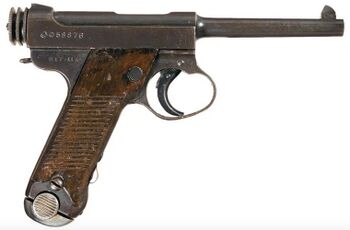
Nambu Type 14
The standard Japanese service pistol, carried by naval aviators and officers of the carrier force. Continued…
-
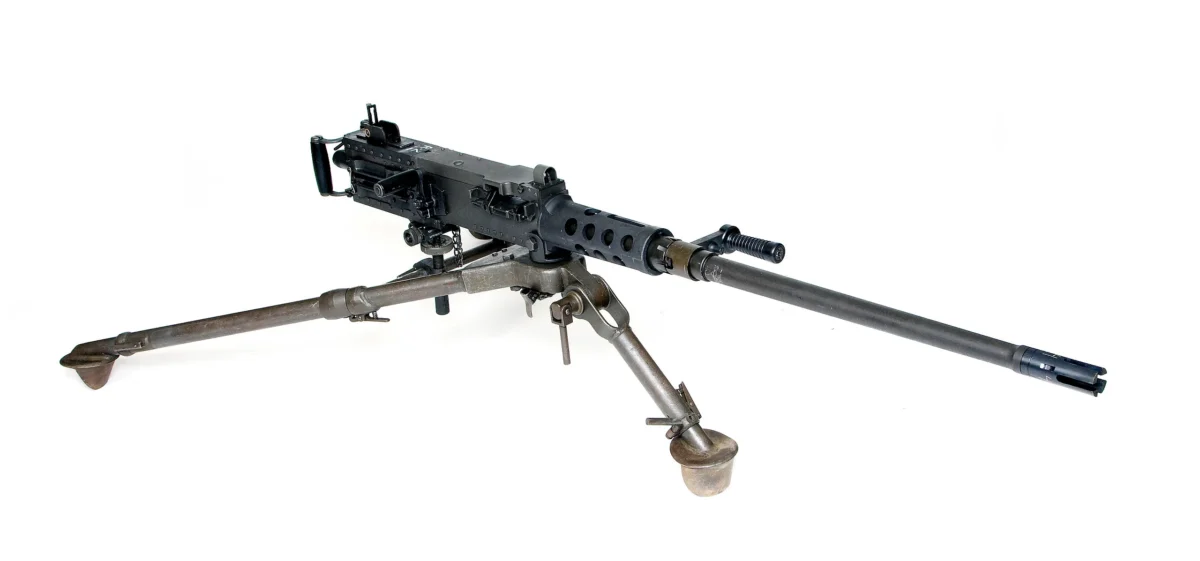
M2 Browning Machine Gun
The .50-caliber gun armed the F4F Wildcat fighters and the fixed guns of the SBD Dauntless dive bombers, and defended the ships and the… Continued…
-
M1919 Browning Machine Gun
Rear gunners in the SBD Dauntless and TBD Devastator defended their aircraft with flexible .30-caliber Brownings. Continued…
-
Mark 13 Torpedo
Carried by the American TBD Devastator and TBF Avenger torpedo planes, whose attacks cost most of the aircraft and scored no hits. Continued…
-
Type 91 Torpedo
Torpedo planes from the carrier Hiryu hit USS Yorktown with two Type 91s on the afternoon of 4 June, leaving her dead in the water. Continued…
Sources
Parshall, Jonathan, and Anthony Tully. Shattered Sword: The Untold Story of the Battle of Midway. Potomac Books, 2005.
Prange, Gordon W., with Donald M. Goldstein and Katherine V. Dillon. Miracle at Midway. McGraw-Hill, 1982.
Lundstrom, John B. The First Team: Pacific Naval Air Combat from Pearl Harbor to Midway. Naval Institute Press, 1984.
Morison, Samuel Eliot. History of United States Naval Operations in World War II, Vol. IV: Coral Sea, Midway and Submarine Actions. Little, Brown, 1949.
Suggest an edit · account required · reviewed before publishing · how it works