M2 Browning Machine Gun
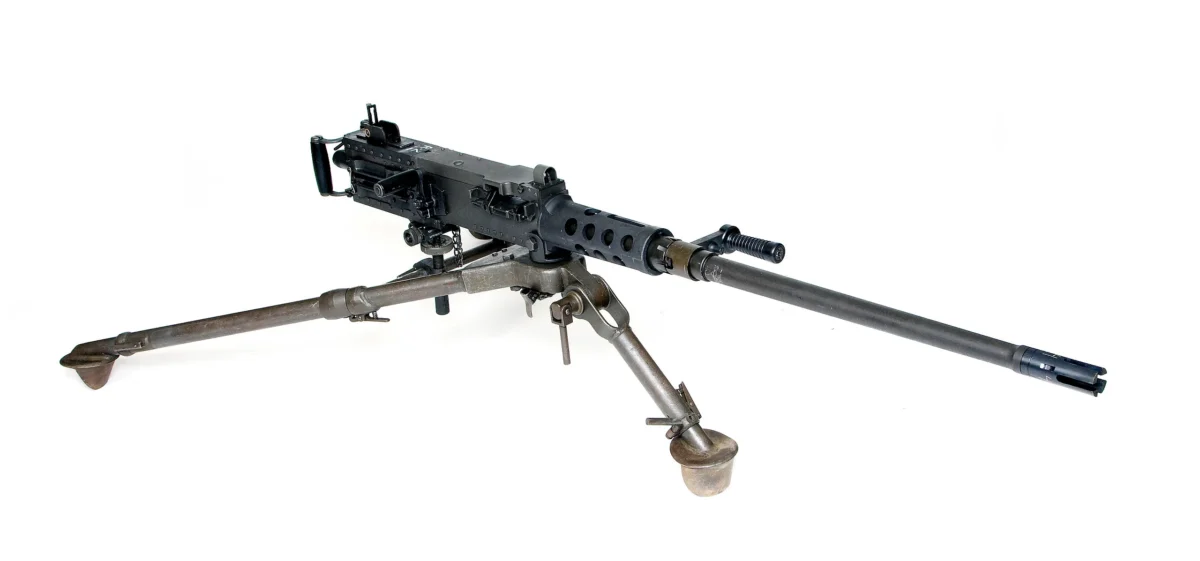
The M2 is the American heavy machine gun of .50 caliber, designed by John Browning at the end of the First World War and adopted in its universal form in 1933. It fires a large cartridge that can wreck aircraft, trucks and light armor at long range. In the Second World War it armed American fighters and bombers, warships, tanks, half-tracks and jeeps, and ground troops fired it from tripods. The heavy-barrel M2HB, nicknamed 'Ma Deuce', has served in every American war since, and it remains in service in dozens of countries.
Also known as M2, M2HB, Ma Deuce, Browning .50, .50 cal, Fifty, AN/M2, M2A1, Browning M2
Origins
In 1918 General John Pershing asked for a machine gun of about half-inch caliber that could shoot down aircraft and stop the new armored vehicles appearing on the Western Front. John Browning scaled up the recoil-operated action of his water-cooled M1917 machine gun, and Winchester developed a new cartridge by enlarging the .30-06 rifle round. The first guns were tested just as the war ended, and a water-cooled version was adopted as the M1921. Browning died in 1926. Engineers at Colt, led by S. G. Green, then redesigned the gun around a single receiver that could be built as a water-cooled anti-aircraft gun, an air-cooled aircraft gun or an air-cooled ground gun just by changing parts. This universal design was adopted in 1933 as the M2.
Design & Construction
The M2 works by short recoil. When a round fires, the barrel and bolt recoil together for a short distance, then the barrel stops and the bolt continues back, extracting the empty case and pulling the next cartridge from the belt. The feed can be switched from one side to the other, which allowed guns to be mounted in pairs in aircraft wings or turrets. The first air-cooled ground guns overheated quickly, so a thicker heavy barrel was introduced, and the M2HB became the standard ground and vehicle version. It fires at roughly 450 to 600 rounds a minute. The aircraft version, the AN/M2, was lighter and fired faster. The gun and barrel alone weigh about 84 pounds, and with its tripod the M2HB is a load for a crew of two or three.
Combat Use
The M2 was one of the most important American weapons of World War II. Six wing guns armed the F4F Wildcat fighters that defended the carriers at the Battle of Midway, and later the P-47, P-51 and F6F Hellcat. The B-17 and B-24 bombers carried a dozen or more in their turrets and waist positions. On warships the M2 was an early anti-aircraft gun, though the 20mm Oerlikon and 40mm Bofors took over most of that role as the war went on. On land it rode on Sherman tanks at the Normandy Landings and after, half-tracks, trucks and jeeps, and infantry used it against aircraft, vehicles and bunkers, alongside the lighter M1919 Browning Machine Gun. The US Marine Corps used it across the Pacific, including on the beaches of the Battle of Iwo Jima. American factories made roughly two million of the guns during the war.
Legacy
The M2HB went on to Korea, Vietnam, the Gulf War, Iraq and Afghanistan. In Vietnam the Marine sniper Carlos Hathcock fitted a telescopic sight to one and made kills at well over 2,000 yards, and the M2's cartridge later became the basis of long-range rifles such as the Barrett M82. The newer M2A1 adds a quick-change barrel with fixed headspace, removing the gun's old need for careful adjustment when a barrel is changed. More than ninety years after its adoption, the M2 is still in production and in front-line service, a record few weapons can match.
Sources
Chinn, George M. The Machine Gun, Volume I. US Navy Bureau of Ordnance, 1951.
Ellis, John. The Social History of the Machine Gun. Pantheon Books, 1975.
Hogg, Ian V., and John Weeks. Military Small Arms of the 20th Century. Arms and Armour Press, 1973 and later editions.
War Department. TM 9-225, Browning Machine Gun, Caliber .50, HB, M2. 1940s editions.
Suggest an edit · account required · reviewed before publishing · how it works