Nambu Type 14
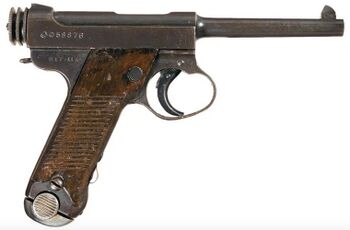
The Nambu Type 14 was the standard service pistol of Japan in the Second World War. Designed by Kijirō Nambu's team and adopted in 1925 (the fourteenth year of the Taishō era, which gave it its name), it fired the light 8mm Nambu cartridge from an eight-round magazine. It was used by the army and the navy, by officers, aircrew, tank crews and machine gunners. It looks rather like a German Luger but works differently, and American servicemen brought home large numbers.
Also known as Type 14 pistol, Taisho 14 Nambu, Nambu pistol, 14 Nen Shiki Kenju
Origins
Kijirō Nambu, Japan's leading small-arms designer, produced his first automatic pistol, the Type A, early in the twentieth century. It was expensive to make and was never formally adopted by the army, although officers bought it privately. In the early 1920s the Nambu design was simplified for mass production, and the army adopted the result in 1925 as the Type 14. It was made at government arsenals, and later at Nagoya and Kokura, until 1945; estimates of total production run to around 200,000 or more.
Design & Construction
The Type 14 is a short-recoil pistol. When it fires, the barrel and bolt move back together until a locking block under the bolt drops and frees it. It is striker-fired, with twin recoil springs on either side of the bolt, a manual safety lever on the left of the frame and a magazine safety that stops it firing with the magazine out. The eight-round magazine goes in the grip, and the long, sloping grip and slim barrel give it a look similar to the German Luger P08, though the mechanism is quite different. Its 8x22mm Nambu cartridge is weak, about as powerful as a .380 ACP. From about 1939 many pistols were made with an enlarged trigger guard so that the trigger could be worked with winter gloves, a feature that came from service in Manchuria. Wartime pistols were made more roughly than those of the 1930s.
Combat Use
The Type 14 was issued to officers, who also bought other pistols privately, and to non-commissioned officers, military police, tank crews, machine gunners and aircrew, and it was used by the navy as well as the army. It was carried in China and throughout the Pacific war, by Japanese naval aviators at the Battle of Midway and by the defenders of islands from Guadalcanal to the Battle of Iwo Jima. As a combat pistol it was only average: accurate and pleasant to shoot, but weak, with a striker spring that could fail and wartime quality that grew worse.
Legacy
Captured Type 14s were among the most common souvenirs brought home by American servicemen from the Pacific, and many are still in the United States. Their holsters, spare magazines and the arsenal markings that date each pistol make them a popular collector's field. After the war the pistol was used for a time in China and elsewhere in Asia. It remains the best-known Japanese handgun, often mistaken for a Luger, and a good example of the Japanese arms industry's efforts between the wars alongside the Type 99 Rifle and the Type 96 Light Machine Gun.
Sources
Derby, Harry L., III. The Hand Cannons of Imperial Japan. Derby Publishing, 1981.
Honeycutt, Fred L., Jr. Military Pistols of Japan. Julin Books, 1982.
Smith, W. H. B. Small Arms of the World. Stackpole, 1943 and later editions.
Suggest an edit · account required · reviewed before publishing · how it works