Battle of the Somme
The Battle of the Somme was a joint British and French offensive against the German lines in northern France, fought from 1 July to 18 November 1916. It was meant to break through the German defenses and to take pressure off the French at Verdun. On the first day the British Army suffered about 57,000 casualties, including more than 19,000 dead, the worst day in its history. The fighting went on for four and a half months and saw the first use of tanks. The Allies advanced only about six miles, and more than a million men were killed or wounded.
Also known as The Somme, Somme offensive, First Battle of the Somme, Bataille de la Somme, Schlacht an der Somme, First day on the Somme
Background
At a conference at Chantilly in December 1915 the Allies agreed to launch great offensives on every front in 1916. On the Western Front, Britain and France planned a joint attack astride the River Somme, where their armies met. In February 1916 Germany attacked Verdun, and the French army was drawn into a long, bloody defense there. The French share of the Somme attack shrank, and the British took the leading role. Much of the British force was Kitchener's New Army, volunteers of 1914 and 1915, including the "Pals" battalions of men from the same towns and workplaces. The German defenses on the Somme were strong, with belts of barbed wire and deep dugouts dug into the chalk. General Sir Douglas Haig and General Sir Henry Rawlinson of the Fourth Army hoped that a week-long bombardment of about 1.5 million shells would destroy them.
The Battle
The bombardment began on 24 June. It looked overwhelming, but many shells were duds, the shrapnel often failed to cut the wire, and the Germans waited safely underground. At 7:30 on the morning of 1 July, after huge mines were blown under the German line, the British infantry went over the top. In many places the Germans climbed out of their dugouts in time and cut down the advancing waves with machine guns and artillery. At Beaumont-Hamel the Newfoundland Regiment lost most of its men in about half an hour. The British gained ground only in the south, near Montauban and Mametz, where the French also did well. The battle then became a long series of attacks for woods, villages and ridges. A night approach and dawn attack on 14 July took the Bazentin Ridge. South Africans fought for Delville Wood, and Australians took Pozières. On 15 September, at Flers-Courcelette, the British used tanks for the first time. Only a few dozen Mark I tanks were available and many broke down, but some helped take the village of Flers. Thiepval fell in late September, and Beaumont-Hamel was finally taken in November. The battle ended in snow and mud on 18 November.
Weapons
The Somme was a battle of artillery and machine guns. The German Maxim Gun, in its MG 08 form, did terrible damage on 1 July. The British had the Vickers Machine Gun and the lighter Lewis Gun. British infantry carried the Lee-Enfield Rifle with the Pattern 1907 Bayonet, wore the Brodie Helmet, and cleared trenches with the Mills Bomb. The Germans fought with the Mauser Gewehr 98, and the French with the Lebel Model 1886.
Aftermath
The Allies had advanced about six miles at most, far short of a breakthrough. British and Empire casualties were about 420,000, French about 200,000, and German losses are disputed, with estimates ranging from about 430,000 to more than 600,000. Historians still argue about whether the battle was a pointless slaughter or a costly but necessary step. It helped relieve Verdun, wore down the German army, and taught the British army lessons it used in 1917 and 1918. In early 1917 the Germans withdrew to the shorter, stronger Hindenburg Line. For Britain the Somme became a symbol of the whole World War I, and of the terrible cost of trench warfare.
Weapons used
-
Maxim Gun
In its German MG 08 form it caused most of the British losses on 1 July, firing from positions that had survived the bombardment. Continued…
-
Vickers Machine Gun
Grouped in Machine Gun Corps companies, Vickers guns fired long barrages over the British infantry, most famously at High Wood on 24 August. Continued…
-
Lewis Gun
The light machine gun of the British infantry battalions, carried forward in the attacks to hold captured trenches. Continued…
-
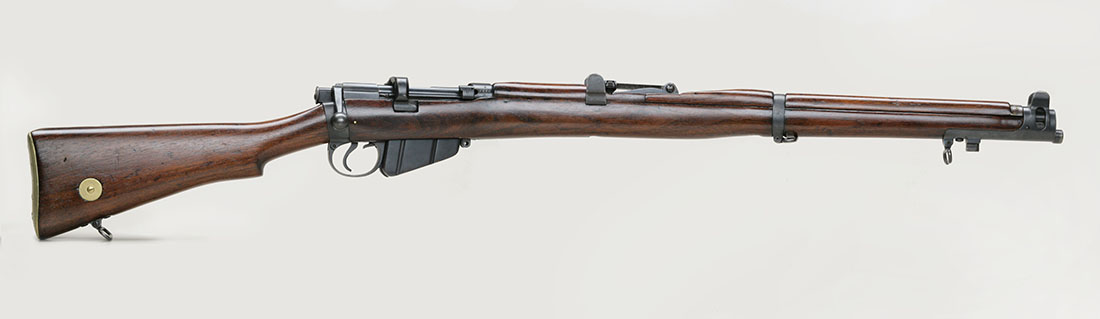
Lee-Enfield Rifle
The Short Magazine Lee-Enfield was the rifle of the British and Empire infantry. Continued…
-
Mauser Gewehr 98
The rifle of the German infantry defending the Somme positions. Continued…
-
Lebel Model 1886
Carried by the French infantry who attacked alongside the British south of the river. Continued…
-
Mills Bomb
The British hand grenade, used in huge numbers to clear trenches and dugouts. Continued…
-
Brodie Helmet
By the Somme the British steel helmet was general issue for the attacking troops. Continued…
-
Pattern 1907 Bayonet
The long sword bayonet fixed to the Lee-Enfield for the advance across no man's land. Continued…
Sources
Middlebrook, Martin. The First Day on the Somme. Allen Lane, 1971.
Prior, Robin, and Trevor Wilson. The Somme. Yale University Press, 2005.
Philpott, William. Bloody Victory: The Sacrifice on the Somme and the Making of the Twentieth Century. Little, Brown, 2009.
Sheffield, Gary. The Somme. Cassell, 2003.
Suggest an edit · account required · reviewed before publishing · how it works