Brigandine
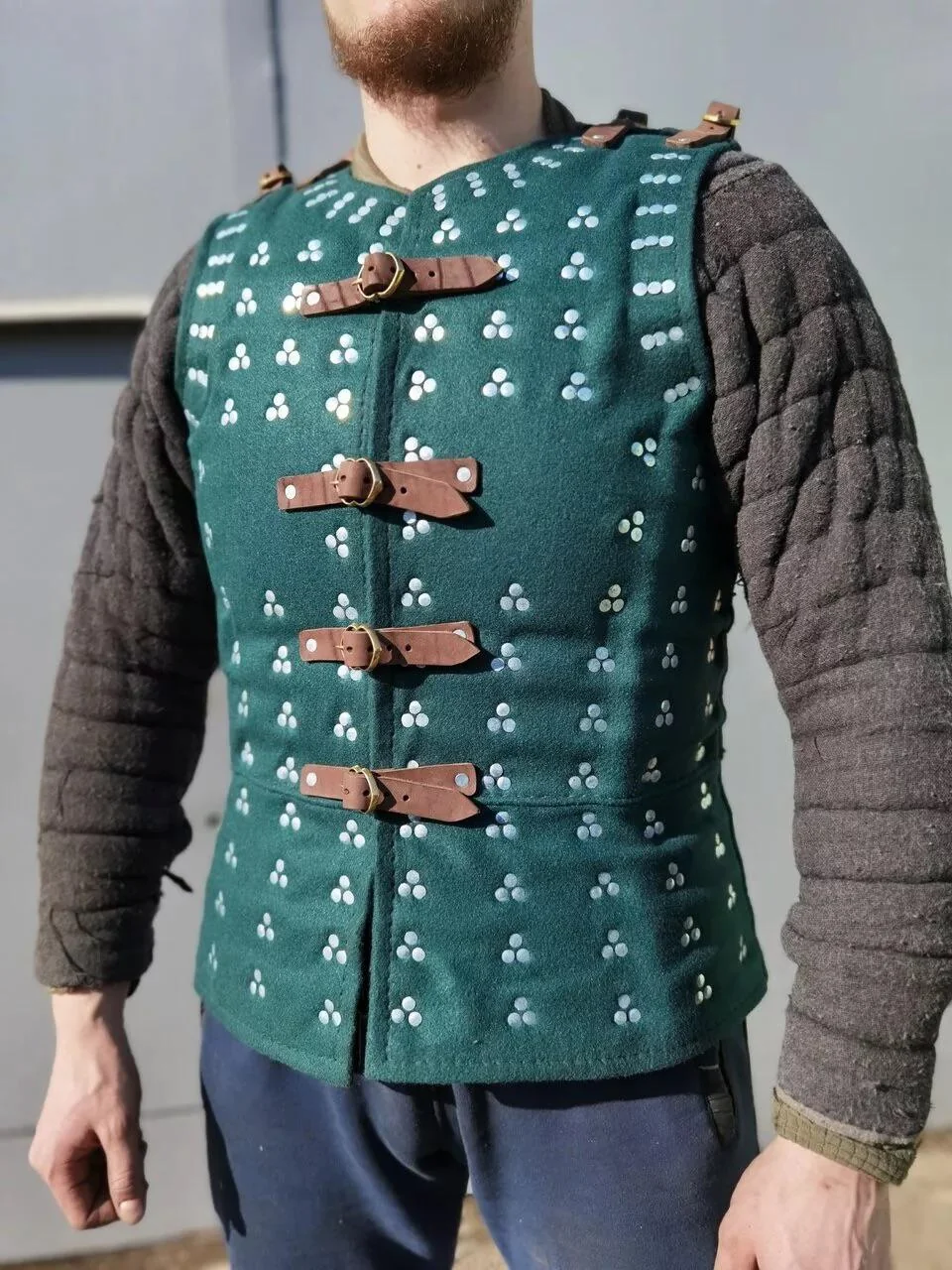
The brigandine was a body armor made of many small iron or steel plates riveted to the inside of a fabric or leather covering, so that only rows of rivet heads showed on the outside. It developed from the earlier coat of plates in the fourteenth century and was worn across Europe until the sixteenth. Cheaper and more flexible than a solid breastplate, it suited archers, foot soldiers and lighter cavalry, and it was common in the English armies of the Wars of the Roses.
Also known as brigandine, brigantine, brigandine armour, brigandine armor, coat of plates, pair of brigandines, brigandyne, brigantina, corazzina, plate-lined coat
Origins
In the thirteenth and early fourteenth centuries European men-at-arms began to add plates of iron over or under their mail. One common form was the coat of plates, a cloth or leather garment lined with large plates riveted to it, worn over the Mail Hauberk. During the fourteenth century the large plates gave way in some armors to many small, overlapping ones, and this lighter, more flexible defense became known as the brigandine. The name is usually linked to the word brigand, which then meant a lightly armed foot soldier rather than a robber. By the fifteenth century the brigandine was worn in England, France, Burgundy, Italy, Spain and the German lands, and it remained in use well into the sixteenth century.
Design & Construction
A brigandine was built from the inside out. The armorer riveted dozens or even hundreds of small plates, each overlapping its neighbors like roof tiles, to the inside of a stout canvas or leather foundation. The outer layer was often a rich fabric such as velvet, silk or fustian, and the rivet heads that held the plates showed through it in neat rows or groups. On expensive pieces these rivets were tinned, gilded or shaped as small rosettes. Most brigandines were sleeveless and closed down the front or at the sides with straps and buckles, and the plates over the chest were usually larger than those at the waist so the wearer could bend. Many were made in two halves, which is why records often speak of a "pair of brigandines." A well-made example gave protection close to that of a plate breastplate, while spreading its weight over the body and moving with it. It was also easier to repair, since a damaged plate could be replaced. Some wearers added a plate at the belly or a breastplate over the top. A related but simpler armor, the jack of plates, held small plates in place with stitching rather than rivets.
Combat Use
The brigandine suited men who needed good protection but could not afford, or did not want, a full harness of plate. English and French archers, crossbowmen and billmen wore it, as did mounted archers and lighter cavalry. Wealthy knights also wore fine brigandines, sometimes instead of a cuirass when riding or on campaign. In the later Hundred Years War and in the Wars of the Roses it was one of the standard defenses of the better-equipped soldier, often worn with a sallet helmet, a mail collar and plate or mail on the arms. At the Battle of Towton in 1461 many of the archers and billmen in both armies are likely to have worn brigandines or padded jacks against arrows and blows from the English Bill. Surviving armors show that the small plates could stop glancing cuts and many arrows, though a heavy thrust at a gap, or a powerful blow from a Poleaxe, could still wound the wearer beneath.
Legacy
A number of brigandines survive in museums, though many have lost their original covering. Some of the best known come from a large hoard of fifteenth-century armor found at Chalcis in Greece, a former Venetian stronghold, and now held in several collections, including the Metropolitan Museum of Art in New York. Other examples are held in the Royal Armouries in Leeds and in continental armories. As plate armor grew cheaper in the sixteenth century, and as firearms made light armor less useful, the brigandine faded from use. Its principle of small plates hidden inside a fabric garment lived on in later forms, and modern body armor that places hard plates inside a fabric carrier works on a broadly similar idea.
Sources
Blair, Claude. European Armour, circa 1066 to circa 1700. Batsford, 1958.
Edge, David, and John Miles Paddock. Arms and Armour of the Medieval Knight. Crescent Books, 1988.
Gravett, Christopher. English Medieval Knight 1400-1500. Osprey Publishing, 2001.
Goodman, Anthony. The Wars of the Roses: Military Activity and English Society, 1452-97. Routledge & Kegan Paul, 1981.
Suggest an edit · account required · reviewed before publishing · how it works