HK417
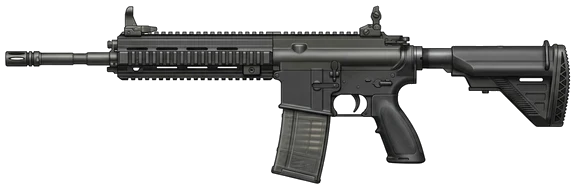
The HK417 is a 7.62x51mm NATO battle rifle made by Heckler & Koch of Germany. It is the larger-caliber partner of the HK416 and uses the same idea: an AR-15 style rifle driven by a short-stroke gas piston instead of direct gas impingement. Introduced in the mid-2000s with 12, 16.5 and 20 inch barrels, it found most of its users as a designated marksman rifle with special operations units and regular armies alike. It served in Afghanistan, and its descendants include the German G28 and the US Army's M110A1, which replaced the M110 as the Army's semi-automatic sniper and squad marksman rifle.
Also known as HK 417, Heckler & Koch HK417, HK417A2, G27, G28, MR308, MR762, M110A1, CSASS, SDMR
Origins
In the early 2000s Germany's Heckler & Koch developed the HK416, a 5.56mm carbine that married the familiar layout of the American M4 to a gas piston system. The HK416 was well received by special operations units, and many of the same users wanted a rifle with the same handling that fired the heavier 7.62x51mm NATO cartridge. Such a rifle could reach farther and hit harder than a 5.56mm carbine, which mattered in the open mountain country of Afghanistan. Heckler & Koch answered with the HK417, which appeared in the middle of the decade and was in production by 2006 (sources differ on the exact year of its introduction). For Heckler & Koch it took the place once held by the roller-delayed G3 Rifle as the company's main 7.62mm rifle.
Design & Construction
The HK417 looks like a large AR-15. It has the same split upper and lower receivers, the same type of controls and a telescoping stock, so a soldier trained on an M4 or HK416 can pick it up and use it at once. The receivers and working parts were enlarged for the 7.62mm round. The key difference from the American rifles is the operating system. In the AR-15, gas from the barrel is piped straight back into the bolt carrier. In the HK417 the gas instead pushes a short piston, which strikes an operating rod that drives the bolt carrier back. Hot gas and carbon stay out at the front, so the bolt and receiver run cleaner and cooler, a real advantage with suppressors fitted. The rotating bolt locks into the barrel extension. The barrel is cold hammer-forged and can be changed by the user. The rifle feeds from 10 or 20 round box magazines and fires semi-automatic or fully automatic. It was offered in three main lengths: a 12 inch "Assaulter," a 16 inch "Recce" and a 20 inch "Sniper." With match ammunition the accurate versions are rated at about one minute of angle.
Service
Norway adopted the HK417 in 2007 as a marksman rifle alongside the HK416, and the German Bundeswehr used it as a stopgap designated marksman rifle under the name G27. The Dutch commandos, the Australian Army and the French special operations command were among other buyers. Norwegian, German and Australian troops carried it in Afghanistan, where a 7.62mm rifle in each squad or patrol let soldiers engage enemy riflemen and machine gunners at ranges where the 5.56mm round was struggling. American and British special operations units are widely reported to have used it as well, though these units rarely confirm their equipment. The rifle also appeared in unexpected hands: photographs from 2015 show Russian FSB special forces in Dagestan carrying a suppressed HK417, and the civilian MR308 version has been reported with Russian police and security sniper teams.
Legacy
The HK417 grew into a family. For its troops in Afghanistan the Bundeswehr wanted a dedicated semi-automatic marksman rifle, and Heckler & Koch developed the G28 from the civilian MR308, a semi-automatic version of the HK417. In April 2016 the United States Army chose a lightened G28 for its Compact Semi-Automatic Sniper System, or CSASS, to replace the M110 Semi-Automatic Sniper System. The rifle was standardized as the M110A1, and a second version, the Squad Designated Marksman Rifle, was fielded to Army units from about 2020, putting a 7.62mm rifle back in the infantry squad. Like the Mk 12 Special Purpose Rifle before it, the HK417 family showed how much a precise semi-automatic rifle in a small unit could add, and it helped bring the full-power 7.62mm rifle back into the front line.
Sources
Neville, Leigh. Guns of the Special Forces 2001-2015. Pen & Sword Military, 2016.
Neville, Leigh. Special Forces in the War on Terror. Osprey Publishing, 2015.
Jones, Richard D., ed. Jane's Infantry Weapons 2010-2011. Jane's Information Group, 2010.
Suggest an edit · account required · reviewed before publishing · how it works