Mk 12 Special Purpose Rifle
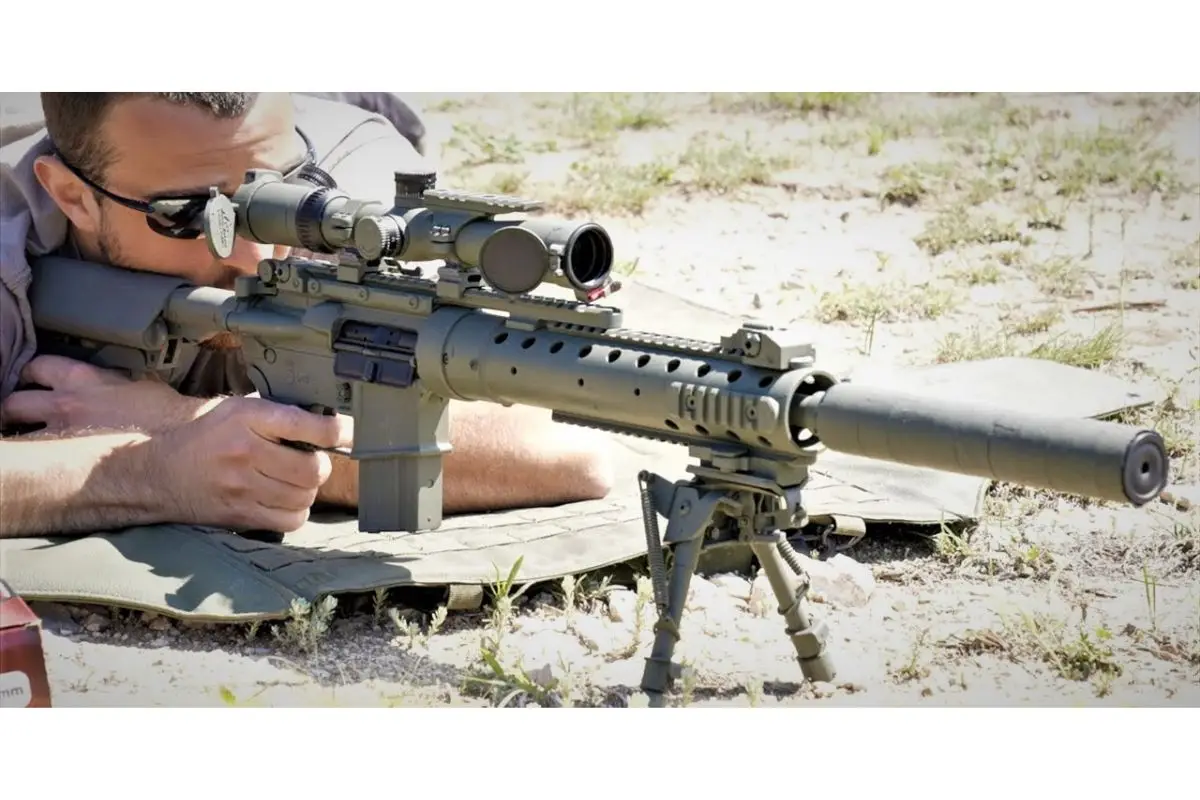
The Mk 12 Special Purpose Rifle (SPR) was a precision rifle built on the M16/AR-15 pattern for US special operations forces. Developed in the early 2000s by the Naval Surface Warfare Center at Crane, Indiana, it combined an 18-inch stainless steel match barrel, a free-floating handguard and a telescopic sight with the standard 5.56 mm cartridge. With heavy 77-grain match ammunition it could hit targets out to about 700 meters. Navy SEALs, Army Special Forces, Rangers and Marines carried it in Iraq and Afghanistan as a designated marksman's rifle.
Also known as Mk12, SPR, Mark 12 Special Purpose Rifle, Mk 12 Mod 0, Mk 12 Mod 1, Mk 12 SPR
Origins
By the late 1990s American special operations units wanted a rifle that sat between the carbine and the sniper rifle. A team member with an M16 Rifle or M4 Carbine could not reliably hit targets at several hundred meters, while a bolt action sniper rifle such as the M24 Sniper Weapon System was slow and used different ammunition. The answer was a precision rifle that fired the same 5.56 mm round as the rest of the team. Work on the idea began around 2000, and the Naval Surface Warfare Center at Crane, Indiana, which supports special operations weapons, turned it into the Mk 12. The name SPR is usually read as Special Purpose Rifle; early documents also spoke of a Special Purpose Receiver, an accurate upper receiver that could be fitted to an existing M4 lower.
Design & Construction
The Mk 12 used the standard AR-15 layout and many standard parts, but everything that affected accuracy was upgraded. Its heart was an 18-inch stainless steel match barrel with a fast rifling twist, made to stabilize heavy bullets. The barrel floated free inside a tubular handguard so that nothing pressed on it. The Mod 0 used a carbon fiber handguard from Precision Reflex, and the later Mod 1 used a Knight's Armament rail system. A two-stage match trigger, a bipod, a sound suppressor and a variable-power telescopic sight completed the rifle. The ammunition mattered as much as the rifle. The Mk 262 cartridge, with a 77-grain open-tip match bullet, was developed for it and gave far better accuracy and hitting power at long range than standard 5.56 mm ball. The rifle was semi-automatic only and fed from normal M16 magazines, so the marksman could share ammunition and magazines with his team.
Service
The Mk 12 entered service in the early 2000s and was used throughout the wars in Iraq and Afghanistan in the Global War on Terror. It was carried by the US Navy SEALs, by Army Green Berets and US Army Rangers, and by the US Marine Corps. SEAL Marcus Luttrell, the only survivor of the four-man reconnaissance team ambushed during Operation Red Wings in Afghanistan in 2005, carried a Mk 12, as he described in his book "Lone Survivor". In mountains and open country, the rifle let a small team engage the enemy at ranges where carbines were ineffective, and in cities it was light and handy enough for close-quarters work.
Legacy
In the 2010s the Mk 12 was gradually retired. Units wanting more range moved to 7.62 mm semi-automatic rifles such as the M110 Semi-Automatic Sniper System, while accurate free-floated uppers for the M4 took over much of its close-range role. The Mk 12 nevertheless proved that a well-built AR-15 with match ammunition could do real precision work, and it influenced a generation of military and civilian designated marksman rifles. Surplus parts and faithful civilian "clone" builds are popular with collectors today.
Sources
Bartocci, Christopher R. Black Rifle II: The M16 into the 21st Century. Collector Grade Publications, 2004.
Rottman, Gordon L. The M16. Osprey Publishing (Weapon series), 2011.
Luttrell, Marcus, with Patrick Robinson. Lone Survivor. Little, Brown, 2007.
Pegler, Martin. Sniper Rifles: From the 19th to the 21st Century. Osprey Publishing (Weapon series), 2010.
Suggest an edit · account required · reviewed before publishing · how it works