Carl Gustaf m/45
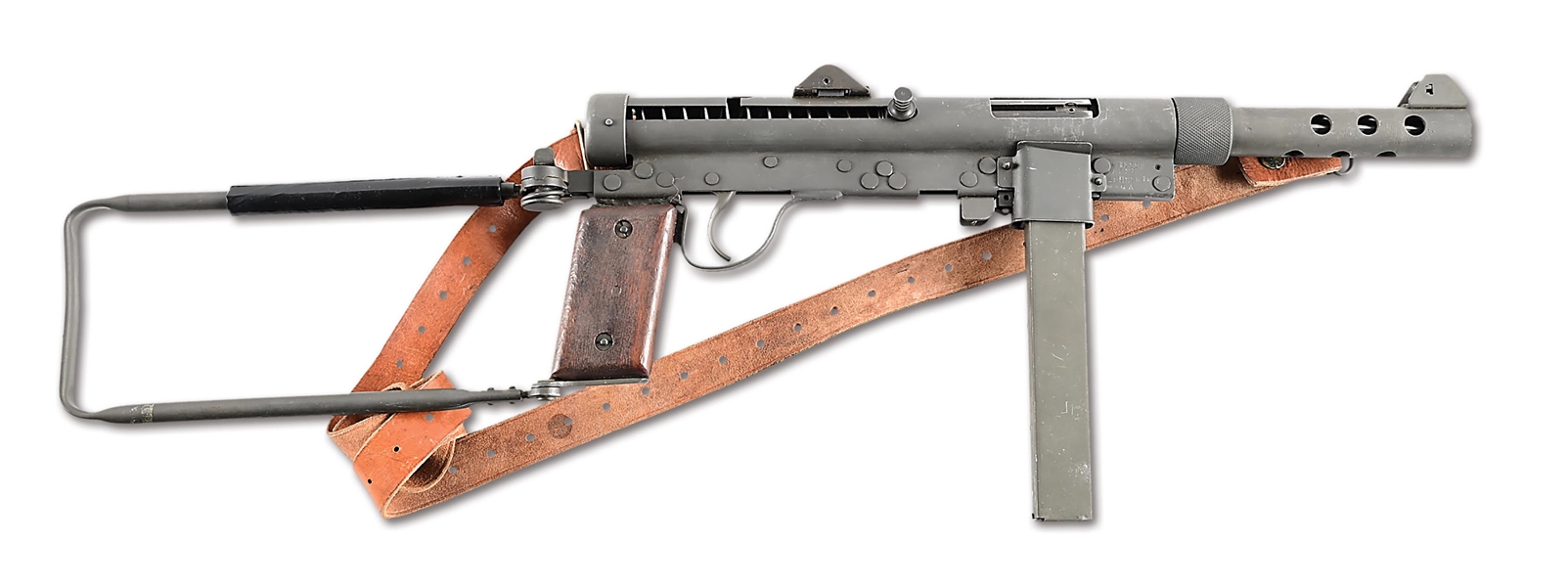
The Carl Gustaf m/45 is a Swedish 9mm submachine gun adopted in 1945 and made at the Carl Gustafs Stads Gevärsfaktori in Eskilstuna. Simple, stamped and extremely reliable, with a side-folding stock and a 36-round box magazine, it served the Swedish armed forces for more than half a century. Americans know it as the 'Swedish K': the CIA, Special Forces and Navy SEALs used it in Vietnam, where its reliability in mud and water made it a favorite, until Sweden halted exports and Smith & Wesson built a copy.
Also known as Carl Gustaf m/45, kulsprutepistol m/45, Kpist m/45, Swedish K, m/45B, Port Said
Origins
Neutral Sweden spent the Second World War building up its defenses and buying and licensing weapons wherever it could, including the Finnish Suomi submachine gun. By 1944 it wanted a cheaper weapon of its own that could be mass-produced from stampings, and the state arms factory at Eskilstuna, Carl Gustafs Stads Gevärsfaktori, developed one. Adopted in 1945 as the kulsprutepistol m/45, it was designed to use the Suomi's 50-round magazine as well as a new one. In 1948 the m/45B introduced a fixed magazine housing for the new 36-round Carl Gustaf magazine, and most guns were converted to that standard. The m/45 went on to serve Sweden until the end of the century and beyond in reserve and home guard units.
Design & Construction
The m/45 is a conventional blowback submachine gun firing from an open bolt on full automatic only, at about 600 rounds per minute — slow enough to fire single shots with a light touch on the trigger. The receiver is a steel tube, the barrel is enclosed in a perforated jacket, and a tubular stock folds to the right side of the receiver. The 36-round magazine is a double-column, double-feed box that tapers into a wedge shape at the top and is noted for its reliability; it was later adopted by other weapons. The gun is heavy for its size, at about 7.6 pounds empty, which makes it steady on automatic. Its simple construction and generous clearances let it keep firing when wet or dirty. Egypt made a licensed copy, the Port Said, from the 1950s.
Combat Use
Sweden fought no wars, but its m/45s went abroad with Swedish United Nations contingents in the Congo and Cyprus. The weapon's most famous combat, however, was American. From the early 1960s the CIA and US special operations forces bought "Swedish K"s as a sterile weapon that could not be traced to the United States, and the Green Berets of MACV-SOG and the US Navy SEALs carried them in Vietnam War. SEALs liked the gun because it would fire straight out of the water of a Mekong Delta canal, which the M3 Grease Gun would not reliably do. In 1966 Sweden, opposed to the war, stopped arms sales to the United States, and in 1967 Smith & Wesson produced a close copy, the M76, for the Navy.
Legacy
The m/45 was one of the most successful submachine guns of the early Cold War, simple and long-lived, and its magazine became a design copied elsewhere. In the United States its association with the SEALs and SOG made the "Swedish K" a legend of the special operations community, and it appears in many Vietnam-era photographs. Compare the Soviet-derived weapons it faced, such as the K-50M, and the gun that finally replaced submachine guns like it in SEAL service, the HK MP5.
Sources
Hogg, Ian V., and John Weeks. Military Small Arms of the 20th Century. 7th ed. Krause Publications, 2000.
Ezell, Edward Clinton. Small Arms of the World. 12th ed. Stackpole Books, 1983.
Dockery, Kevin. Weapons of the Navy SEALs. Berkley Books, 2004.
Suggest an edit · account required · reviewed before publishing · how it works