Ithaca 37
The Ithaca 37 is an American pump-action shotgun made by the Ithaca Gun Company of Ithaca, New York, from 1937. Based on a John Browning and John Pedersen design, it loads and ejects through the bottom of the receiver, which makes it equally handy for left- and right-handed shooters. It has been made longer than any other pump shotgun, passing two million guns. The US military bought it as a trench and riot gun in the Second World War, and Navy SEALs used it in Vietnam, while police departments across America carried it for decades.
Also known as Ithaca Model 37, Ithaca 37, M37, Featherlight, Deerslayer, Stakeout
Origins
The Ithaca 37 is a pump action shotgun from the United States. Its design goes back to a pump gun patented by John Browning in 1915 and refined by John Pedersen, which Remington sold as the Model 17. The Ithaca Gun Company, a respected maker of double-barreled shotguns in Ithaca, New York, wanted a pump gun of its own and waited for the Remington patents to expire; it introduced the Model 33 and then, in 1937, the Model 37. The Depression and then the war held back civilian sales, but the gun's light weight and simplicity made it a success, and it has since been made longer than any other pump-action shotgun in history.
Design & Construction
The Model 37's defining feature is its bottom ejection: shells load into the tubular magazine through a port on the bottom of the receiver, and empties are ejected through the same port. The receiver has no ejection port on the side, so it is sealed against dirt and rain and suits left- and right-handed shooters equally. It is light for a 12-gauge — about 6.5 pounds with a short barrel — and was made in 12, 16, 20 and 28 gauge, with sporting models like the Featherlight and the rifled-slug Deerslayer. Guns made before 1975 had no trigger disconnector, so a shooter holding the trigger back could fire each round as the action closed ("slam-fire"), which made for very fast shooting at close range.
Combat Use
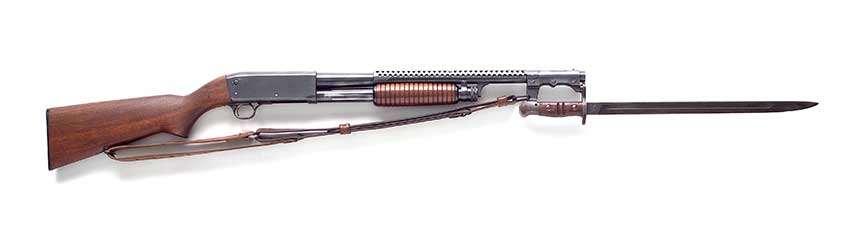
This shotgun saw action in conflicts starting with World War II, when the US government bought about 1,400 Model 37s, mostly as riot guns for guarding bases and prisoners, along with a small number of trench guns with a ventilated heat shield and bayonet lug. More were bought for the Korean War. In Vietnam War the Ithaca became associated with the US Navy SEALs, who used Model 37s in the Mekong Delta, some fitted with the experimental "duckbill" choke that spread shot into a horizontal pattern. The US Marine Corps and Army also used them in Vietnam.
Legacy
At home the Ithaca 37 became one of the standard police shotguns of the twentieth century, carried by the New York and Los Angeles police departments and many others, including a short-barreled "Stakeout" model for concealment. Ithaca's fortunes rose and fell over the years, but the Model 37 passed two million guns and is still made today. Military-marked trench and riot guns, especially those with US property marks, are sought after by collectors.
Sources
Snyder, Walter C. Ithaca Gun Company: From the Beginning. Cook & Uline, 1991.
Canfield, Bruce N. Complete Guide to United States Military Combat Shotguns. Andrew Mowbray, 2007.
Thompson, Leroy. Combat Shotguns. Greenhill Books, 2002.
Suggest an edit · account required · reviewed before publishing · how it works