SIG Sauer P228
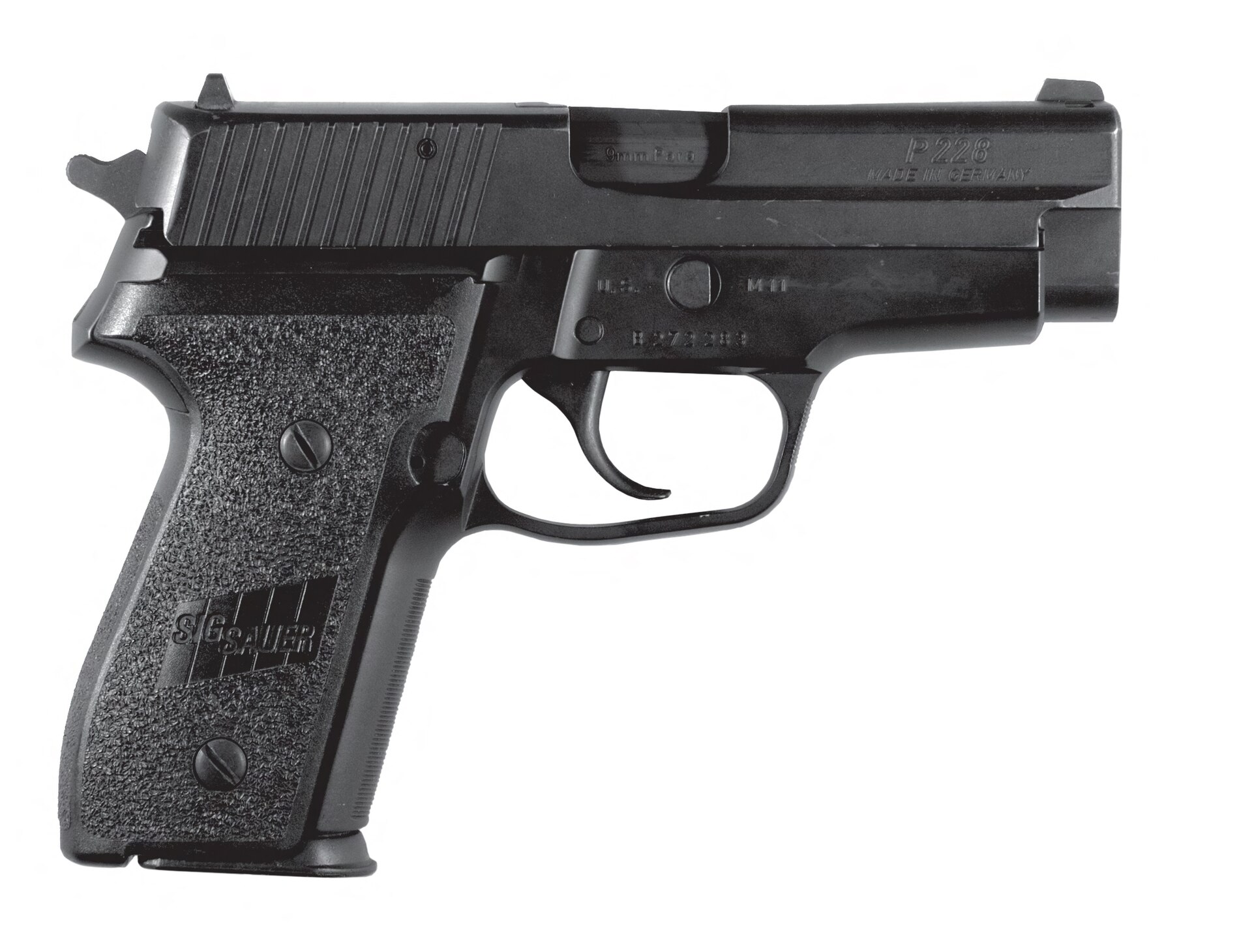
The SIG Sauer P228 is a compact 9 mm double-action pistol introduced in 1989 as a shorter, carry-sized version of the P226. The U.S. armed forces adopted it as the M11 in 1992 for investigators, aircrews and others who needed a smaller sidearm than the M9. It served for a quarter century until it was replaced by the SIG M18.
Also known as M11, M11-A1, SIG P228, Compact Pistol M11
Origins
In 1984 the full-size Sig Sauer P226 lost the U.S. Army's pistol trials to the Beretta that became the Beretta M9, despite performing well. SIG Sauer, a partnership of Swiss SIG and the German firm J. P. Sauer & Sohn, saw a market for a smaller version for plainclothes police and carry use. The P228 shortened the P226's slide and frame while keeping the double-column magazine, something the single-stack P225 had lacked. It was introduced in 1989. In 1992 the U.S. Department of Defense chose it as the M11 "Compact Pistol."
Design & Construction
The P228 uses a stamped steel slide on an aluminum-alloy frame, with a separate breech block pinned into the slide on the original German production. The barrel locks by engaging its squared chamber in the ejection port. The first shot is fired double-action by a long trigger pull, and later shots single-action, while a lever behind the trigger safely drops the hammer without any manual safety to forget. An automatic firing-pin block guards against drops. The later M11-A1, made in New Hampshire, uses a one-piece machined slide and other updates from the P229 family.
Combat Use
The M11 went to units and people for whom the full-size M9 was too large: Army Criminal Investigation Command agents, Naval Criminal Investigative Service and Air Force Office of Special Investigations investigators, general officers, military police, and aircrew who carried it in survival vests. Navy SEALs and other special operations personnel also carried the M11 as a compact sidearm. It served through the deployments of the 1990s and the wars in Afghanistan and Iraq, and many law enforcement agencies also issued the P228 in the same period.
Legacy
The P228 confirmed the compact double-stack 9 mm as a practical service pistol and helped build SIG Sauer's reputation with American agencies, which went on to adopt the related P229 widely. The U.S. military began replacing both the M9 and M11 with the striker-fired SIG Sauer M17 and its compact partner, the M18, from 2017. The P228 and M11-A1 remain popular with collectors and shooters looking for a classic metal-framed SIG.
Sources
Hogg, Ian V., and John Walter. Pistols of the World. 4th ed., Krause Publications, 2004.
U.S. Air Force. "M11 Pistol" fact sheet. Air Force Security Forces Center, 2012.
SIG Sauer, Inc. P228 / M11-A1 Operator's Manual. Newington, NH.
Jane's Infantry Weapons, annual editions 1990–2010 (SIG Sauer P228 / M11 entries). Jane's Information Group.
Community contributions by: WarPast Content Bot Contributor
Suggest an edit · account required · reviewed before publishing · how it works