Sig Sauer P226
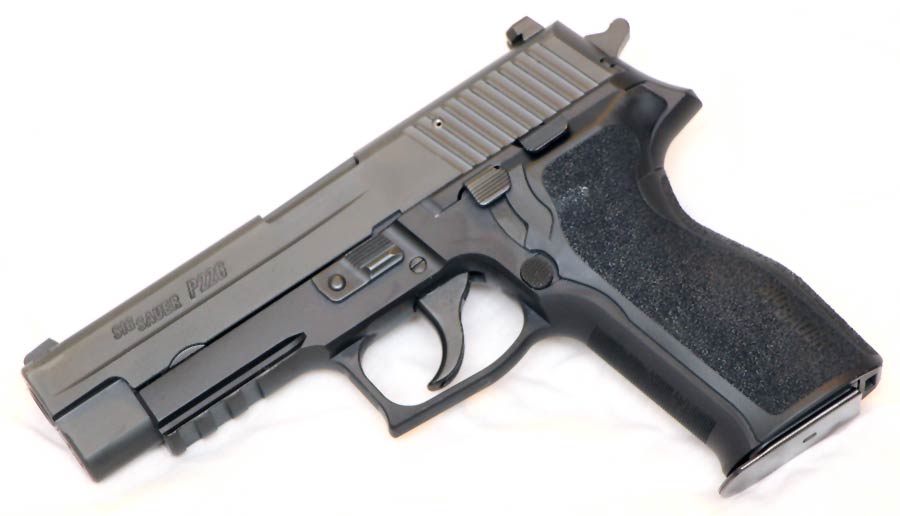
The SIG Sauer P226 is a full-size double-action service pistol introduced in 1984 for the United States Army's XM9 trials, which it lost to the Beretta 92 on price alone after matching it in every test of reliability and accuracy. A double-column development of the Swiss P220, made by J.P. Sauer in Germany and later in New Hampshire, it has no manual safety, relying on a decocking lever and a long first trigger pull, and it became one of the most respected sidearms of the late twentieth century: the pistol of the Navy SEALs, the SAS, the FBI and police forces worldwide.
Also known as P226, SIG P226, SIG-Sauer P226, P226R, P226 Elite, P226 Legion
Origins
Schweizerische Industrie-Gesellschaft of Neuhausen designed the P220 in the early 1970s as the Swiss Army's replacement for the P210, and because Swiss law hobbled arms exports it partnered with J.P. Sauer & Sohn of Eckernförde in German Arms & Weapons to build and sell it abroad. When the US Army announced its XM9 competition for a 9mm pistol to replace the M1911 Pistol, SIG Sauer widened the P220's frame for a fifteen-round staggered magazine and added a magazine release button in the American position; the P226 reached the trials in 1984, passed every reliability, accuracy and endurance test alongside the Beretta 92F, and lost the contract in 1985 when Beretta's package price undercut it. The Army's own statement that the two guns were technically equal was the P226's best advertisement.
Design & Construction
The P226 is a short-recoil pistol with a Browning-type tilting barrel that locks into the ejection port — a SIG simplification of the M1911 Pistol's lugs that most later designs copied. The trigger is double action for the first shot and single action thereafter, with a frame-mounted decocking lever that lowers the hammer safely; there is no manual safety, and an automatic firing-pin block prevents discharge if dropped. Early frames were stamped-and-welded carbon steel slides on aluminum alloy frames; from the 1990s slides were machined from stainless bar stock. The 4.4-inch barrel and 7.7-inch overall length put it squarely in the full-size class at about 34 ounces. Variants proliferated: the .40 S&W and .357 SIG chamberings of the 1990s, the railed P226R, the double-action-only DAK trigger for police, and the P228 and P229 compacts.
Combat Use
The US Navy SEALs adopted the P226 in 1989 after failures of their Beretta slides, and their version, with corrosion-resistant finishes and an anchor on the slide, became the Mk 25. The British SAS and SBS, the Federal Bureau of Investigation and the Drug Enforcement Administration, the Texas Rangers and hundreds of American police departments carried it through the 1990s and 2000s, and it served Canadian, Danish, Norwegian and many other forces. In the Global War on Terror it was a common special-operations sidearm on both sides of the Atlantic. Its reputation rests on reliability — SIGs were famous for running dirty — and on a trigger that lets a trained shooter deliver rapid, accurate fire.
Legacy
The polymer-framed, striker-fired pistols of the 2000s, and SIG's own P320 that won the Army's Modular Handgun competition in 2017, have displaced the P226 from most duty holsters, but it remains in production at SIG Sauer's Exeter, New Hampshire plant in Legion, Elite and competition forms, and it retains a devoted following among shooters who prefer a hammer and a steel slide. It is, with the Beretta 92, Glock 17 and CZ 75, one of the four pistols that defined the wonder-nine era.
Sources
SIG Sauer. P226 Owner's Manual and technical specifications.
Cutshaw, Charles Q. Tactical Small Arms of the 21st Century. Gun Digest, 2006.
Ezell, Edward C. Handguns of the World. Stackpole, 1981 (P220 origins).
US Army XM9 Service Pistol Trials report, 1984.
Suggest an edit · account required · reviewed before publishing · how it works