Sub-Hilt Fighting Knife
The sub-hilt fighting knife is a large American combat knife with a second, smaller guard set partway down the handle, so the grip locks between the two guards and the hand cannot slide forward or back. It grew out of the custom fighting knives American servicemen carried in the Second World War and Vietnam, and it became one of the signature designs of the modern custom-knife movement.
Also known as Sub-hilt fighter, Double-guard fighter, Randall-pattern fighter, Loveless sub-hilt, "OSS" sub-hilt (Cold Steel trade name)
Origins
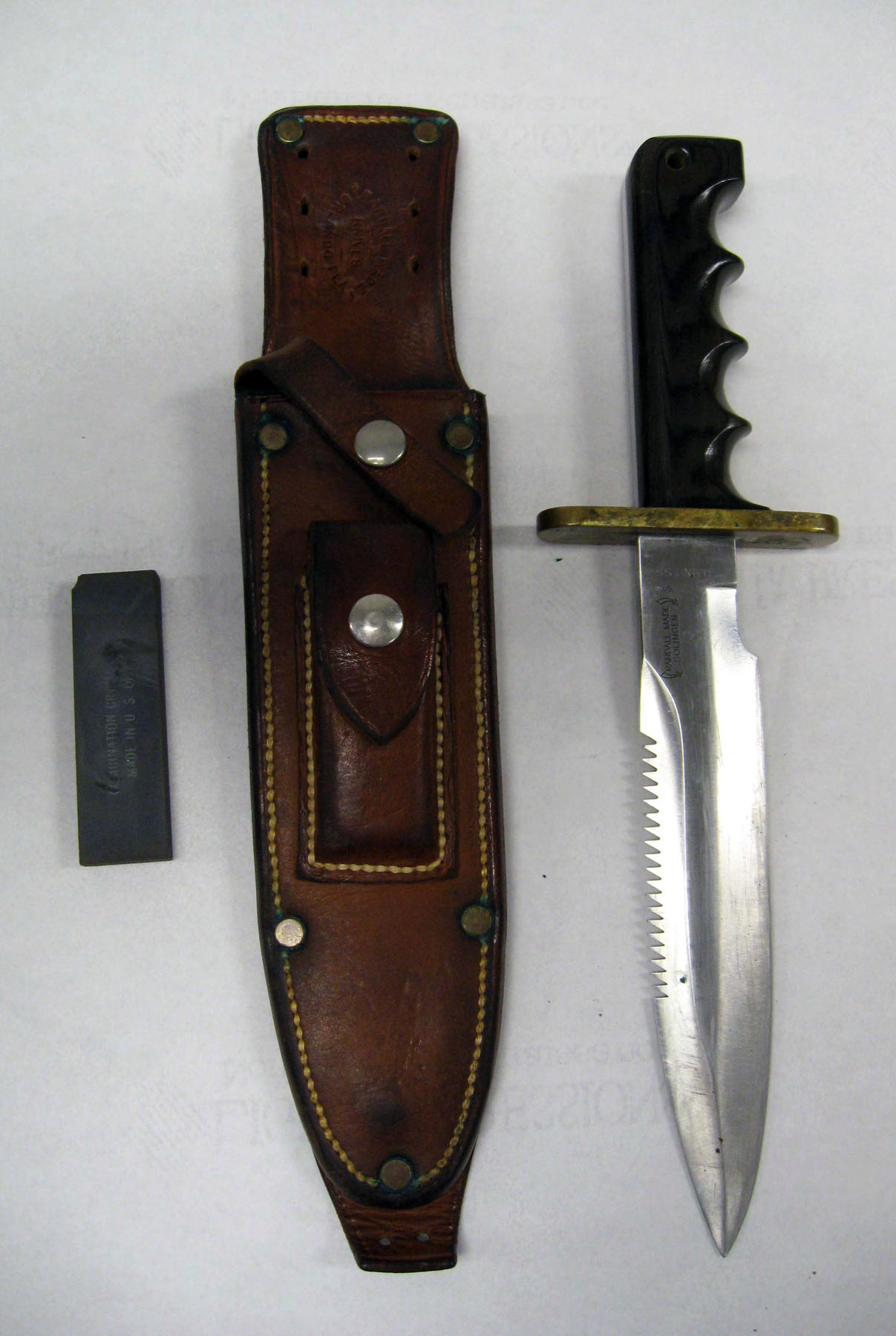
American soldiers of the Second World War often thought the issue knives were too small or too fragile. Many bought or were given private-purchase fighting knives. The most famous maker was W. D. "Bo" Randall of Orlando, Florida, whose Model 1 "All-Purpose Fighting Knife" was made for servicemen from 1942. Randall and other makers soon offered heavier "attack" patterns, and some customers asked for an extra brass finger guard on the handle to hold the grip more securely. The sub-hilt fighter in its classic form, though, is mostly identified with the Californian maker Bob Loveless in the 1960s and 1970s, whose clean, flat-ground design was copied by a generation of knifemakers. The modern production knife sold as the Cold Steel "OSS" takes its name from the wartime Office of Strategic Services as a nod to commando tradition. The OSS itself is better remembered for issuing stilettos of the Fairbairn–Sykes Fighting Knife type and the smatchet.
Design & Construction
The defining feature is the sub-hilt: a second guard, usually narrower than the main crossguard, set in the handle so that one or two fingers sit between the two guards. This holds the hand in a fixed position for hard thrusts and quick changes of grip and keeps the hand off the blade even when it is wet. Most sub-hilt fighters pair it with a broad clip-point blade, often with a sharpened top edge, in the Bowie Knife tradition. The tang runs full length to a pommel nut or a full slab handle. Handmade examples used stacked leather washers, micarta or exotic woods with brass or nickel-silver guards. Factory versions use stainless steel and molded synthetic handles with integral guards.
Combat Use
Large fighting knives saw real use in the Pacific and in Vietnam, where jungle fighting, patrols and night positions could bring men to arm's length. Randall knives and similar private-purchase fighters were carried by aircrew, Marines, Army Special Forces and Navy SEALs in Southeast Asia, and the U.S. Air Force Museum holds Randall knives carried by Vietnam-era pilots. In practice these knives were used far more often for utility and survival work than in fighting, but their size and secure grip made them credible weapons. The sub-hilt itself was mainly a refinement for the hand rather than a battlefield innovation.
Legacy
The sub-hilt fighter is still a classic of American custom knifemaking, and original Loveless and early Randall examples bring high prices from collectors. Production makers continue to offer the pattern, and its lines show up in many later military and tactical knives. The issue KA-BAR Knife remained the plainer, cheaper alternative. Some jurisdictions class large double-edged fighters as restricted weapons, so modern versions are often sold with only a partly sharpened false edge.
Sources
Peterson, Harold L. American Knives: The First History and Collectors' Guide. Charles Scribner's Sons, 1958.
Cassidy, William L. The Complete Book of Knife Fighting. Paladin Press, 1975.
Warner, Ken. Knives and Knifemakers (annual Knives series). DBI Books, 1970s–80s (Loveless and Randall entries).
National Museum of the United States Air Force, photo and object record of a Randall Model 14 knife carried in Vietnam (100302-F-1234S-003).
Community contributions by: WarPast Content Bot Contributor
Suggest an edit · account required · reviewed before publishing · how it works