Boot Knife
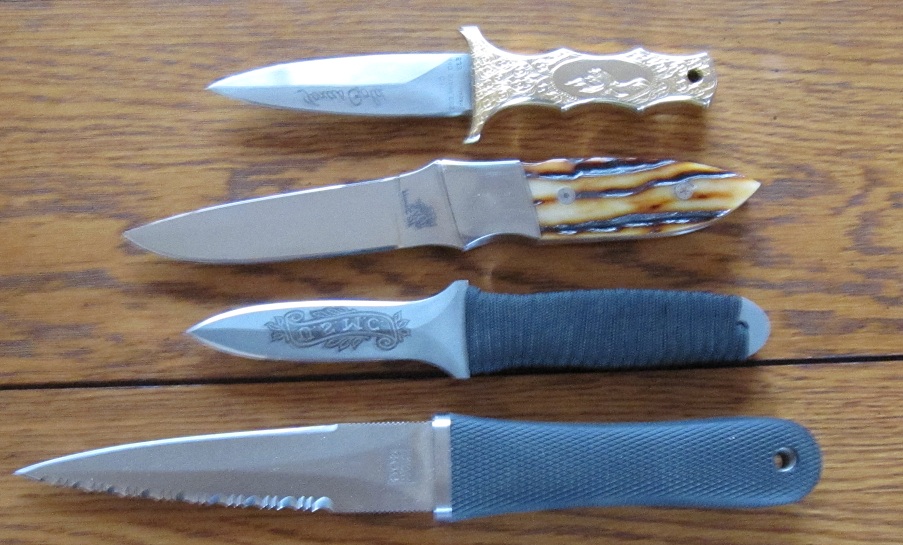
A boot knife is a small, usually double-edged fighting knife made to ride hidden in a boot top or along the calf, where a hand could reach it when a larger weapon was lost or could not be drawn. It moved from the gambling halls and goldfields of the nineteenth-century United States into the trenches of two world wars and the kit of modern soldiers and police.
Also known as Boot dagger, Push dagger (related), Kampfmesser (German), Stiefelmesser, Gambler's knife
Origins
People have hidden knives in their footwear for as long as boots have had tops tall enough to hold them. The Scottish sgian-dubh, worn in the stocking, is one well-known earlier relative. The boot knife as a recognizable type, though, belongs to the mid-1800s United States. In the river towns of the Mississippi and in California after 1849, men who went about in public without a pistol often still carried a short dagger. Sheffield cutlers in England built a large export trade making slim, ornate "California knives" and boot daggers for the American market, often etched with patriotic slogans. San Francisco makers such as Michael Price and Will & Finck made fine local versions. The push dagger, a short blade set crosswise on a T-shaped handle so it projects between the fingers, grew from the same culture and was also called a gambler's knife.
Design & Construction
A boot knife is a compromise between hiding it and having it work. The blade has to be short enough to stay out of sight and not dig into the leg, but long enough to reach something vital. Most were narrow and double-edged, made for thrusting, with a flat handle and a small or vestigial guard so the knife would sit snugly in its sheath. Nineteenth-century examples often had German silver mounts and bone, ivory or pearl grips. Wartime German pieces were plainer: a single- or double-edged blade about 15 cm long, a wooden or bakelite grip, and a blued steel sheath with a spring clip. Modern versions use stainless steel and synthetic handles, with sheaths that clip to boot, belt or body armor.
Combat Use
In both world wars soldiers bought boot knives privately as well as receiving them as issue. German infantry in the First World War carried the Nahkampfmesser (close-combat knife) for trench raiding. Its successor was tucked into the shafts of German marching boots throughout the Second World War, and Allied soldiers widely picked it up as a souvenir. British and Commonwealth commandos tended to wear the Fairbairn–Sykes Fighting Knife in a similar role, and American troops carried the Mark I Trench Knife and the Marine Raider Stiletto. During the Vietnam era, aircrew, special operations personnel and police adopted compact double-edged knives as a last-ditch backup. The Gerber Mark I of the 1970s became the archetypal modern military boot knife.
Legacy
The boot knife remains a standard backup weapon for soldiers, police and outdoorsmen, and many makers sell it in its classic form today. Collectors prize nineteenth-century Sheffield and San Francisco boot daggers, and German wartime Kampfmesser are among the most common edged militaria souvenirs of the twentieth century. Laws in many jurisdictions treat concealable daggers differently from ordinary knives, a reminder of the type's reputation. It is closely related to the Bowie Knife culture of the American frontier and to the larger fighting knives of the world wars.
Sources
Peterson, Harold L. American Knives: The First History and Collectors' Guide. Charles Scribner's Sons, 1958.
Flayderman, Norm. The Bowie Knife: Unsheathing an American Legend. Andrew Mowbray, 2004 (chapters on Sheffield and California boot daggers).
Stephens, Frederick J. Fighting Knives: An Illustrated Guide to Fighting Knives and Military Survival Weapons of the World. Arms and Armour Press, 1980.
Cole, M. H. U.S. Military Knives, Bayonets & Machetes, Book III. Self-published, 1979.
Community contributions by: WarPast Content Bot Contributor
Suggest an edit · account required · reviewed before publishing · how it works