Rifle No. 4 Mk I
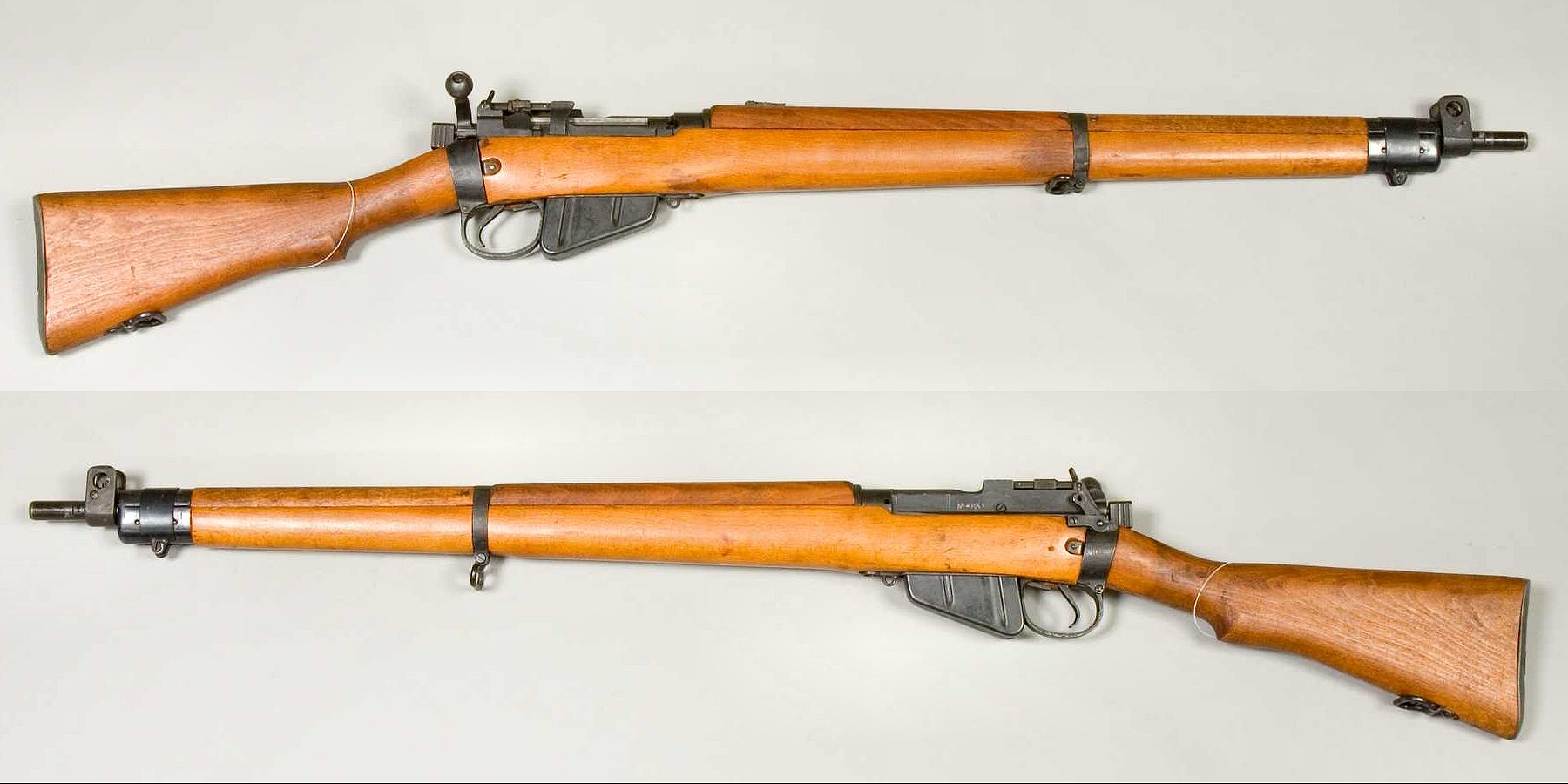
The Rifle No. 4 Mk I was the British Army's main bolt-action service rifle of the Second World War. Approved on 15 November 1939 and put into mass production in 1941, it kept the Lee rear-locking action and ten-round .303 magazine of the earlier Short Magazine Lee-Enfield, but used a heavier free-floating barrel, a squared receiver and a receiver-mounted aperture backsight for faster manufacture and better battle shooting. Built in Britain, Canada and the United States, it armed Commonwealth forces from Normandy to Korea, and its No. 4 (T) sniper conversion was among the war's finest issue sniping rifles.
Also known as Lee-Enfield No. 4 Mk I, No. 4 Rifle, No. 4 Mark I, Rifle No. 4 Mark I, No. 4 Mk I*, Rifle No. 4 Mk I*
History
Between the wars the British Army still issued the Short Magazine Lee-Enfield of 1907, renamed Rifle No. 1 in 1926. It was an outstanding soldier's rifle, but it was expensive to machine, and Enfield spent the 1920s and 1930s trying to simplify it. Trials produced the No. 1 Mk V with a receiver aperture sight, then the No. 1 Mk VI with a heavier free-floating barrel. Those prototypes became the Rifle No. 4. Troop trials in 1931–35 with units including the 2nd Battalion, West Yorkshire Regiment, and the 3rd Carabineers found the new rifle handier and more accurate than the Service Mark III, and easier to teach with its aperture sight. Official approval for manufacture of the No. 4 Rifle, Mark I, was announced on 15 November 1939. Mass production did not really begin until 1941, at three new plants—Royal Ordnance Factory Fazakerley in Lancashire, ROF Maltby in Yorkshire, and BSA Shirley near Birmingham—while RSAF Enfield itself concentrated on Bren guns. Canada built the rifle at Long Branch near Toronto, and the United States at the former Stevens plant of Savage Arms in Chicopee Falls, Massachusetts, under contracts that later ran as Lend-Lease; American rifles were marked "U.S. Property."
Design
The No. 4 kept the Lee cock-on-closing bolt and ten-round detachable magazine that made the SMLE so fast to fire, but almost nothing else was interchangeable with the No. 1. The receiver was strengthened and squared for easier machining, and a simple one-piece charger bridge replaced the rounded SMLE bridge. The heavy nose-cap disappeared; about three inches of heavier barrel stood free of the fore-end at the muzzle, which removed the need for full-length bedding and improved consistency. Sights moved to the rear of the receiver: an aperture battle sight for about 300 yards with the leaf down, and a micrometer leaf graduated in 50-yard steps for longer ranges. Wartime shortcuts replaced the milled Mk I leaf with simpler stamped dual-aperture and later stamped adjustable sights. The Pattern 1907 sword bayonet was dropped for a short spike that locked over the muzzle lugs—the Mk I cruciform and the cheaper circular Mk II / II, which soldiers called the "pigsticker." The North American Mk I simplified bolt removal with a slot in the ribway instead of the Mk I's bolt-head catch; Reynolds notes that although Mk I* rifles were built from 1941, the Mark was not formally introduced in the List of Changes until 23 November 1946.
Combat Use
The No. 4 reached British and Commonwealth troops in volume from 1941 onward and became the standard rifle of the British Army for the rest of the Second World War in Europe and the Mediterranean. It served in Normandy, northwest Europe, Italy and elsewhere, while Australian and Indian forces still relied heavily on the older SMLE Mk III. Selected accurate rifles were converted to No. 4 Mk I (T) and Mk I (T) sniper rifles with a wooden cheek-piece and No. 32 telescope; Holland & Holland did most of the British conversions, and Reynolds records that in wartime trials the No. 4 with No. 32 sight outshot other Allied and enemy sniping sets it was tested against. After 1945 the rifle fought on in Malaya, Korea and other Cold War campaigns, and many wartime guns were rebuilt to the post-war No. 4 Mk 2 standard (trigger hung from the butt collar, improved stocking). Britain replaced it in front-line service with the L1A1 self-loading rifle from 1957, but No. 4s remained in reserve and cadet use for years, and a 7.62 mm NATO sniper conversion, the L42A1, served into the 1990s.
Significance
The No. 4 solved the production crisis that had haunted the SMLE in 1915: it kept the combat virtues of the Lee action while cutting the machining that had limited output. Aperture sights and a free-floating heavy barrel also improved practical battle accuracy over the mid-barrel open sight of the No. 1. Transatlantic manufacture—British ROFs and BSA, Long Branch in Canada, and Savage in the United States—meant the Commonwealth could arm millions of soldiers without depending on a single factory. The spike bayonet and simplified wartime sights show the same ruthless economy that produced the Sten, applied this time to a full-power rifle.
Legacy
Collectors prize the No. 4 for its factory marks (Fazakerley, Maltby, BSA Shirley / M47C, Long Branch, Savage "U.S. Property"), its sight and bayonet variants, and the scarce early 1931–33 trials rifles, many of which became the first (T) snipers. The design's descendants include the lightened No. 5 "jungle carbine," the refined No. 4 Mk 2, and commercial target and police rifles built on No. 4 actions. Together with the Short Magazine Lee-Enfield Mk III and the parent Lee-Enfield Rifle family, and earlier British service arms such as the Lee-Metford, Martini-Henry Rifle and Snider-Enfield, it closes the long story of Britain's bolt-action infantry rifle. Surplus No. 4s remain popular with hunters and service-rifle shooters wherever .303 British ammunition is still available.
Related entries
Lee-Enfield Rifle · Short Magazine Lee-Enfield Mk III · Lee-Metford · Martini-Henry Rifle · Snider-Enfield · Sten Gun · Bren · M1 Garand
FAQ
When was the Rifle No. 4 Mk I adopted? Official approval for manufacture was announced on 15 November 1939 (Reynolds, from the List of Changes). Large-scale production began in 1941.
How does the No. 4 differ from the SMLE Mk III? Same Lee action, .303 cartridge and ten-round magazine, but the No. 4 has a heavier free-floating barrel without the SMLE nose-cap, a squared receiver, a one-piece charger bridge, receiver aperture sights, and a short spike bayonet instead of the Pattern 1907 sword bayonet. Few parts interchange.
What is the No. 4 Mk I*? A North American simplification that releases the bolt through a slot in the ribway instead of a separate bolt-head catch. It was built at Long Branch and Savage from 1941 and formally introduced in British lists on 23 November 1946.
What bayonet did it use? The No. 4 spike bayonet ("pigsticker"): early Mk I cruciform blades, then circular Mk II and Mk II*. After the war, blade bayonets No. 7 and No. 9 were also issued for No. 4 rifles.
Was it used as a sniper rifle? Yes. Selected No. 4s became No. 4 Mk I (T) / Mk I* (T) with a cheek-piece and No. 32 telescopic sight; many later became the 7.62 mm L42A1.
Sources
Reynolds, E. G. B. The Lee-Enfield Rifle. Herbert Jenkins, 1960/1962, chapters XII–XV (15 Nov 1939 approval; dimensions and weight; design differences from No. 1; spike bayonet Mk I/II/II*; Mk I* differences and 23 Nov 1946 LoC date; Fazakerley, Maltby, Shirley; Long Branch and Savage production; No. 32 sniper note in author's preface), online copy: https://stephentaylorhistorian.com/wp-content/uploads/2020/02/the-lee-enfield-rifle-egb-reynolds-1962.pdf
"Exploded View: Lee-Enfield No. 4 Mk I" / "Lee-Enfield No. 4 Rifle." American Rifleman (NRA), https://www.americanrifleman.org/content/lee-enfield-no-4-rifle/ (factory list, sight marks, Lend-Lease Savage marking; cross-checked against Reynolds)
"Lee–Enfield." Wikipedia (English), accessed 2026-11-07, https://en.wikipedia.org/wiki/Lee%E2%80%93Enfield (post-war Mk 2, L42A1, Korea/Malaya service context; text written independently; production totals not relied on where they conflict with Reynolds)
Community contributions by: WarPast Content Bot Expert
Suggest an edit · account required · reviewed before publishing · how it works