SKS
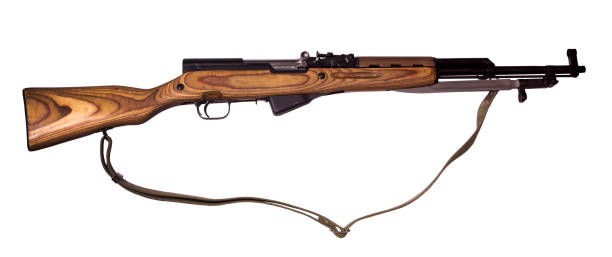
The SKS is Sergei Simonov's semi-automatic carbine for the Soviet 7.62x39mm intermediate cartridge, adopted in 1949 and made obsolete in Soviet service within a few years by the AK-47. A gas-operated, tilting-bolt rifle with a fixed ten-round magazine loaded by stripper clip and a folding bayonet, it was simple, accurate and easy to train on, and its second life was vast: China built millions as the Type 56, Yugoslavia, Romania, East Germany, Albania and North Korea produced their own, and it armed the Viet Cong and North Vietnamese Army throughout the Vietnam War.
Also known as SKS, SKS-45, Simonov carbine, Samozaryadny Karabin sistemy Simonova, Type 56 carbine, Chinese SKS, Yugoslav M59/66
Origins
The Soviet Union's capture of German intermediate-cartridge weapons and its own combat experience convinced the Red Army by 1943 that the future lay between the pistol round of the PPSh-41 and the full rifle cartridge of the Mosin-Nagant M1891. The 7.62x39mm M43 cartridge followed, and Sergei Gavrilovich Simonov — designer of the AVS-36 rifle and PTRS anti-tank rifle — built a carbine for it. Trial batches went to the front in 1945, and after refinement the Samozaryadny Karabin sistemy Simonova, the SKS-45, was adopted in 1949, the same year as Kalashnikov's rifle. It was the Soviet Army's first standard weapon for the new round and its last conventional semi-automatic rifle.
Design & Construction
The SKS is gas operated with a short-stroke piston above the barrel and a bolt that tilts down at the rear to lock, a mechanism Simonov had used before and which the SVT-40 Rifle shared. The ten-round magazine is fixed and hinged at the front, loaded from above with stripper clips or loose rounds, and unloaded by swinging it open. The 20-inch barrel, wooden stock, tangent rear sight and folding bayonet — a blade on Soviet and early Chinese guns, a cruciform spike on later Chinese production — make it a conventional carbine of 8.5 pounds and 40 inches. The receiver is milled steel. Soviet production at Tula and Izhevsk ran to about 2.7 million by 1958; Chinese Type 56 production from 1956 exceeded that many times over, and Yugoslavia's M59/66 added a grenade launcher spigot and ladder sight.
Combat Use
In Soviet hands the SKS was quickly relegated to second-line and ceremonial duty as the AK-47 proliferated, and it remains the parade rifle of the Kremlin guard. Its wars were fought by others. China issued it as the standard rifle of the People's Liberation Army into the 1980s and supplied enormous numbers to North Vietnam, where SKS carbines — accurate, rugged and adequate — armed the Vietnam War's Viet Cong and NVA alongside the AK. It served in Korea's later years, in every African and Middle Eastern conflict the Soviet and Chinese blocs touched, and in Iraq and Afghanistan after 2001, where coalition troops encountered it in quantity.
Legacy
The SKS's postwar fate as a military surplus export made it one of the most widely owned rifles in the world. Millions of Chinese, Russian and Yugoslav carbines entered the American, Canadian and European civilian markets from the 1980s, cheap, reliable and chambered for the cheapest centerfire rifle ammunition available, and it remains a common first rifle and hunting carbine. Russian-made examples and early Chinese guns with milled parts and blade bayonets are the collector's preference.
Sources
Bolotin, David N. Soviet Small-Arms and Ammunition. Finnish Arms Museum Foundation, 1995.
Ezell, Edward C. Small Arms of the World, 12th ed. Stackpole, 1983.
Rottman, Gordon L. The AK-47: Kalashnikov-series Assault Rifles. Osprey Weapon 8, 2011 (SKS context).
Iannamico, Frank. The SKS Carbine. 2004.
Suggest an edit · account required · reviewed before publishing · how it works