Seax
The seax is the single-edged knife of the early medieval Germanic peoples, carried from the fifth to the eleventh century by Franks, Saxons, Anglo-Saxons and Scandinavians. It ranged from a small everyday knife to the long seax, a heavy fighting blade approaching the length of a sword, and the Saxons may take their very name from it. Worn horizontally across the front of the belt, it served as tool, weapon and sign of free status, and inscribed examples such as the Seax of Beagnoth are among the treasures of Anglo-Saxon archaeology.
Also known as Sax, scramasax, langseax, broken-back seax, Saxon knife
Origins
Single-edged knives are as old as iron-working, but the seax as a distinct type appears among the Germanic peoples of the late Roman frontier in the fifth century. The Frankish historian Gregory of Tours, writing in the sixth century, describes "strong knives which they commonly call scramasaxes" used by assassins, and the name "Saxon" has long been connected with the seax, though the link is debated. Seaxes are found in large numbers in Frankish and Alamannic graves on the continent and in Anglo-Saxon England, where they became especially common from the seventh century, and they reached Scandinavia and the Viking world by the eighth.
Design & Construction
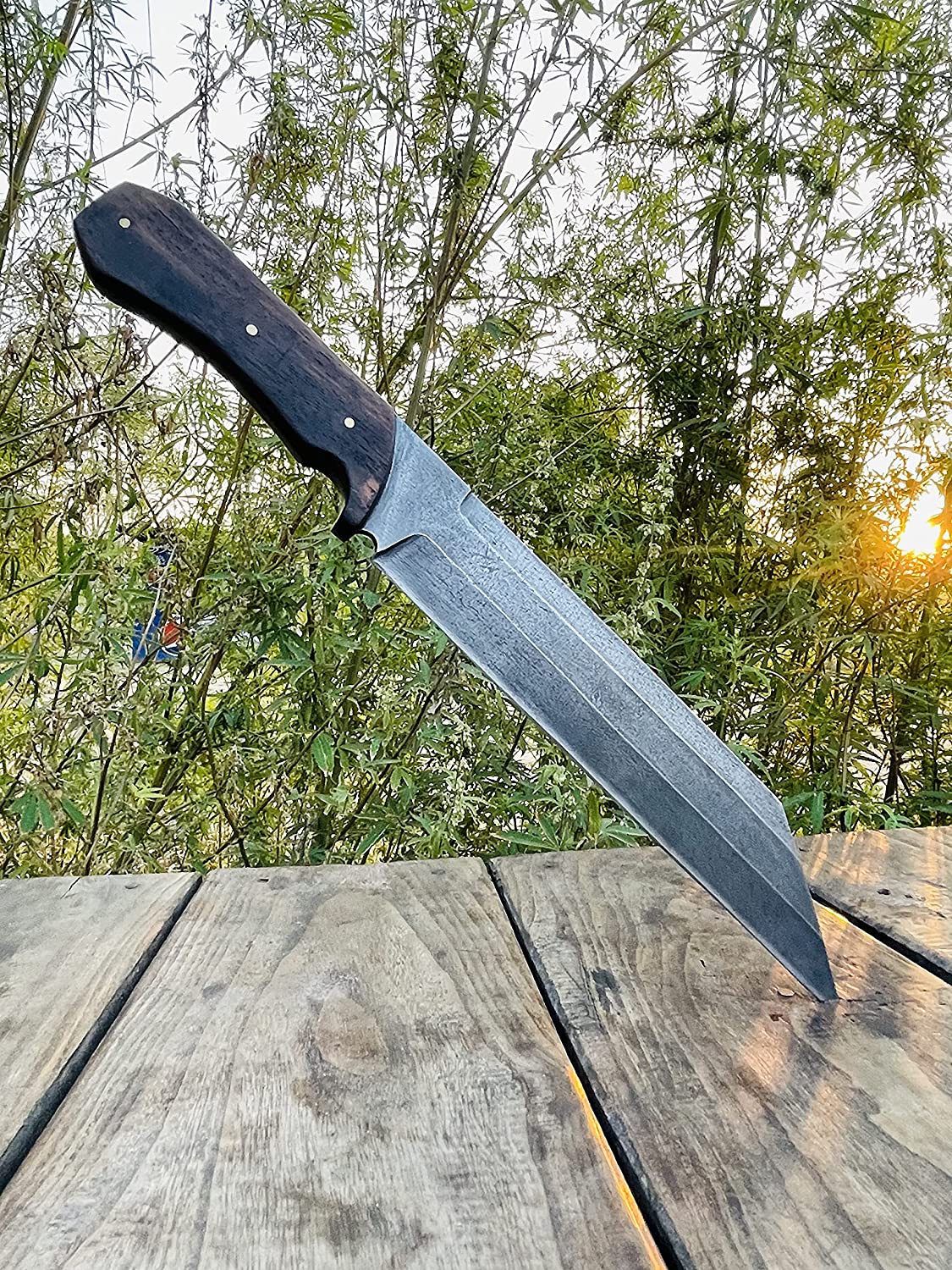
A seax has a single edge and a thick, straight back, with the tang set in a simple wooden or bone handle without a guard. Blades range from a few inches to more than two feet: the long seax or langseax of the ninth and tenth centuries could reach thirty inches and served as a sidearm in its own right. The most distinctive English form is the "broken-back" seax, whose back runs straight and then angles sharply down to the point, giving a strong, acute tip. Better blades were pattern-welded and inlaid with brass, copper, silver or niello along the back. The seax was carried edge-up in a leather sheath hung horizontally from the belt, across the front of the body, where it could be drawn quickly by either hand.
Combat Use
For most men the seax was an everyday tool, used for eating, woodwork and butchery; for a free man it was also a weapon always to hand. In battle the long seax served warriors who could not afford a sword, and as a secondary weapon for those who could, alongside the spear and shield that were the mainstays of Anglo-Saxon and Viking fighting. It was a weapon for the press of the shield wall and for close-quarters fighting when a spear was lost or broken. In the Viking Age Scandinavian warriors carried seaxes alongside the Viking Battle Axe and swords such as the Ulfberht Sword, and the knife appears in the Norse sagas.
Legacy
The seax faded from use in the eleventh century as the knightly sword and the dagger replaced it. It survives in the archaeological record in great numbers and in some remarkable pieces. The Seax of Beagnoth, found in the Thames in 1857 and now in the British Museum, carries a complete runic alphabet and its owner's name inlaid in brass and silver wire; seaxes from the Staffordshire and other hoards show the craftsmanship lavished on them. The seax is a staple of Anglo-Saxon and Viking reenactment and a favorite of modern bladesmiths, and a seax appears in the arms of the English county of Essex.
Sources
Gale, David A. 'The Seax.' In Weapons and Warfare in Anglo-Saxon England, ed. Sonia Chadwick Hawkes. Oxford University Committee for Archaeology, 1989.
Underwood, Richard. Anglo-Saxon Weapons and Warfare. Tempus, 1999.
Pollington, Stephen. The English Warrior from Earliest Times till 1066. Anglo-Saxon Books, 1996.
Suggest an edit · account required · reviewed before publishing · how it works