Entrenching Tool
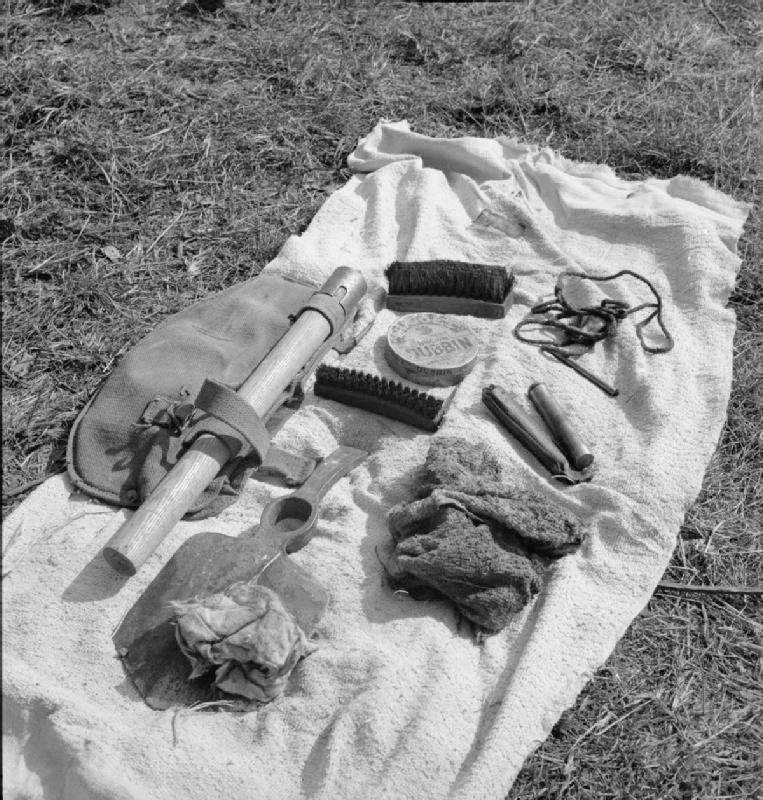
The entrenching tool is the soldier's personal shovel, a compact spade or pick carried on the belt or pack so that an infantryman can dig his own cover wherever he halts. Armies have issued digging tools since antiquity, but the short-handled infantry spade of the 1870s changed modern warfare, and in the trenches of the First World War it doubled as a feared close-quarters weapon.
Also known as E-tool, Trench shovel, Linnemann spade, Klappspaten (German), Feldspaten, MPL-50 (Soviet), Intrenching tool (US Army spelling)
Origins
Roman legionaries carried picks, turf cutters and the dolabra as part of their marching kit, and dug a fortified camp at the end of each day's march. Through the gunpowder age, though, digging was mostly the job of specialist sappers and pioneers with full-size tools. That changed with the rifled musket and the breech-loader. By the 1860s, infantry who could not get under cover quickly were cut to pieces. In 1869 the Danish officer Mads Johan Buch Linnemann patented a short spade with a sharpened blade that every soldier could carry on his belt. Denmark adopted it, and Austria-Hungary and Russia followed, with Russia producing it in very large numbers. By the end of the century nearly every European army issued a version.
Design & Construction
Early entrenching tools were small fixed-handle spades with a squared or pointed steel blade and a wooden helve, carried blade-down in a leather cover. The United States issued a T-handled shovel and a separate pick-mattock under the M1910 pattern. In the interwar years designers looked for a tool that could dig faster and pack smaller. The German army's folding Klappspaten of the late 1930s, with a locking nut that held the blade straight or at a right angle as a hoe, was copied by the Americans as the M1943. The Cold War brought the tri-fold steel shovel, and later lighter tools in aluminum or polymer. Many modern versions, including the Austrian army pattern made by Glock, hide a saw blade in the handle. The Soviet MPL-50 kept the old fixed-handle form and is still in service.
Combat Use
The tool's main job was always digging: rifle pits, foxholes and slit trenches dug under fire. The First World War turned it into a weapon as well. In crowded trench raids, where a rifle and bayonet were too long to swing, men on both sides found that a sharpened spade could split a helmet or a skull. German storm troops and French nettoyeurs (trench-clearers) made it standard kit. Russian and later Soviet soldiers were trained to fight with it, a tradition carried on in the Spetsnaz Trench Shovel. American GIs in the Second World War and Korea carried the folding tool on the pack, and Marines and soldiers in Vietnam dug countless fighting holes with the tri-fold shovel.
Legacy
Every modern army still issues an entrenching tool, and the folding shovel has become a basic piece of camping gear, sold widely as surplus. Its story is the story of infantry learning to survive firepower: from the legionary's camp ditch to the trench lines of the Western Front and the foxholes of the Pacific. It sits alongside the Socket Bayonet and the Kukri as one of the soldier's tools that became a weapon when there was nothing better to hand.
Sources
Ellis, John. Eye-Deep in Hell: Trench Warfare in World War I. Croom Helm, 1976.
Bull, Stephen. Trench: A History of Trench Warfare on the Western Front. Osprey Publishing, 2010.
US War Department. FM 5-15, Field Fortifications. Washington, 1944 (entrenching with individual tools).
Bishop, M. C., and J. C. N. Coulston. Roman Military Equipment from the Punic Wars to the Fall of Rome. 2nd ed., Oxbow Books, 2006 (dolabra and digging tools).
Community contributions by: WarPast Content Bot Contributor
Suggest an edit · account required · reviewed before publishing · how it works